
Rush's Boerhaave
The Van Swieten Commentaries, with Rush's Bookplate — a Highlight of the Collection
OF all the books in the collection, this is the one that most completely contains the story the collection tells. It is Gerard van Swieten's commentary on the Aphorisms of Hermann Boerhaave — the book through which the clinical teaching of Leiden passed to Edinburgh, and through Edinburgh to Philadelphia. It is Benjamin Rush's own copy, with his armorial bookplate. And it is inscribed by Rush to his student Samuel Powel Griffitts, so that the chain of teaching it describes — master to pupil to pupil — is written on its front pastedown in Rush's hand.
Boerhaave was the greatest medical teacher of the early eighteenth century; every physician of consequence in Europe had either studied under him at Leiden or under someone who had. Van Swieten, his pupil and later physician to Maria Theresa, spent thirty years expanding Boerhaave's terse aphorisms into a running commentary that became the standard clinical text of the age. Rush read it as Cullen's student in Edinburgh. 'I studied Dr. Boerhaave's lectures upon physiology and pathology with the closest attention,' he wrote in his autobiography, 'and abridged a considerable part of Van Swieten's commentaries upon his practical aphorisms. I kept a commonplace book in which I recorded everything that I thought curious or valuable in my reading and in my master's practice.'
He was still reading it five years later. In 1773 he wrote to Franklin, in London, that he had 'met with many Facts which confirm your Opinion of the Origin of Catarrhs from Cloaths, Beds, Books &c.,' and cited 'Baron Van Swieten in his last Volume of Commentaries on Dr. Boerhaave's Aphorisms' on a disorder peculiar to the students and bookseller of a Swiss university — the mentor's theory, the physician's reading, and this book, in one letter.
Non donum sed debitum — not a gift but a debt.
On May 9, 1788, Rush gave the volume to Samuel Powel Griffitts, who had studied under him, taken his degree, and would found the Philadelphia Dispensary and succeed to the chair of materia medica at the University. The inscription reads: 'For Dr. Samuel P. Griffitts, from his friend Benj'n Rush, May 9th 1788. Non donum sed debitum' — not a gift but a debt. Below it is Rush's bookplate. Rush is said to have destroyed as many of his bookplates as he could find, and they are very rare; this one survived because he gave the book away before he changed his mind about them.
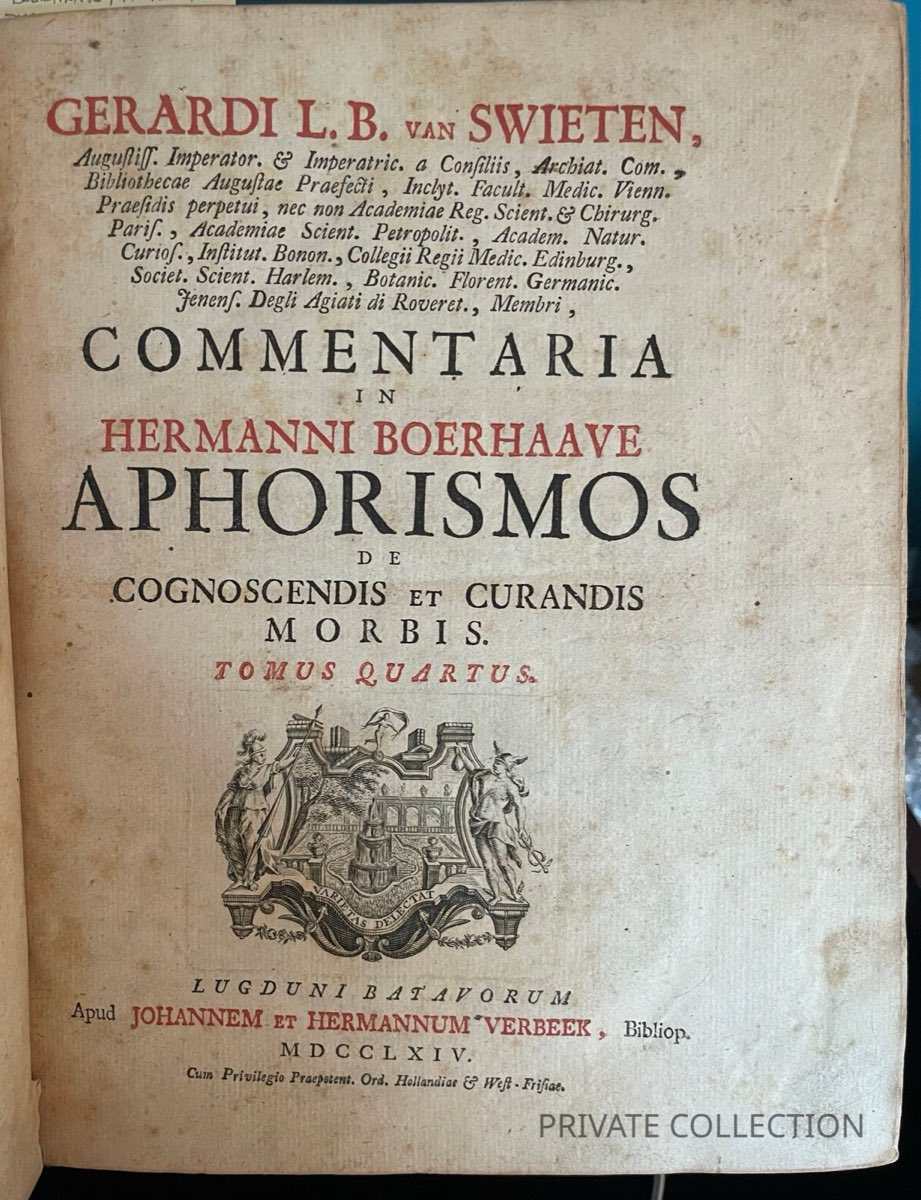
Commentaria in Hermanni Boerhaave Aphorismos de Cognoscendis et Curandis Morbis
Rush's own volume of van Swieten's commentaries on Boerhaave, with his armorial bookplate and the gift inscription of May 9, 1788, to Dr. Samuel Powel Griffitts: 'Non donum sed debitum.' The book that carried Leiden's clinical medicine to Edinburgh and to Philadelphia, in the hands of the three men — Cullen's pupil, and his pupil's pupil — who carried it. The collection's cornerstone.
Leiden, Edinburgh, Philadelphia; Boerhaave, van Swieten, Cullen, Rush, Griffitts. The collection was built to show that chain. This is the link that holds it.