
Against Cullen
From Disciple to Apostate: Rush and the System He Learned, 1769–1811
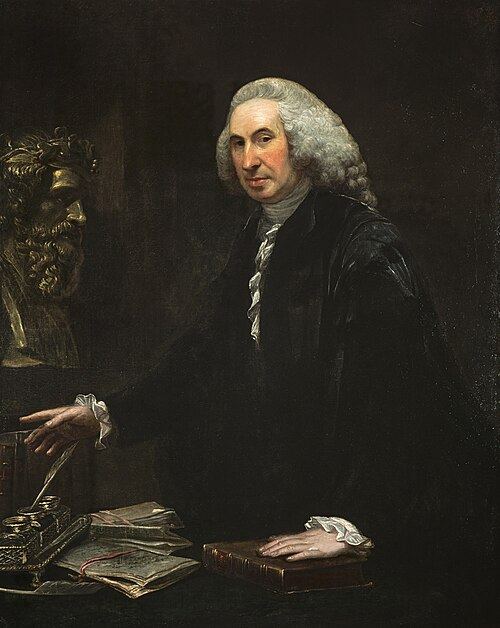
William Cullen (1710–1790)
Professor of the Practice of Physic at Edinburgh, the most celebrated medical teacher of his age, and the master Rush first followed and then fought. Painted with his hand on a book and a bust of Hippocrates at his shoulder — the two authorities Rush would set himself against.
RUSH came home from Edinburgh in 1769 as William Cullen's apostle. He taught Cullen's system for twenty years — the elaborate nosology that sorted disease into classes, orders, genera, and species like a botanist's flora, and the doctrine that each species called for its own remedy. When Cullen died in 1790 Rush delivered his eulogy before the College of Physicians and called himself, without qualification, his disciple. Then, in the fevers of the 1790s, he changed his mind about all of it, and spent the rest of his life telling his students that the master had been wrong.
The change came from the bedside. Bleeding his way through the epidemics of 1793 and 1797, Rush concluded that the diseases Cullen had so carefully distinguished were not different diseases at all but one — that there was 'but one fever' in the world, that its proximate cause was a convulsive excitement of the blood vessels, and that the physician's whole art lay in reducing that excitement by depletion. A nosology of many diseases was, on this view, not merely useless but harmful: it taught students to look for distinctions that did not exist and to withhold the lancet while they looked. By the Sixteen Introductory Lectures of 1811 he was saying so in print, in a chapter on the errors of his own education.
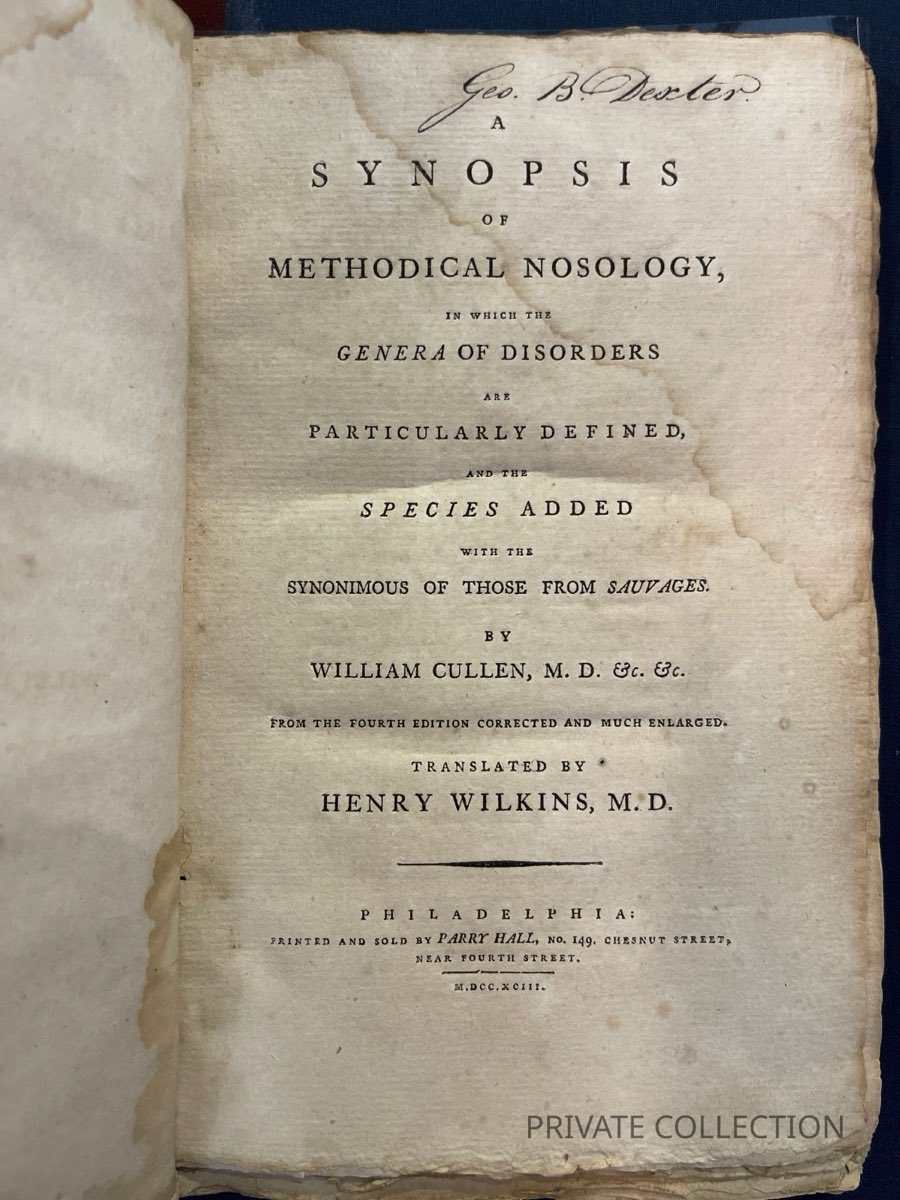
A Synopsis of Methodical Nosology, in Which the Genera of Disorders Are Particularly Defined, and the Species Added
Cullen's classification of diseases in its Philadelphia edition — the book Rush taught from, and the book he turned against. This copy belonged to George B. Dexter, a University of Pennsylvania graduate who practised in Nova Scotia, with his ownership signature and annotations: a student of Rush's school reading the system Rush was in the act of repudiating. With the Pennsylvania copyright notice of February 1795 claimed by Parry Hall's widow.
There is but one fever in the world.
The eulogy is the hinge. Delivered on July 9, 1790, four months after Cullen's death, it is a tribute, an intellectual autobiography, and — read with what came after — the last thing Rush wrote as a Cullenite. Everything he says he learned from Cullen, the collection can show him unlearning: the 'complicated nosology,' the 'distrust of natural healing powers,' the 'confidence in the use of special remedies for each species of disease.' The chapter will grow as the evidence of the turn is added to it: the annotated texts, the lecture notes, and the rare printings in which Rush's revolt against his master can be followed year by year.
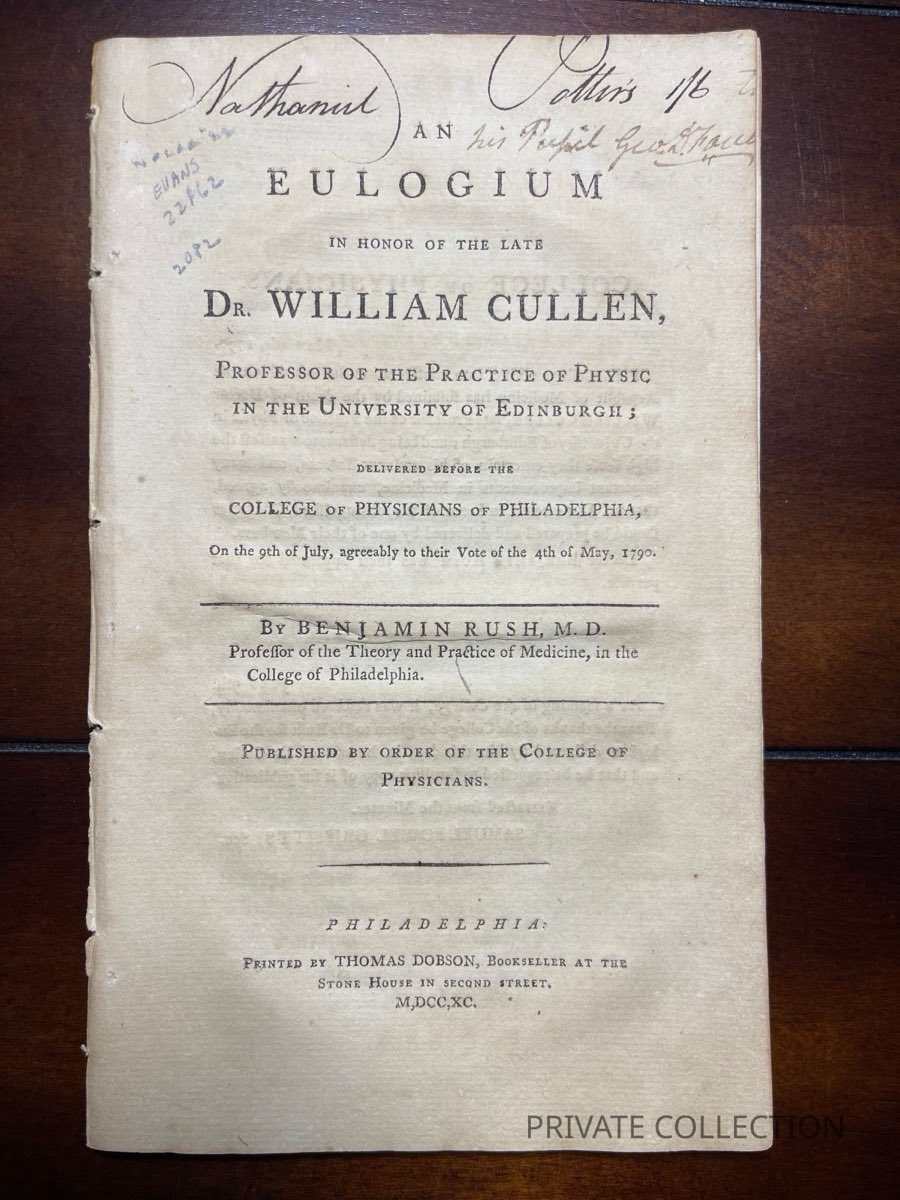
Eulogium in Honor of the Late Dr. William Cullen, Professor of the Practice of Physic in the University of Edinburgh
Delivered before the College of Physicians on July 9, 1790, and published by its order. Rush's account of what he owed his master — 'a complicated nosology, a distrust of natural healing powers, and a corresponding confidence in the use of special remedies for each species of disease' — and, unknowingly, the inventory of what he would spend the next twenty years rejecting. No copy has come to auction since the Pennypacker sale of 1909.
He never renounced the man. In the autobiography he wrote for his children he still 'owed more to Dr. Cullen than to any other teacher.' What he renounced was the system — and in renouncing it he built one of his own that was simpler, bolder, and, in the judgment of the century that followed, more dangerous than anything Cullen had taught him. That system is the subject of the next chapter.