
The Petition and the Stamp
Pennsylvania and Parliament, 1764–1765
THE Revolution reached Pennsylvania by way of a quarrel with its own proprietors. In the spring of 1764 the Assembly, led by Franklin and Joseph Galloway, resolved to petition the King to take the province from the Penn family and make it a royal colony. John Dickinson spoke against it; Galloway answered him; Franklin wrote a preface to the printed speech that was, in the words of the collection's entry, 'a very bitter attack on the Penns and their supporters.' That autumn Franklin lost his Assembly seat over the fight and was sent to London to carry the petition. He arrived in December 1764 to find Parliament preparing something that would make the petition irrelevant.
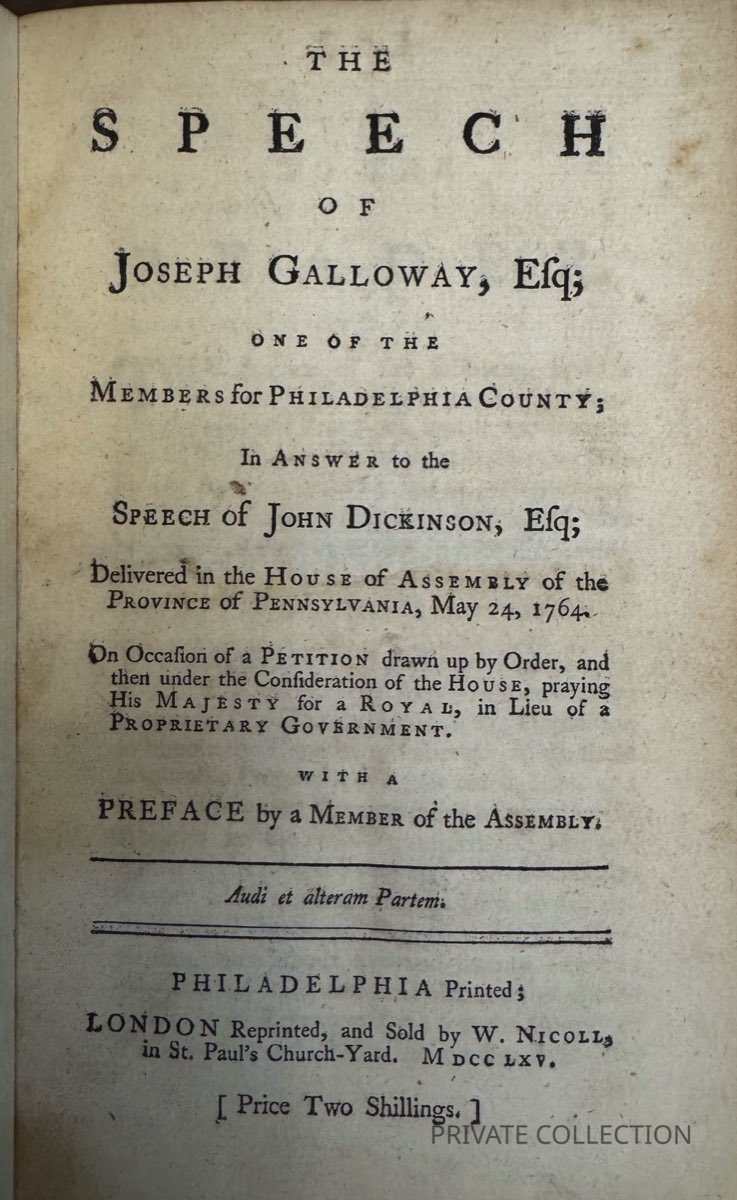
The Speech of Joseph Galloway, Esq., One of the Members for Philadelphia County … in Answer to the Speech of John Dickinson
Galloway's Assembly speech of May 24, 1764, for royal government, printed in London the same year as the Philadelphia edition, with Franklin's forty-page preface against the Penns. The three men on this title page — Galloway, Dickinson, Franklin — would be, twelve years later, a Loyalist, a reluctant patriot who refused to sign the Declaration, and a signer. Adams dates the printing to 1764 despite the 1765 on the title.
The Stamp Act passed on March 22, 1765. It was a direct tax on the colonies — on every newspaper, almanac, legal document, and pack of cards — to be paid by using paper embossed with a revenue stamp made in London. Britain's debt had doubled in the French war and the interest alone took half the budget; to Grenville the tax seemed reasonable, and for a few months it seemed reasonable to Franklin too, who recommended his friend John Hughes as stamp distributor for Pennsylvania and nearly lost his house to a Philadelphia mob for it. The colonies thought otherwise. By October nine of them had sent delegates to a Stamp Act Congress in New York; merchants had signed non-importation agreements; and the stamped paper itself, when it arrived, could not be given away.
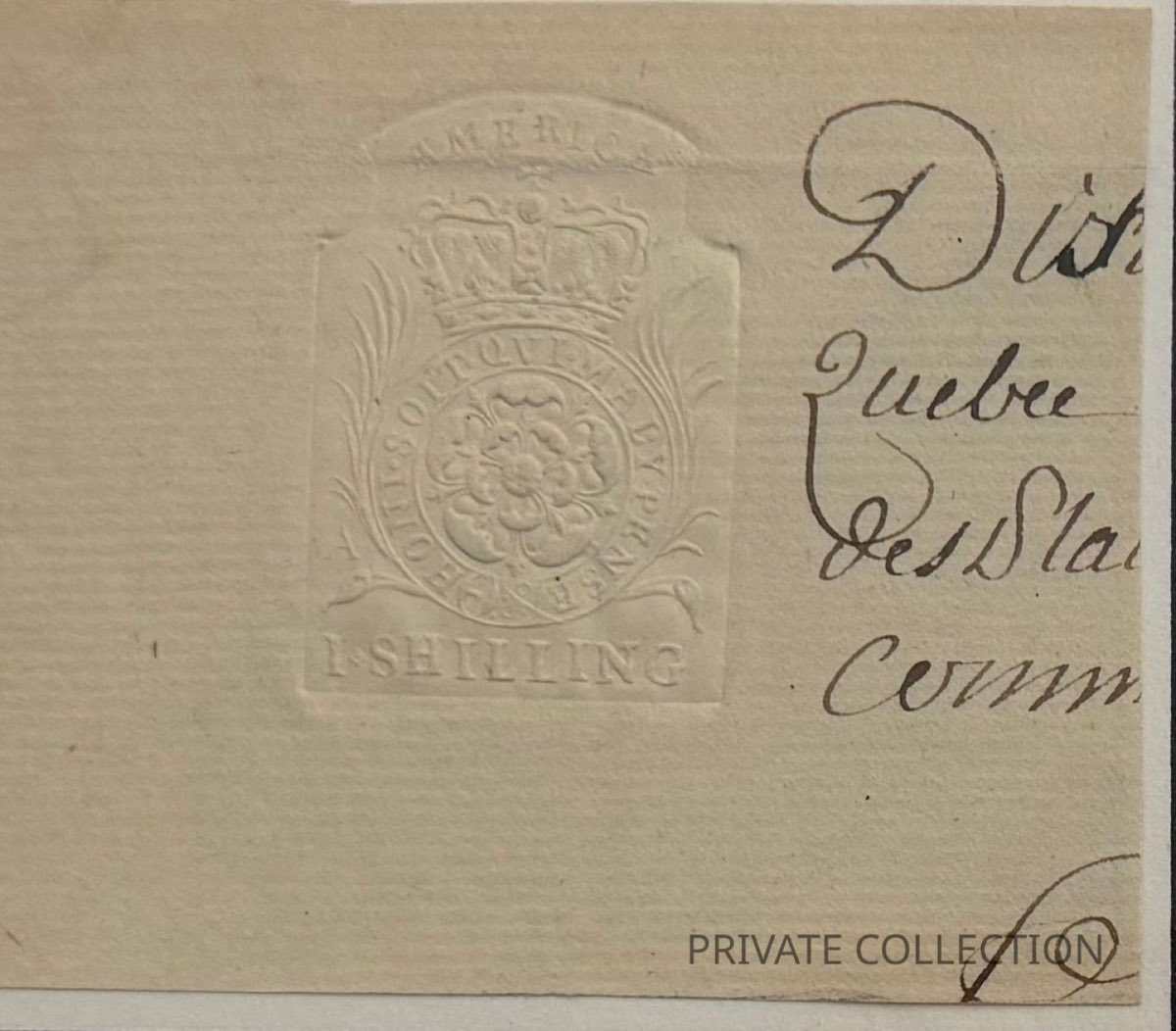
American Revenue Stamp, One Shilling
The thing itself: an embossed one-shilling stamp of the kind the Act required on colonial paper, one of approximately twenty examples known to survive. This one is on period paper with a notation of Quebec — proof that it was actually used in America, which almost none of them were. It is the rarest object in this catalog and the smallest.
The stamped paper, when it arrived, could not be given away.