
The Library and the Society
The Library Company and the American Philosophical Society, 1731–1802
THE two oldest of Franklin's institutions were made of the same people. The Junto of 1727 became the Library Company of 1731; the Library Company's members, with Bartram and the Bonds among them, became the Philosophical Society Franklin proposed in 1743. Rush joined the second in 1768, before he had a degree, and read from the first for the rest of his life. This chapter holds the library's catalogue as Franklin's press printed it, the memoir of the patron whose books enlarged it, and the Society's Transactions and Rush's two orations before it — the second dedicated, in print, to Franklin.
The oldest of Franklin's institutions was the Library Company, founded in 1731 by the members of his Junto and printed for by his press ever since.1 Its catalogue of 1764 is a portrait of what Philadelphia read in the decade Rush was a student; the Loganian Library that James Logan — Franklin's early patron, and the translator of the Cato Major Franklin printed — left to the city was folded into it. The Philosophical Society, which Franklin proposed in 1743 and presided over from London, made Rush a member in 1768, before he had a degree; he delivered his first oration to it in 1774 and his most ambitious in 1786, and dedicated the latter to Franklin.2
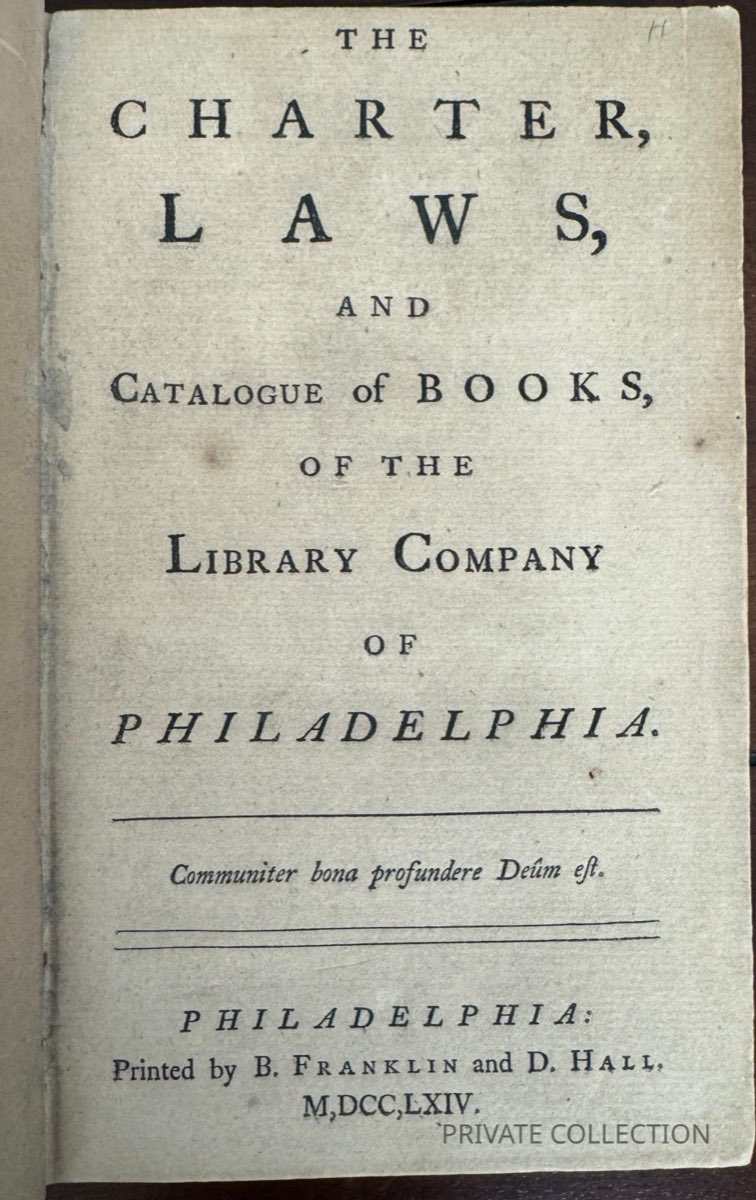
The Charter, Laws, and Catalogue of Books, of the Library Company of Philadelphia
The catalogue of the first subscription library in America, founded by Franklin in 1731 and probably the most extensive library in the colonies by the time this was printed — arranged by format, with blank leaves after each section for additions. Rush read in it as a student; Franklin was the person most responsible for what was on the shelves. Miller locates over twenty copies; the last at auction were in 1976, 1934, and 1919.
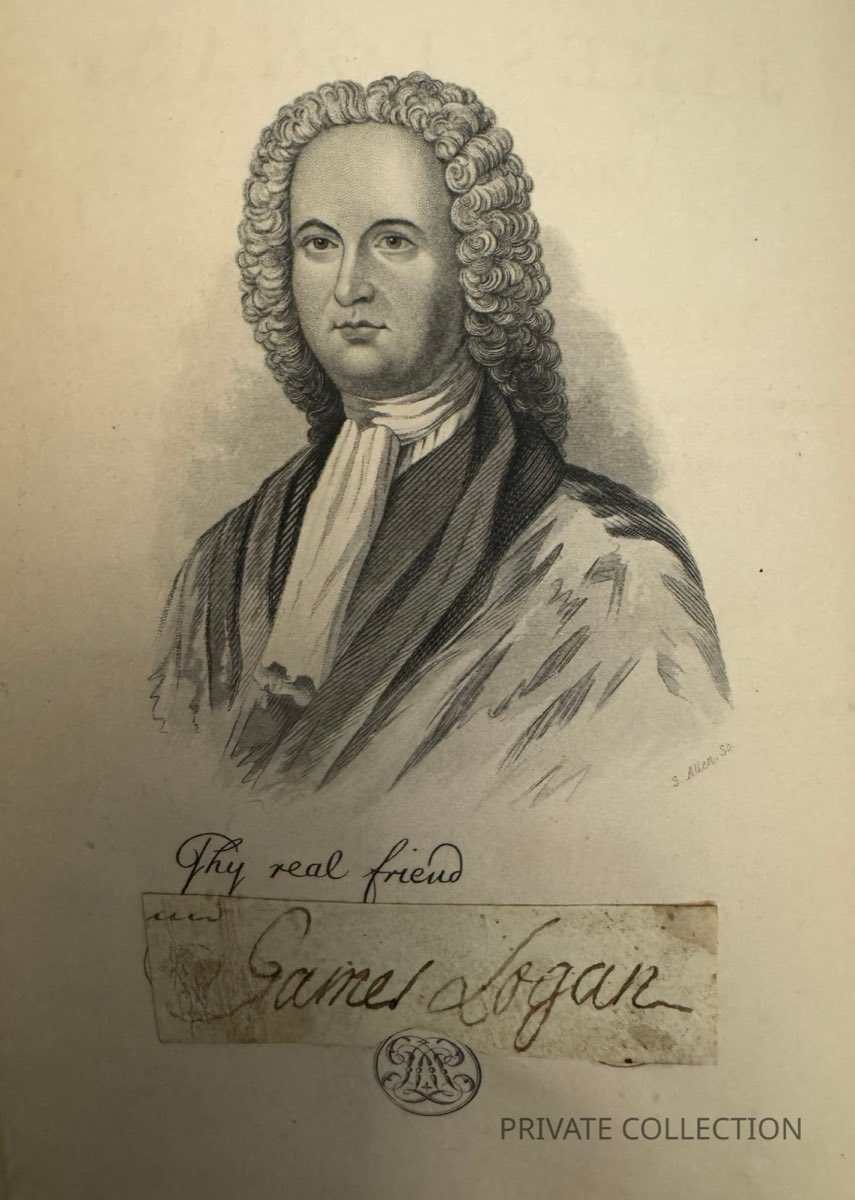
Memoirs of James Logan; A Distinguished Scholar and Christian Legislator; Founder of the Loganian Library at Philadelphia
The first life of Logan, Penn's secretary, chief justice, acting governor, and the most learned man in the province — Franklin's patron in the 1730s, whose Cicero Franklin printed in 1744 and whose library became the Loganian, the scholarly wing of the Library Company. With several of his letters first printed from manuscript.
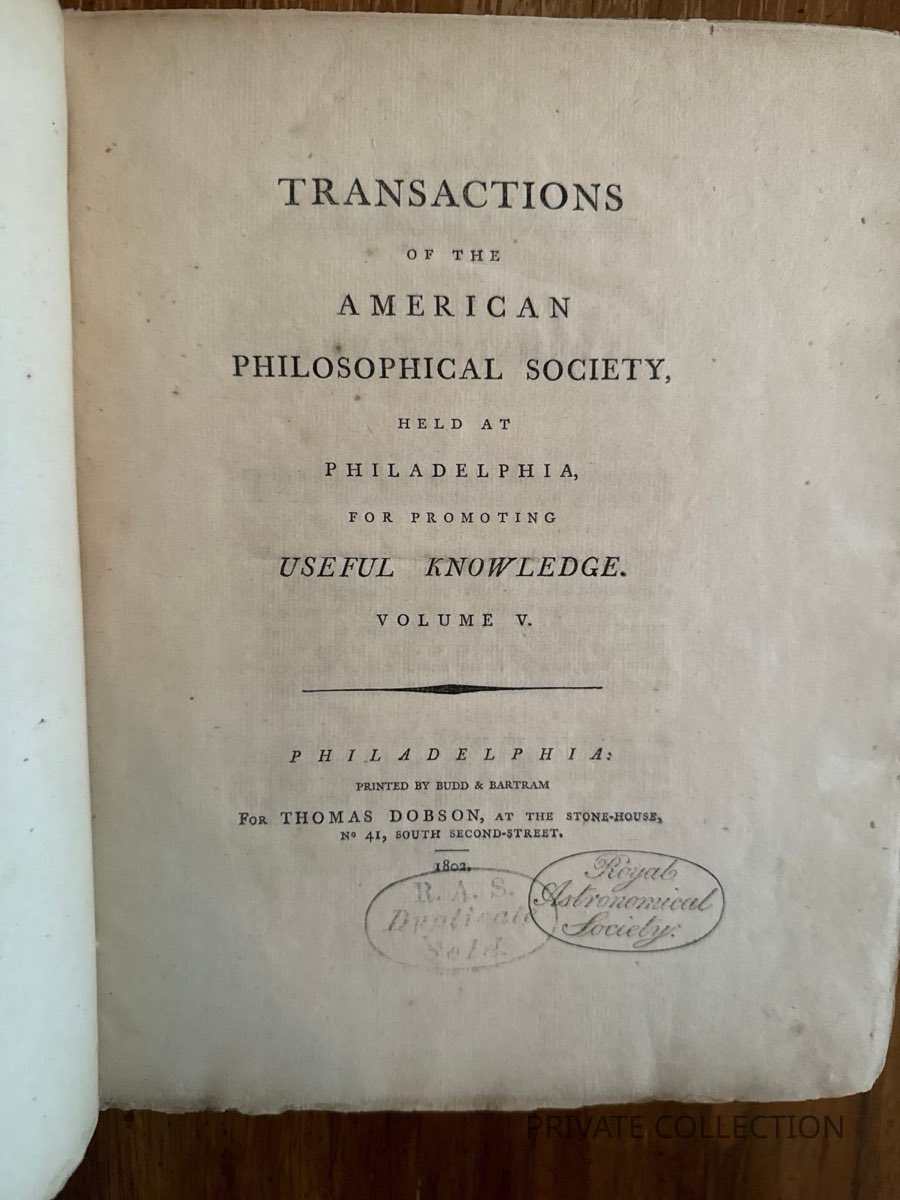
Transactions of the American Philosophical Society, Volume V
The fifth volume of the Transactions of the society Franklin founded and Rush joined at twenty-two. The first volume of 1771 had announced to Europe 'a new stage of maturity in American science'; by this volume the society was the republic's scientific establishment, and both men's names were on its rolls — Franklin's as its first president, Rush's as one of its longest-serving members.
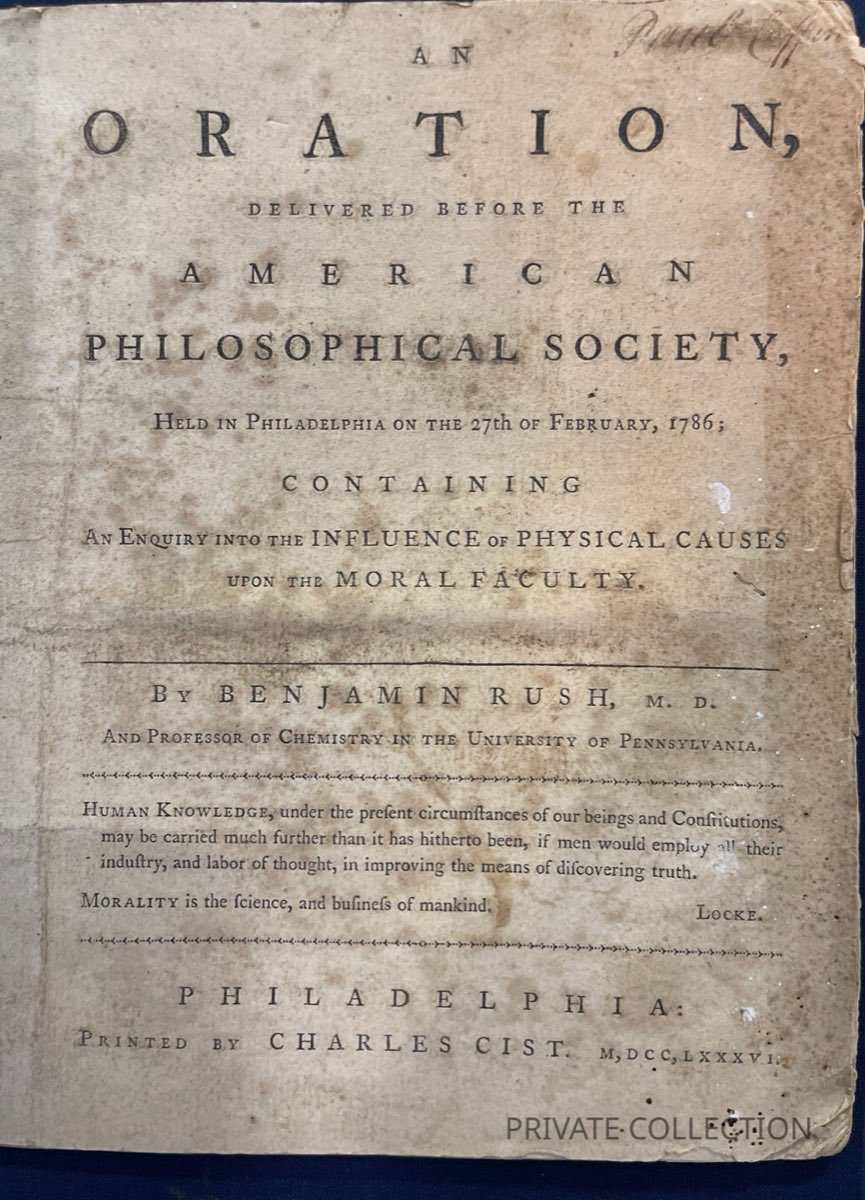
An Oration, Delivered before the American Philosophical Society … Containing an Enquiry into the Influence of Physical Causes upon the Moral Faculty
Rush's landmark oration on the physical causes of moral conduct — climate, diet, drink, hunger, idleness, pain, solitude — in which immoral behavior is traced to the body rather than to sin alone, and mental health to the same laws as bodily health. Dedicated to Franklin, the society's founder and then its president. This copy with the early signatures of Paul Coffin (1738–1821), the Buxton, Maine, Congregationalist minister. Scarce.
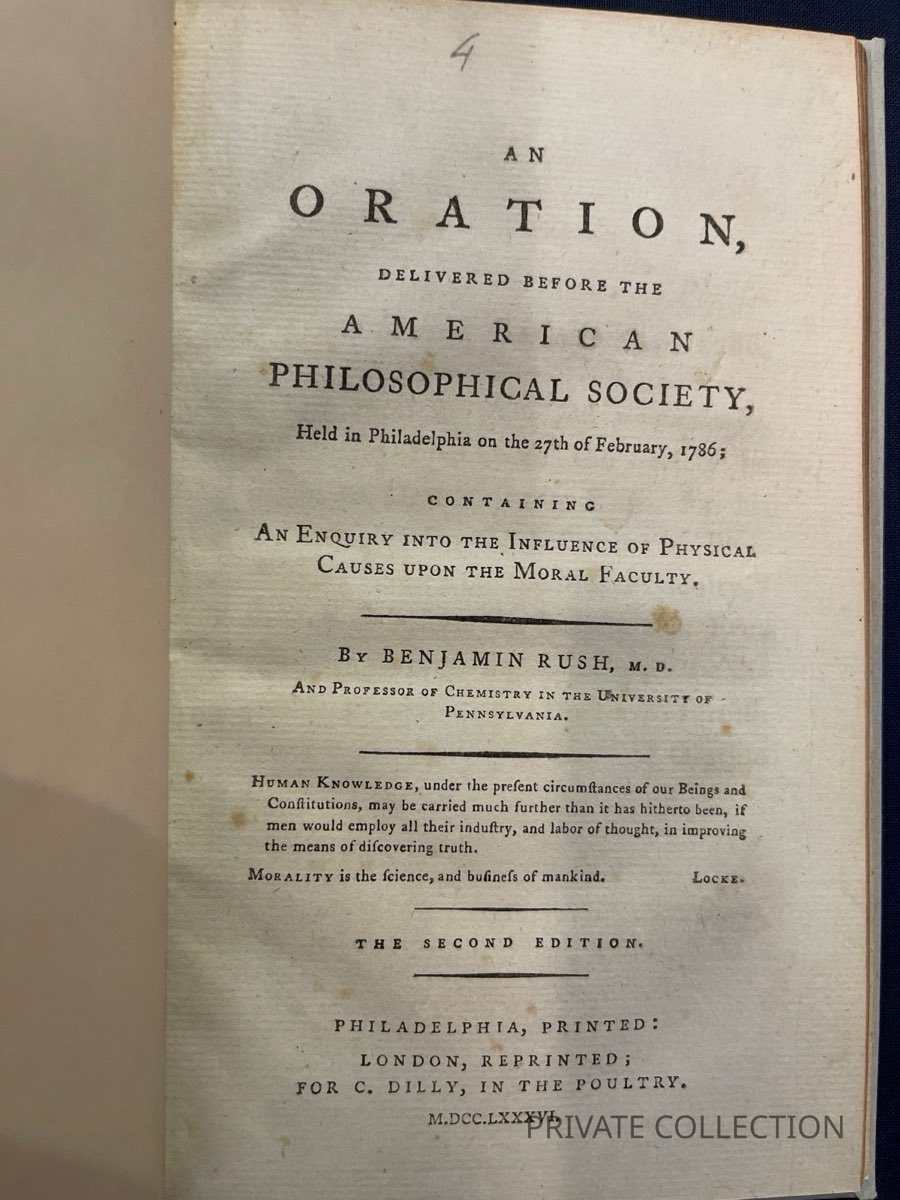
An Oration, Delivered before the American Philosophical Society … upon the Moral Faculty
The London reprint of the same year — Dilly was Rush's London publisher and Franklin's friend — which carried the dedication to Franklin and the argument that 'the disorders of the moral faculty' belonged in the physicians' nosology to a British readership. The collection holds the oration in both its Philadelphia and its London forms.
- Edwin Wolf 2nd, 'At the Instance of Benjamin Franklin': A Brief History of the Library Company of Philadelphia (Philadelphia: Library Company, 1976); Franklin, Autobiography. ↩
- Brooke Hindle, The Pursuit of Science in Revolutionary America, 1735–1789 (Chapel Hill: University of North Carolina Press, 1956); the Society's early minutes are printed in Proceedings of the American Philosophical Society 22, part 3 (1885). ↩