
The Pennsylvania Hospital
Franklin's Foundation, Rush's Practice — 1751 to 1813
THE Pennsylvania Hospital was the product of a legislative maneuver so elegant that Franklin described it in his Autobiography as "the best of my political manoeuvres."1 In 1751, convinced that the Assembly would not fund a hospital directly, he proposed a conditional grant: the legislature would provide two thousand pounds if private citizens first raised an equal sum. The Assembly agreed, confident the private goal was unachievable. Franklin organized the subscriptions himself, met the target, collected the matching funds, and the hospital was built. "The subscribers," he observed, "are thereby encouraged to subscribe more readily, and to become more active in collecting from others."
Thomas Bond had conceived the institution; Franklin had made it happen. The Pennsylvania Hospital, which opened on Pine Street in Philadelphia in 1756, was the first hospital in America. It was simultaneously a charity (treating the poor without charge), a medical facility (treating paying patients), and a teaching resource (providing medical students access to clinical cases they could not otherwise observe). All three functions reflected the Philadelphia Enlightenment's characteristic conviction that private philanthropy, public support, and practical education should work together.
Rush joined the Hospital staff in 1783, fourteen years after his return from Edinburgh. He served as physician to the Hospital until his death in 1813 — thirty years of practice in the institution Franklin had founded. During those three decades he treated thousands of patients, trained scores of students in clinical settings, and argued repeatedly with the Board of Managers over matters ranging from the treatment of the insane (Rush wanted more active intervention; the Board was cautious) to the Hospital's response to the yellow fever epidemics of the 1790s (Rush wanted his methods applied; the Board was divided).
Franklin did not live to see Rush's full tenure at the Hospital. He died in April 1790, three years after Rush joined the staff. But the institution he founded was the setting in which Rush's medical career reached its fullest expression, and the founding documents of that institution — Some Account of the Pennsylvania Hospital (1754), the promissory notes, the ledgers, the rules of government — are among the most important items in the collection.
"I do not remember any of my political manoeuvres, the success of which gave me at the time more pleasure." — Benjamin Franklin, Autobiography, on founding the Pennsylvania Hospital
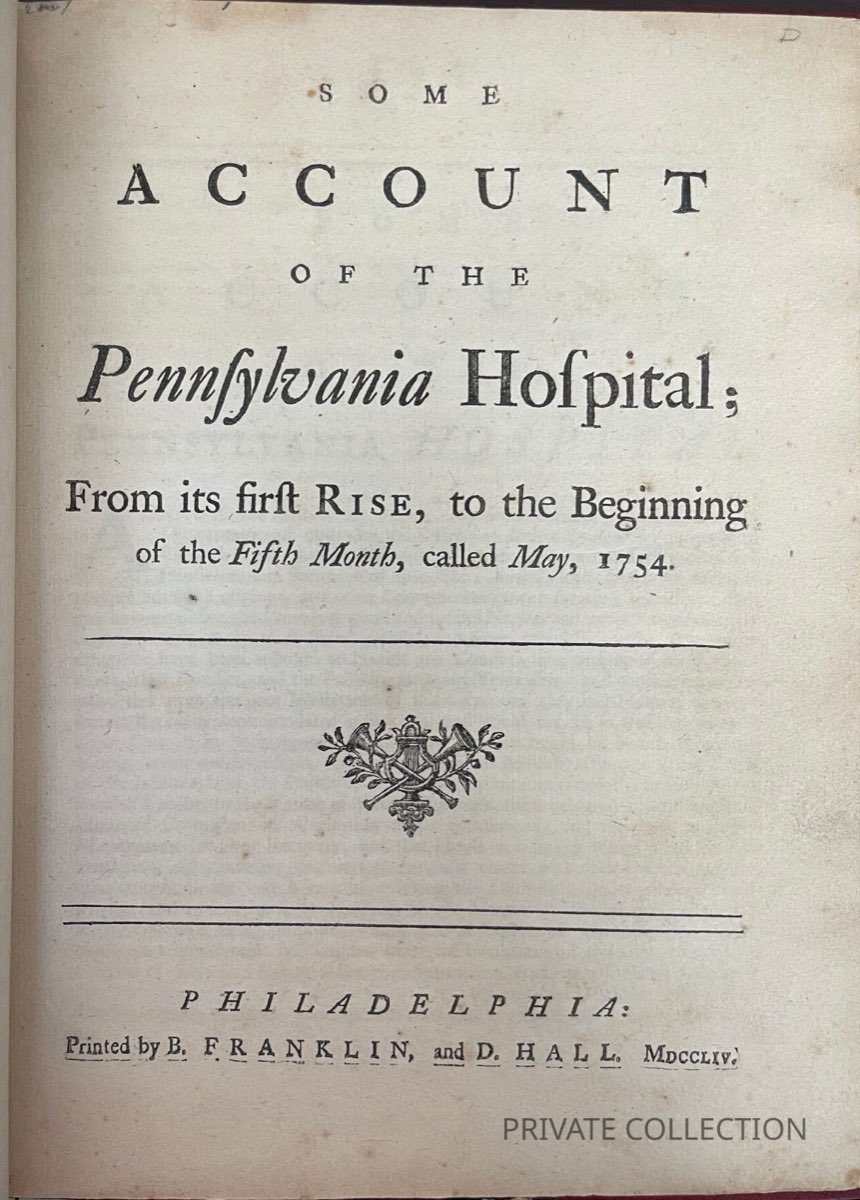
Some Account of the Pennsylvania Hospital
Franklin printed this Account at his own shop on Market Street, making it simultaneously a philanthropic argument and a physical product of his printing enterprise. The pamphlet documents the Hospital's founding rationale — a city of Philadelphia's size requires a dedicated medical institution for its poor; private philanthropy combined with legislative support is the appropriate funding mechanism — with the precision and clarity that characterize all of Franklin's public writing. Thomas G. Morton, in his History of the Pennsylvania Hospital (1895), notes that this Account was the essential document of the Hospital's public legitimacy in its first decades. Rush inherited all of Franklin's arguments when he joined the staff thirty years later.
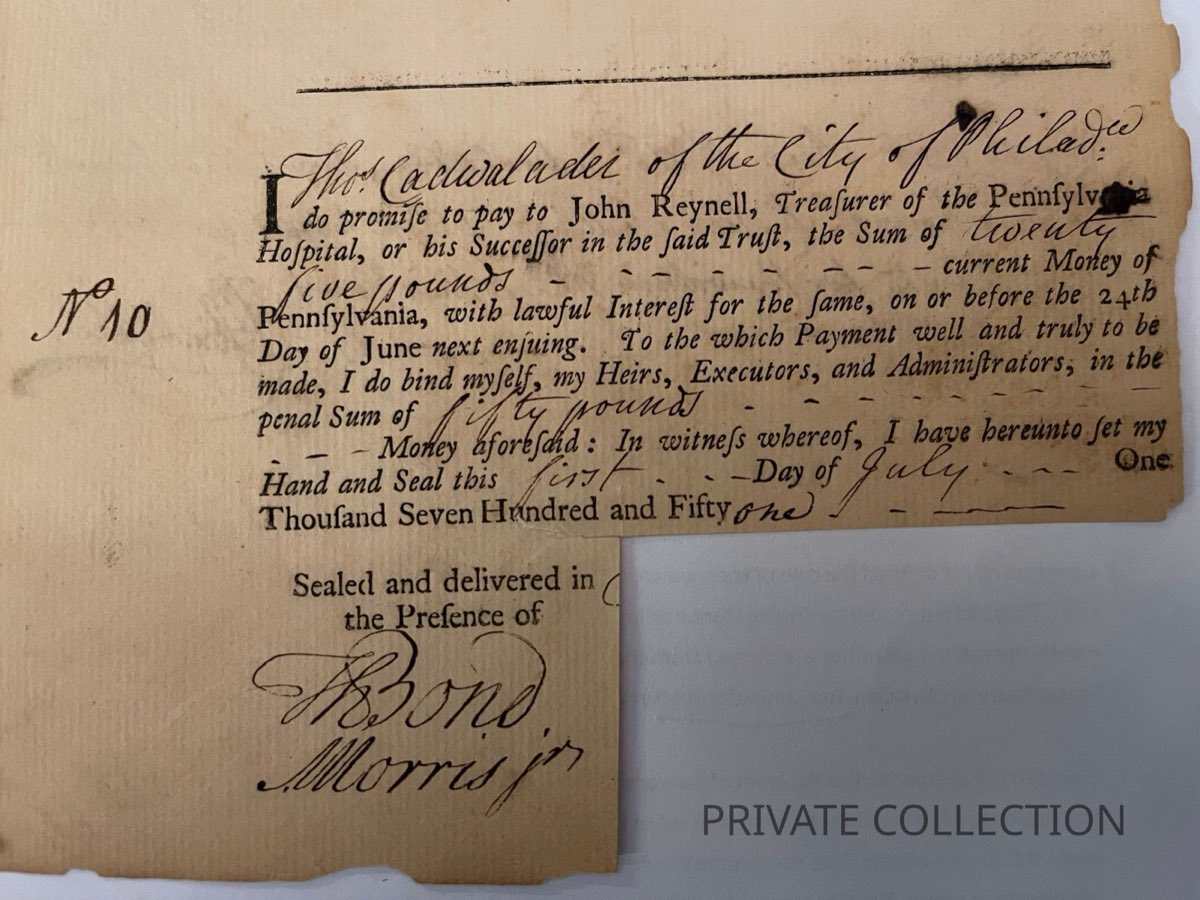
Promissory Notes for the Pennsylvania Hospital
The physical instruments of Franklin's fundraising campaign: the documents through which Philadelphia citizens committed their subscriptions and through which the matching-grant strategy was implemented. These notes are the ledger-level reality behind the legislative maneuver — the civic infrastructure of early American philanthropy in its most material form. Franklin understood that institutions were built through the accumulation of individual commitments recorded in ink on paper. Each note is a citizen's investment in the proposition that a city owed its poor the means of healing.
Pennsylvania Hospital Ledger
The administrative backbone of the institution Rush practiced at for thirty years: admissions, discharges, deaths, expenses, and attending physicians. Rush's name appears in the Hospital's records during the yellow fever years of the 1790s, when his insistence on his own treatment protocol made him a controversial figure on the staff. Rush clashed repeatedly with the Board of Managers over the management of the insane patients in the lower ward — a conflict that informed his eventual Diseases of the Mind (1812) — and over the institution's response to the epidemics. The ledgers are silent on these controversies but document the institutional life within which they occurred.
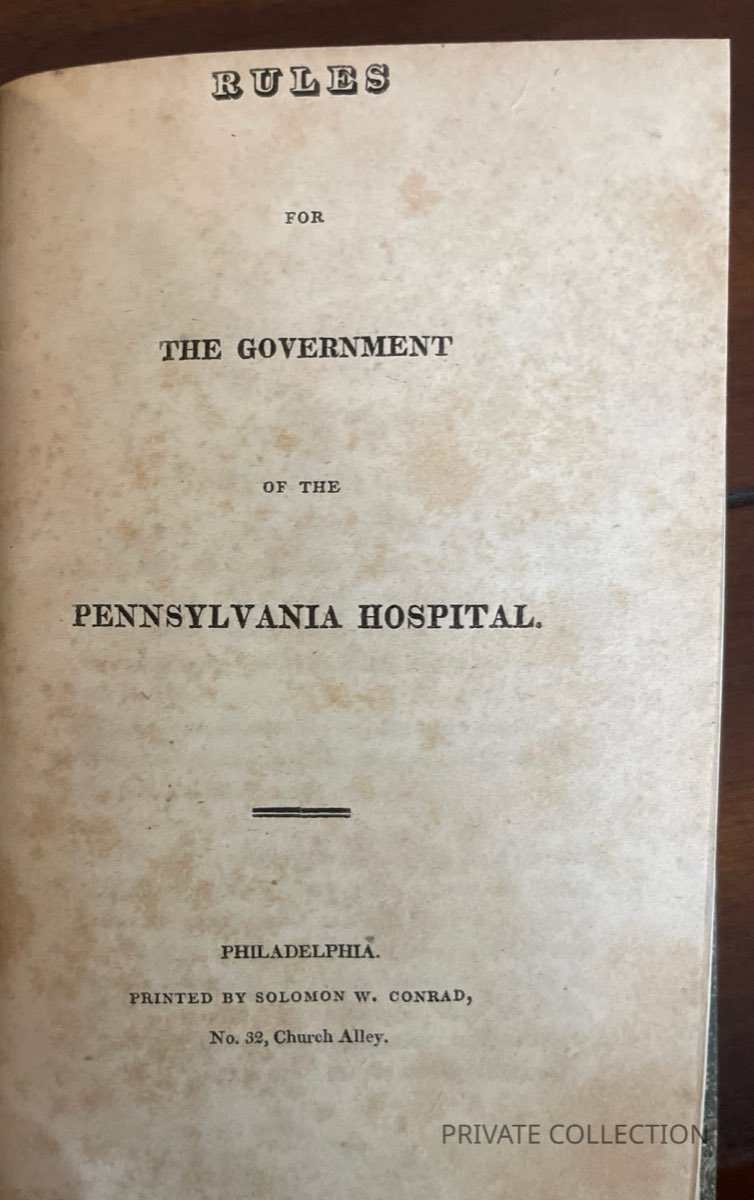
Rules for the Government of the Pennsylvania Hospital
The institutional constitution of the facility that Rush and Franklin helped define. The Rules establish the hierarchy of authority (Board of Managers, attending physicians, resident apothecary, nurse), the terms of patient admission and discharge, the obligations of the medical staff, and the moral expectations placed on patients. Rush's influence on the Hospital's culture is visible in the Rules' combination of humanitarian concern and disciplinary expectation — medicine as reform, healing as civic virtue — that characterized all of his professional commitments.
Franklin's role at the Pennsylvania Hospital was that of the inspired founder who creates an institution, endows it with a rationale, and then leaves it to be inhabited by others. Rush's role was that of the dedicated practitioner who inhabits the institution for a lifetime and is shaped by it as much as he shapes it. Between them, they turned a charitable facility into the most important medical teaching resource in the early republic.
The Hospital's connection to Rush's later career in psychiatry is particularly significant. The institution's care for the mentally ill — the "maniacs" and "melancholics" housed in the lower ward, often in brutal conditions by modern standards — gave Rush three decades of clinical observation that would eventually produce the first systematic American treatise on mental illness. The book that resulted, Diseases of the Mind (1812), is documented in Catalog I, Chapter II.
The founding paper is followed by the institution's record through the next eighty years: the certificates and notes by which money was raised, the letters of the men who worked in it and hoped to, the accounts the managers printed to satisfy the Legislature, and the successive Some Accounts in which the hospital told its own story to each new generation of subscribers.
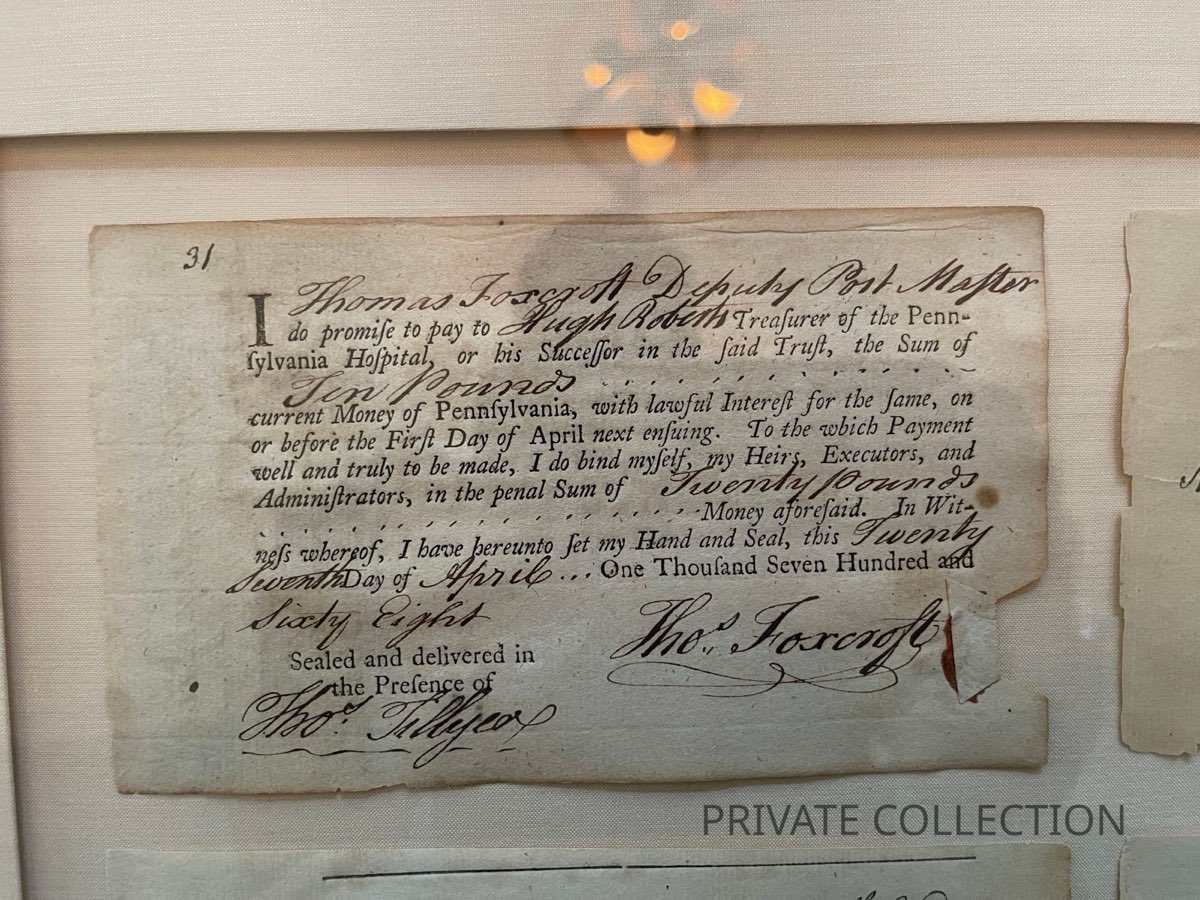
Pennsylvania Hospital Promissory Notes: Israel Pemberton, Jr. (No. 2), William Smith, Thomas Foxcroft, and Others
A second group of the Franklin-printed notes: Israel Pemberton's of May 1, 1751 — numbered 2, and so the second note the hospital ever issued, signed by one of its first managers — with those of William Smith, Provost of the Academy, in 1761, Thomas Foxcroft in 1768, and another. With the notes of Cadwalader, Bond, Redman, and Moore, the collection holds seven of the first twelve notes printed.
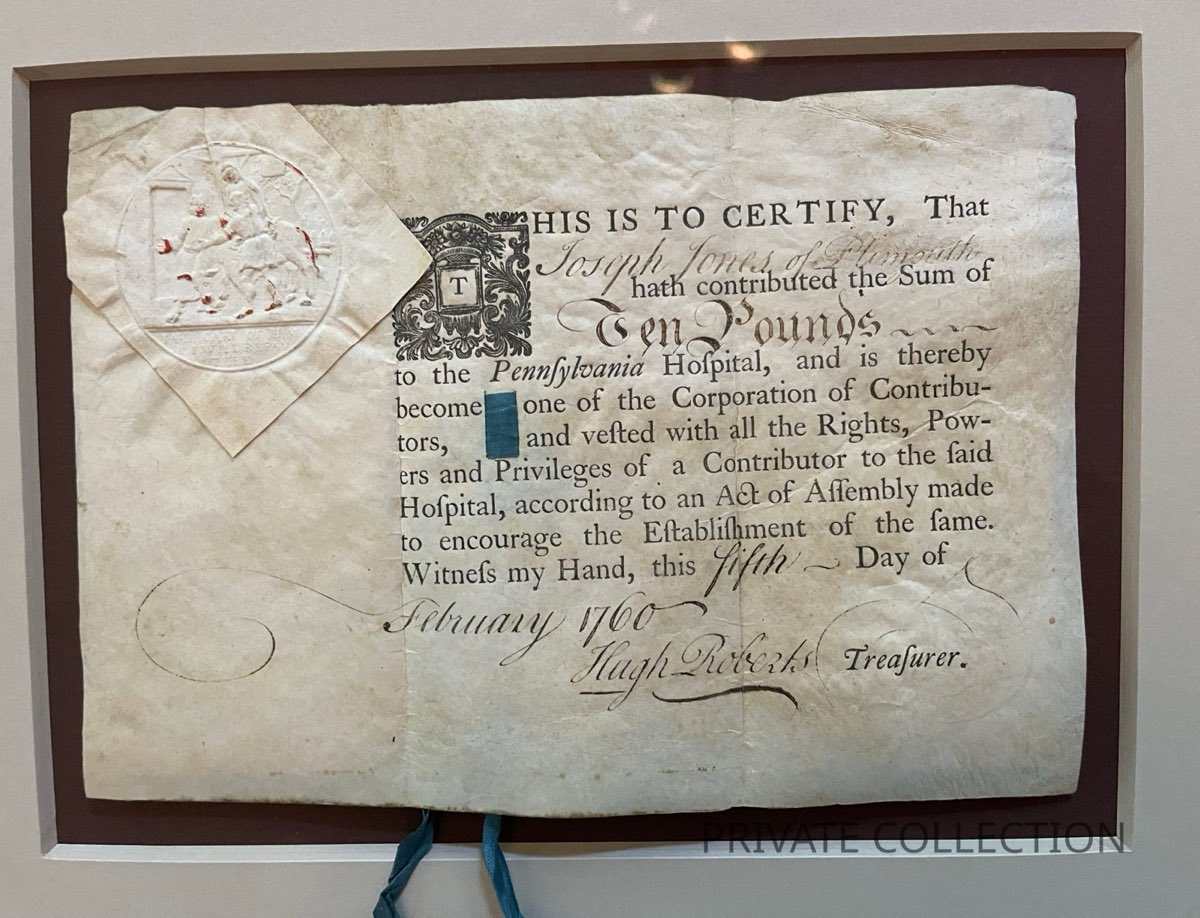
Pennsylvania Hospital Contributor's Certificate, Issued to Joseph Jones
The certificate acknowledging Jones's contribution of ten pounds — the document a subscriber received for his money, printed on vellum with the hospital's paper seal. Not to be confused with the common Miller 598: Miller locates only five copies of this form.2
Continuation of the Account of the Pennsylvania Hospital, from the First of May 1754 to the Fifth of May 1761
The second part of Franklin's Some Account, issued as a fundraising appeal in 1761 when the managers needed money for the east wing: seven more years of admissions, cures, and finances, printed by the same press. It is held separately from the 1754 Account, as it was sold.
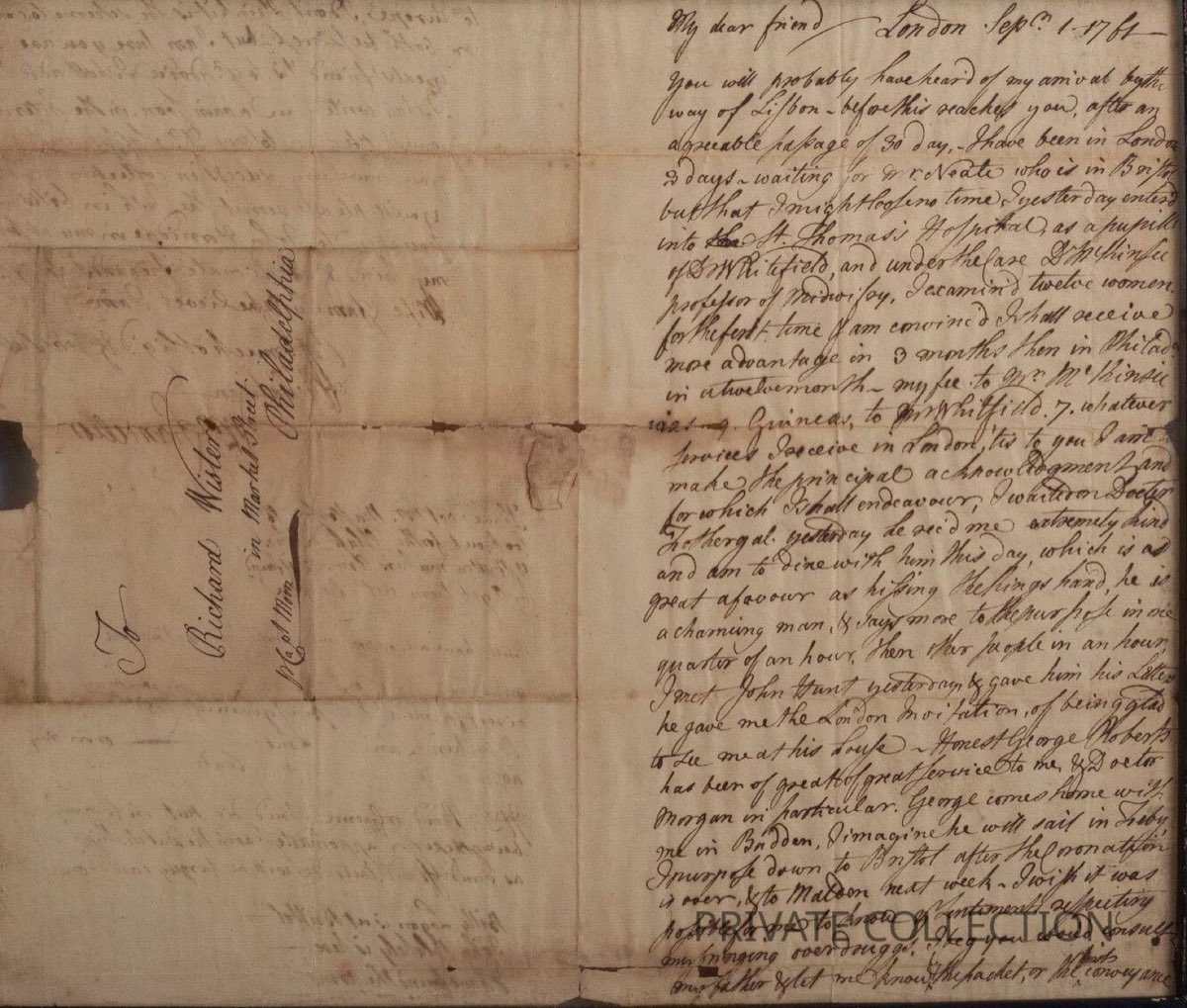
Autograph Letter Signed, to Richard Wister of Philadelphia
A young Philadelphia surgeon writes home from London, where he is walking the hospitals: he laments the poor medical education he received in Philadelphia, says he will see more patients in a month in London than in a year at home, and asks Wister, in a postscript, to put his name forward for a post 'if Dr. Bond or Greme should die.' Thomas Bond was the hospital's founder and senior physician. The letter also refers to the transatlantic slave trade. The ambitions of the hospital's staff, in their own hand.
He would see more patients in a month in London than in a year at home.
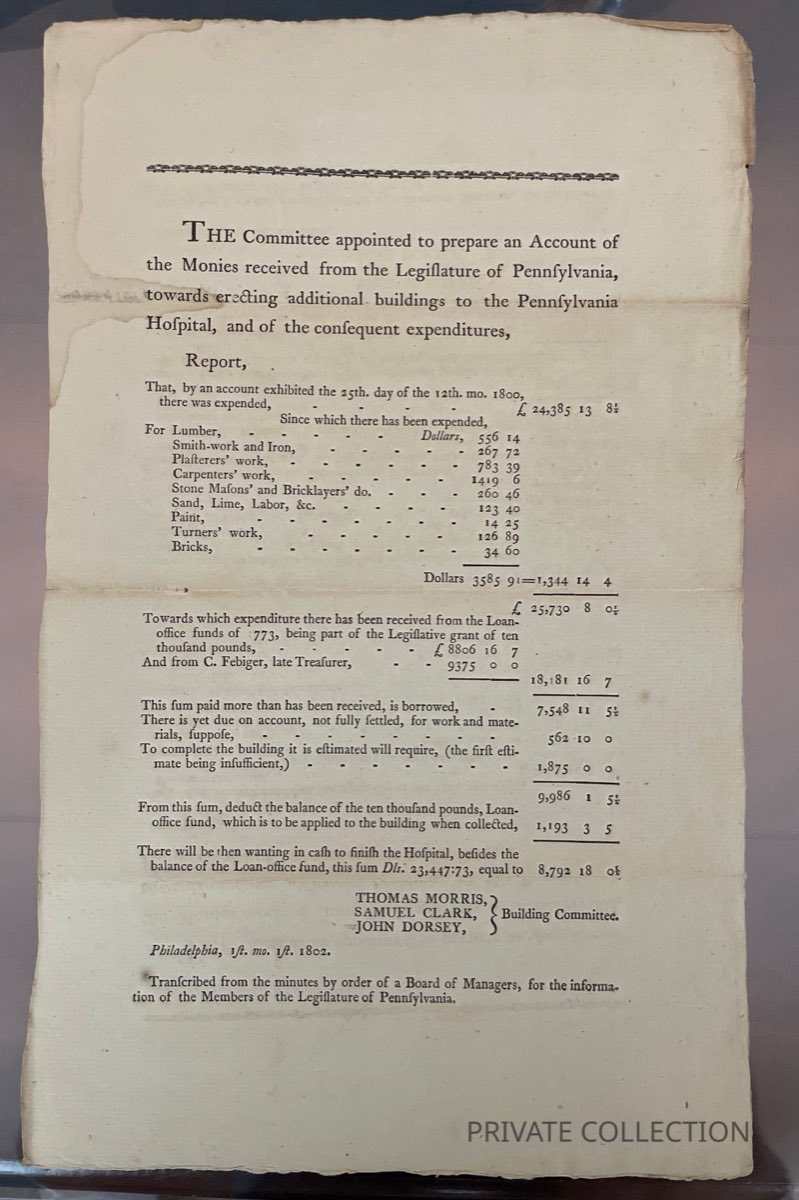
From 1796 the managers were building again — the center house and the west wing that gave the hospital the form it still has on Pine Street — with money from the Legislature, and they reported to the Legislature on paper.3 The collection holds five of the building committee's printed accounts, each a broadside statement of expenses down to the lumber, hair for plaster, ironmongery, and copper spouts, set against the money received from the Loan Office and the state treasurer. Almost none survive: OCLC locates one copy of one of them, and none of the others.
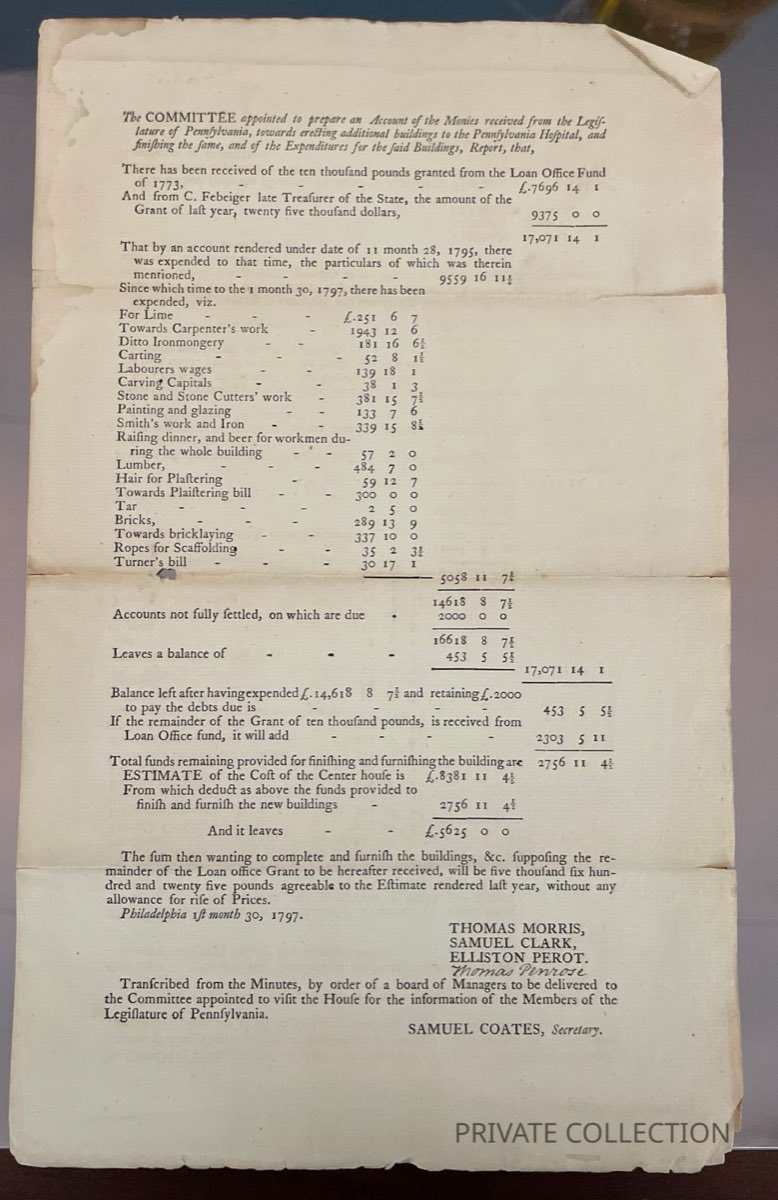
Report of the Building Committee of the Pennsylvania Hospital, Statement of Expenses to 28 November 1795
Transcribed from the committee's minutes and signed by Samuel Coates as secretary, with Thomas Penrose's name added in ink to the printed committee: lumber, hair for plastering, wages, and the rest, against the money received. OCLC identifies a single institutional copy.
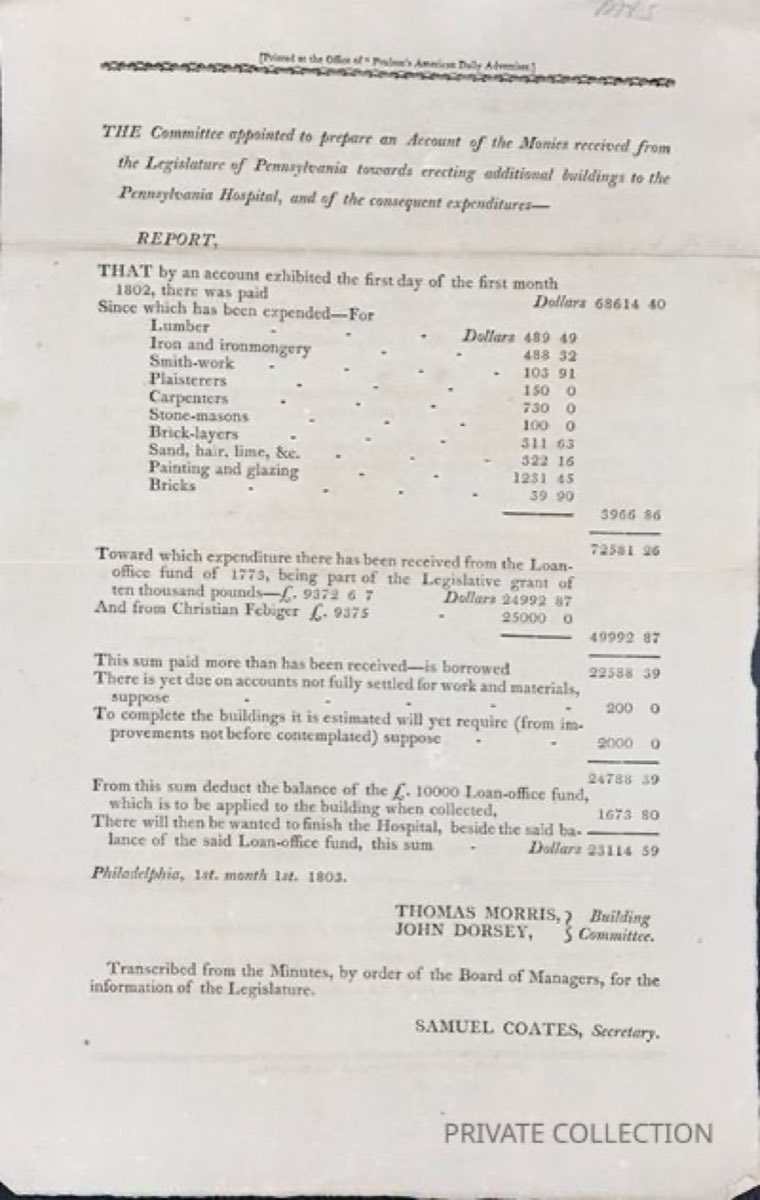
The Committee Appointed to Prepare an Account of the Monies Received from the Legislature of Pennsylvania towards Erecting Additional Buildings to the Pennsylvania Hospital
The report of New Year's Day 1803, signed in type by Morris and Dorsey and transcribed by Samuel Coates, on heavy paper watermarked 'MATHEWS'; three horizontal folds. Not in Shaw & Shoemaker.
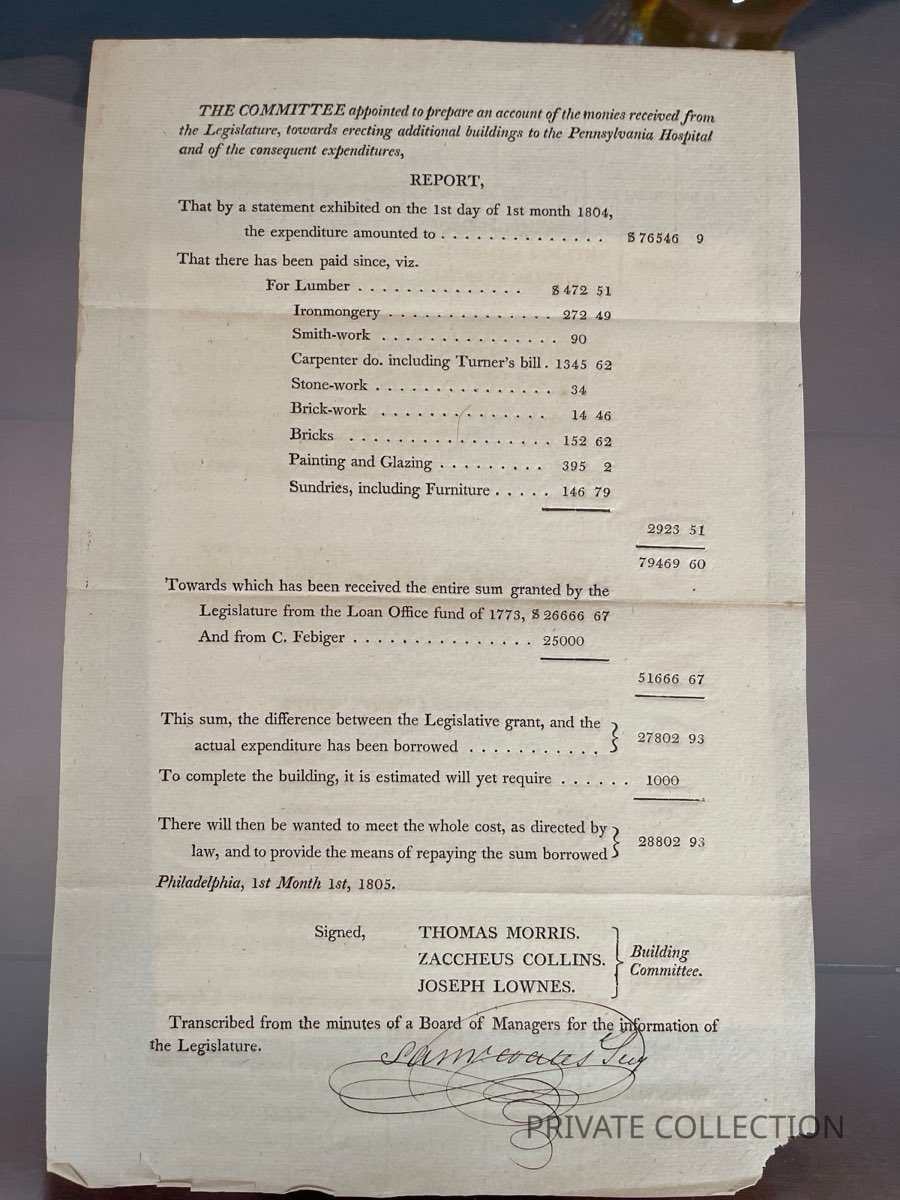
Account of the Monies Received from the Legislature towards Additional Buildings, and of the Consequent Expenditures, to 1 January 1804
The account for 1804, signed by hand by Coates, the hospital's long-serving secretary and manager. Near fine, with only light wear at the folds. Not in Austin or Shaw & Shoemaker.
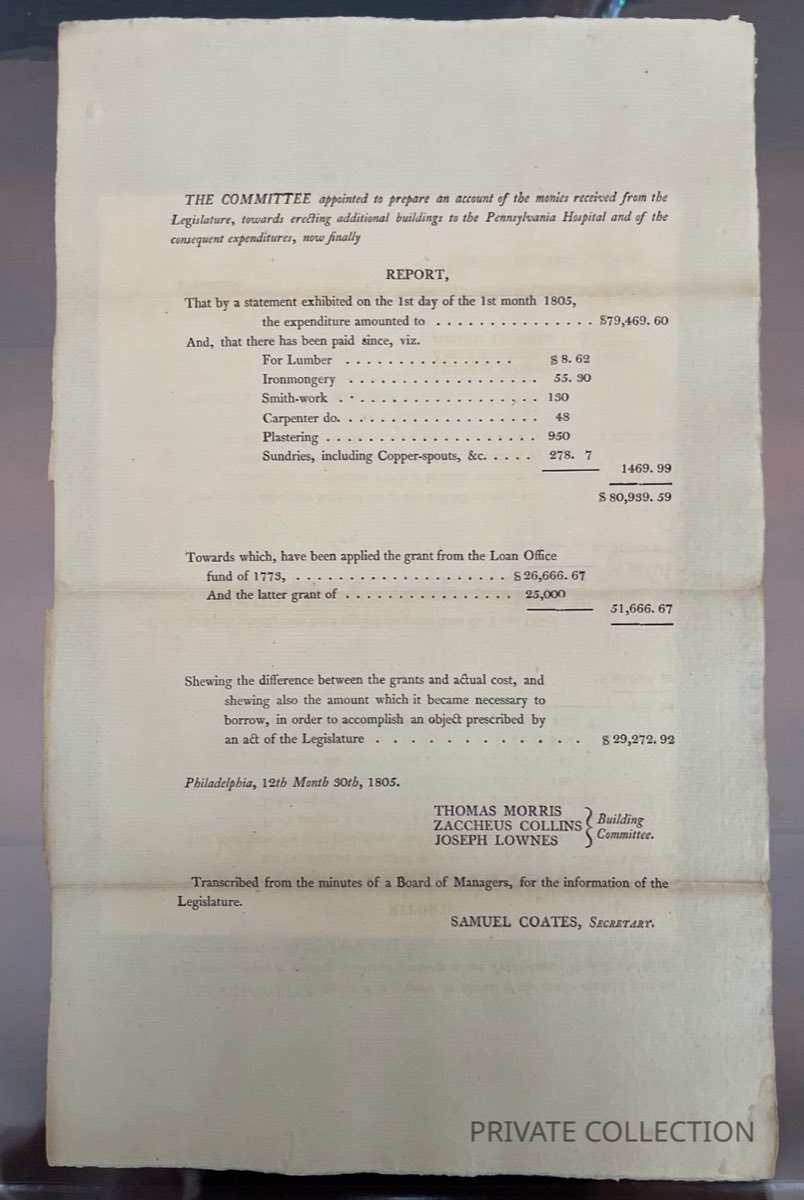
Report of the Building Committee of the Pennsylvania Hospital, Final Statement of Expenses to 1 January 1805
The last of the series: the final expenses of the buildings — ironmongery, plastering, copper spouts — against the state grants, showing a deficit. The hospital as the eighteenth century had built it was finished, and it had cost more than the Legislature gave. No institutional holdings according to OCLC.
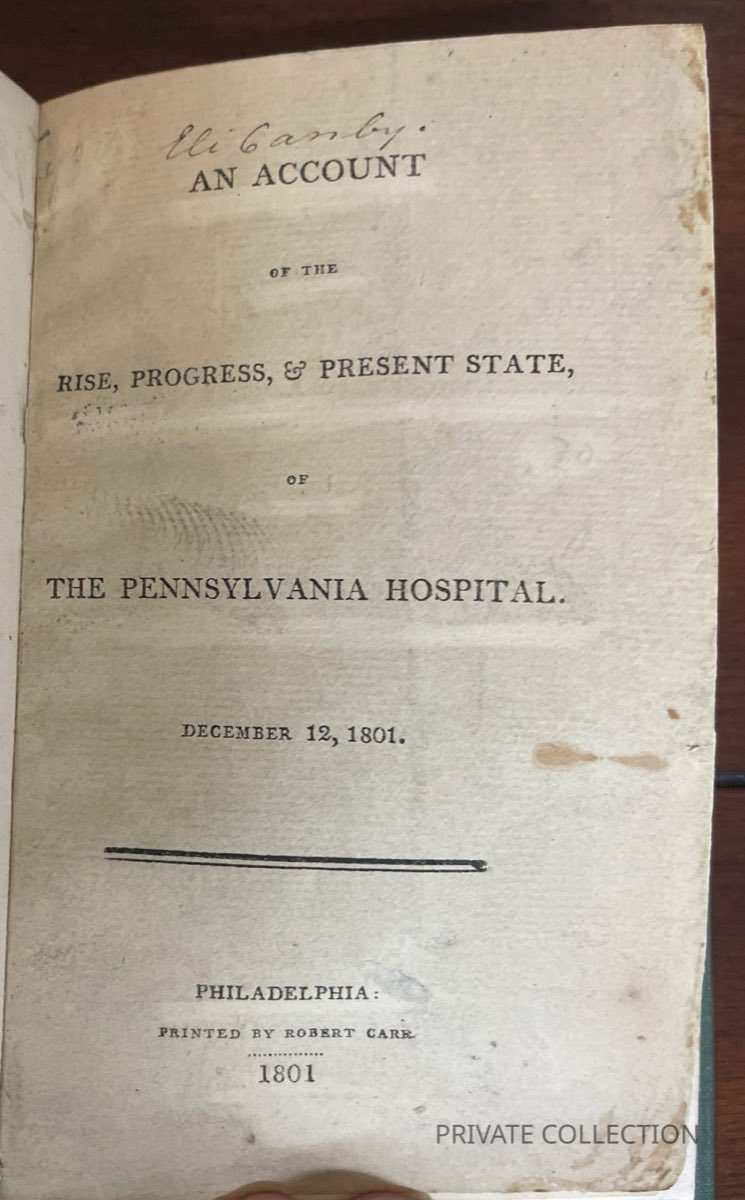
The Managers of the Hospital continued in the same way as before, preparing periodic accounts to show their progress. The collection holds the series from Franklin's Some Account of 1754 through the editions of 1801, 1817, and 1828 to William Malin's of 1832, with its engraved frontispiece of the completed building — the same institution telling the same founding story to eighty years of subscribers, each time with more wards, more patients, and a longer list of benefactors. With them is a letter regarding the hospital from the same years.
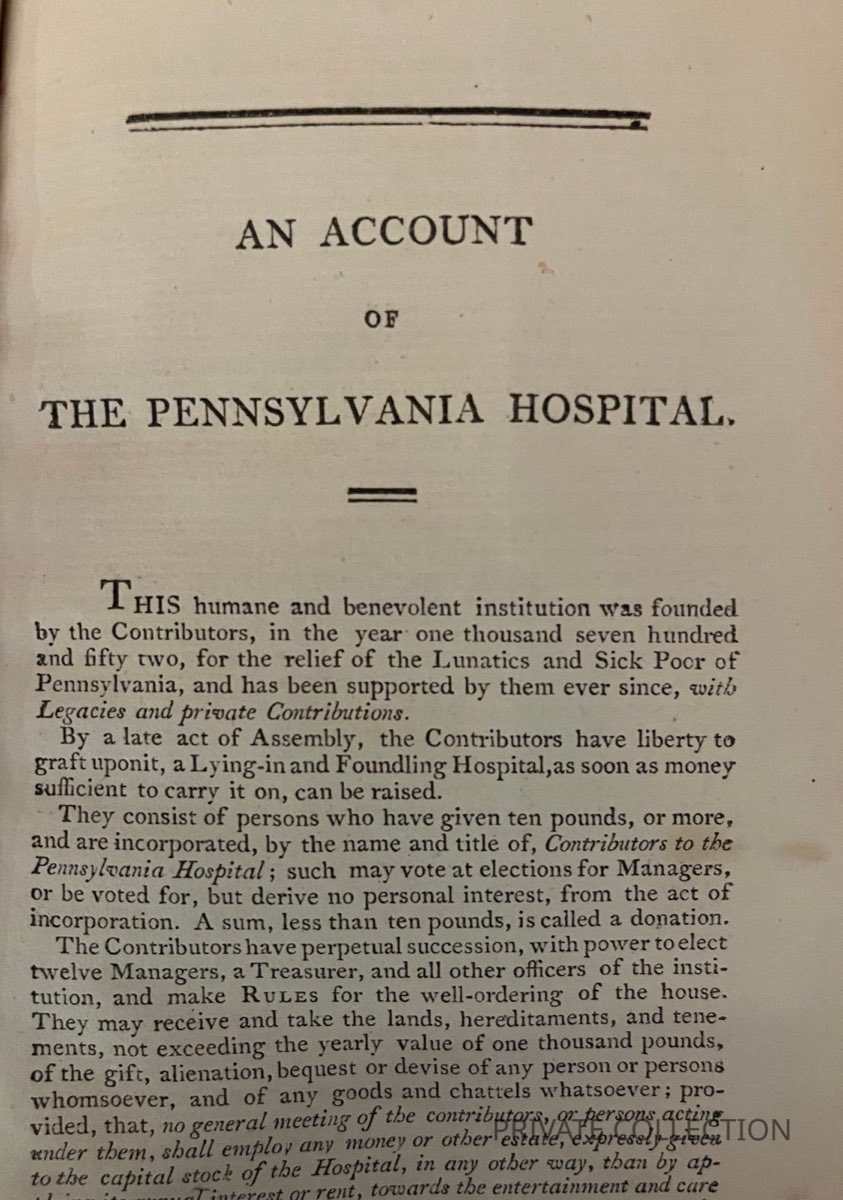
Some Account of the Pennsylvania Hospital
The Managers' periodic account at the turn of the century, prepared in the same way as Franklin's, as the west wing was going up and Rush was in his eighteenth year on the staff.
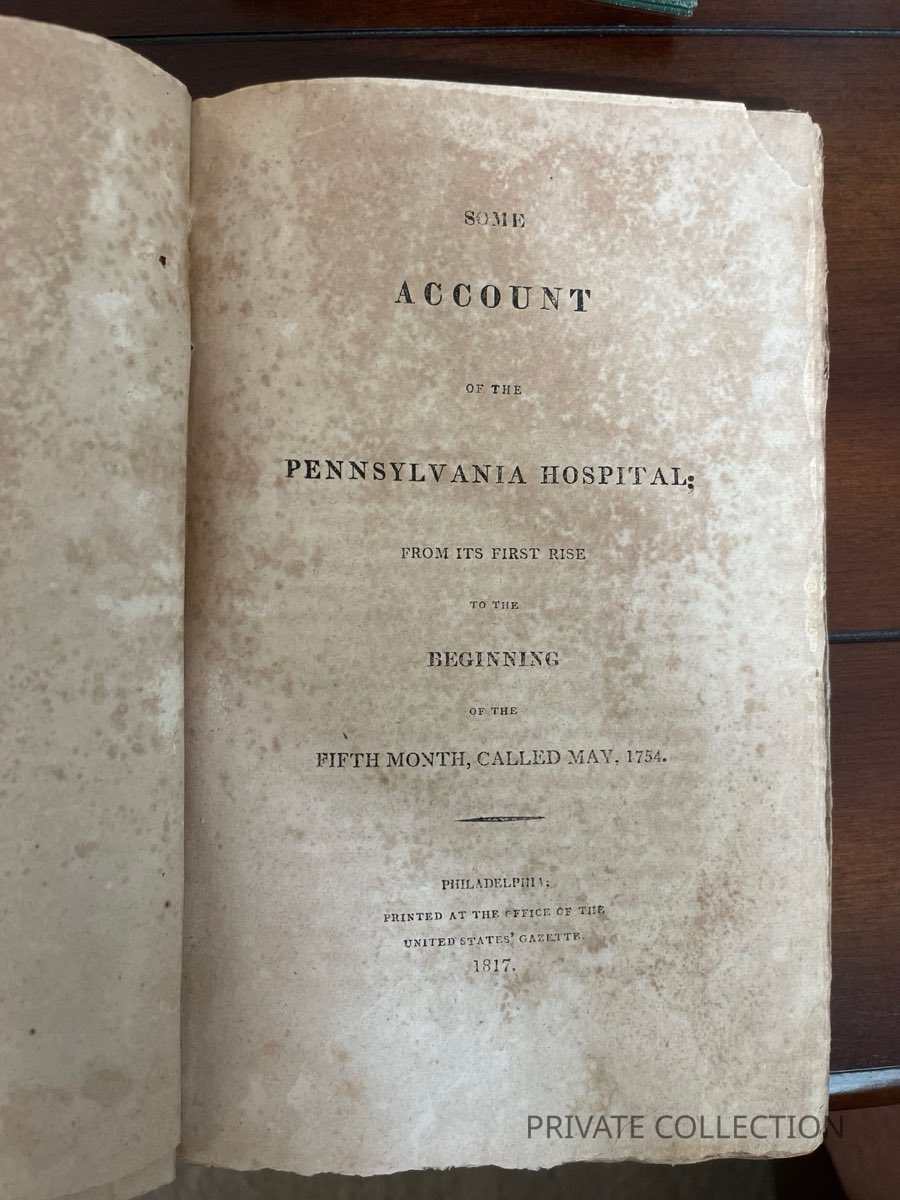
Some Account of the Pennsylvania Hospital
The Managers' account four years after Rush's death, showing the hospital's progress in the form Franklin had set: finances, rules, and the list of contributors carried forward from the original.
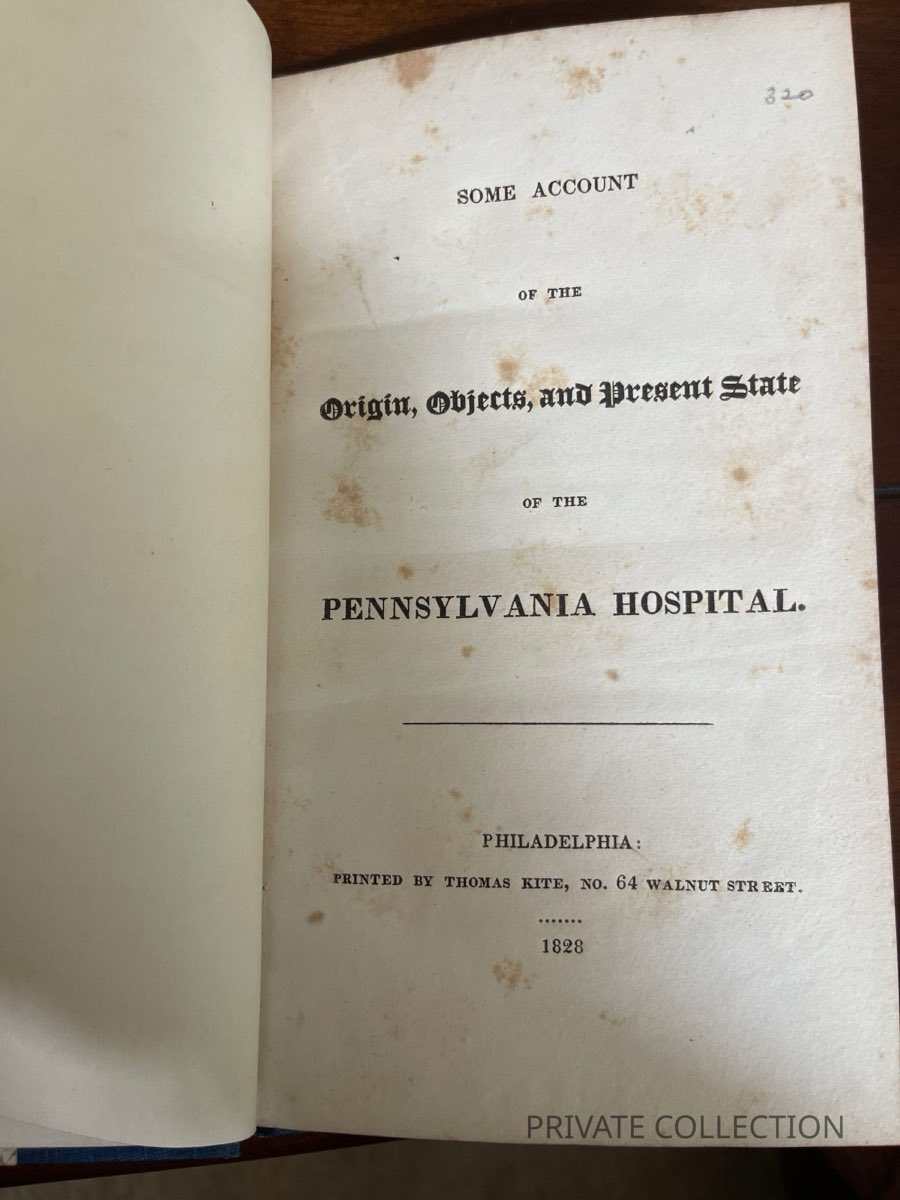
Some Account of the Pennsylvania Hospital
The Managers' account of 1828, in the decade they began planning the separate hospital for the insane that Rush's Diseases of the Mind had argued for.
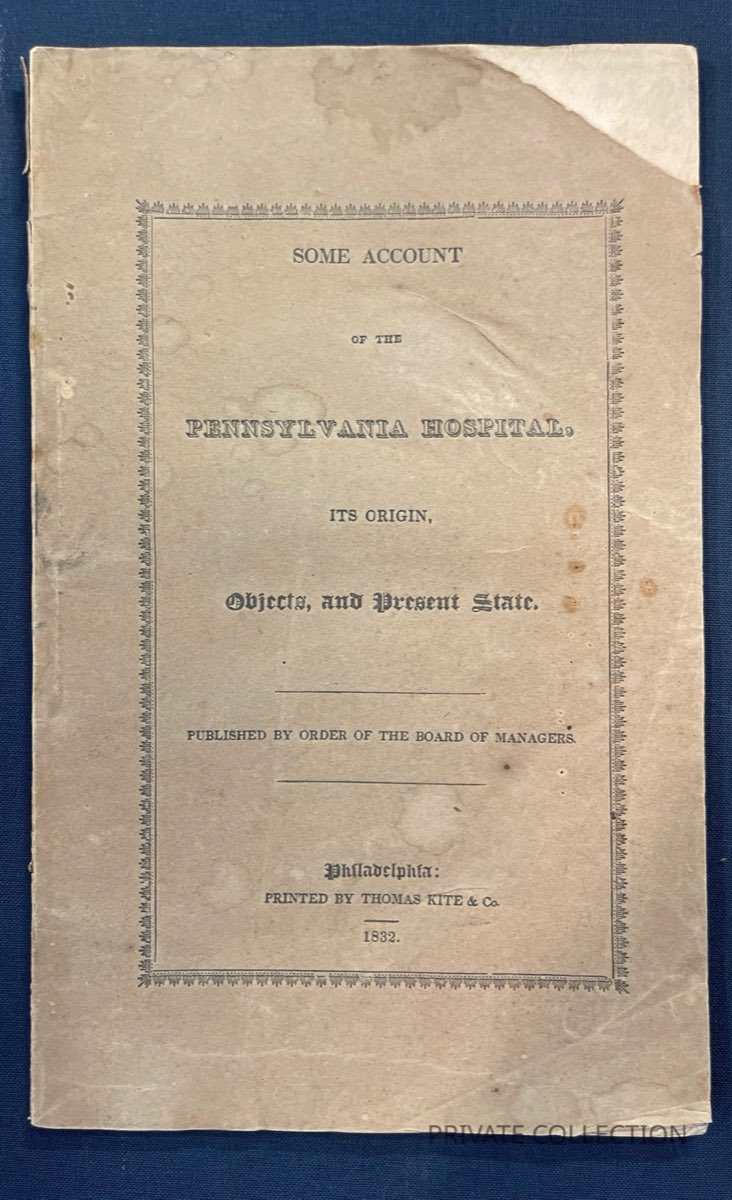
Some Account of the Pennsylvania Hospital, Its Origin, Objects, and Present State
Malin's history and description of the hospital at eighty, with Childs's engraving of the finished Pine Street front.4 Scarce. The last of the collection's Some Accounts, and the first to look back on the founders as history.
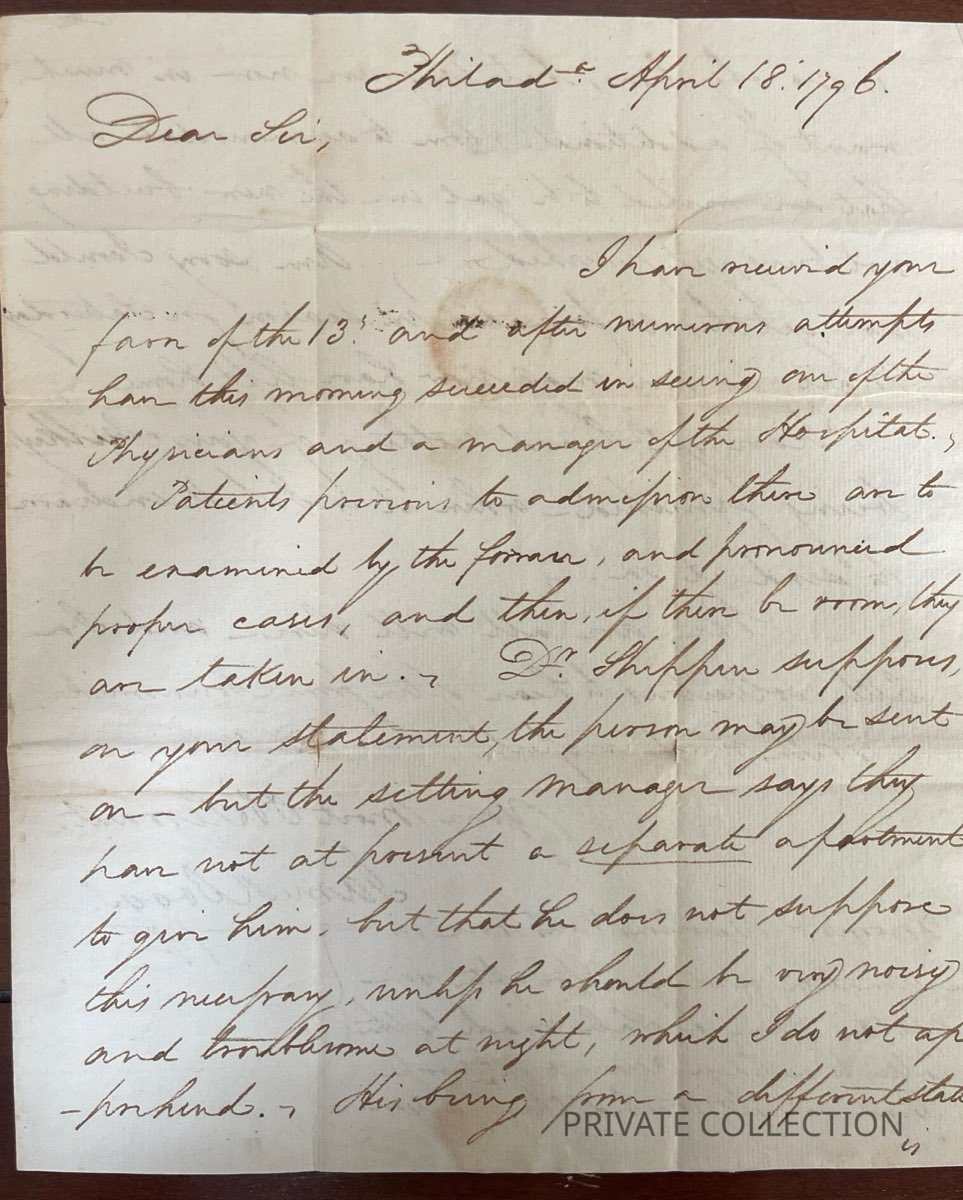
Letter Regarding the Pennsylvania Hospital
A letter to an unknown recipient relating the inner workings of the hospital's admission process. The writer tells of speaking with Dr. Shippen (William Shippen) and the requirements for admission to the hospital. A fascinating look into the plight of the people who needed the assistance of the Hospital.
- Franklin, Autobiography, ed. J. A. Leo Lemay and P. M. Zall (New York: Norton, 1986), Part Three. ↩
- C. William Miller, Benjamin Franklin's Philadelphia Printing, 1728–1766: A Descriptive Bibliography (Philadelphia: American Philosophical Society, 1974). ↩
- Thomas G. Morton and Frank Woodbury, The History of the Pennsylvania Hospital, 1751–1895 (Philadelphia: Times Printing House, 1895), which prints the managers' minutes for the building campaign of 1794–1805. ↩
- W. G. Malin, Some Account of the Pennsylvania Hospital (Philadelphia: Thomas Kite, 1832); Morton and Woodbury, History. ↩