
The Causes They Took Up Together
Abolition, Punishment, and the Writer Both Men Touched, 1773–1797
IN the 1780s the two men were, for the first time, colleagues. Franklin had come home from Passy in 1785 to preside over the state, the Philosophical Society, and the Abolition Society; Rush was a secretary of the last, and read his papers on punishment at meetings convened in Franklin's house. The full record of those causes is in Catalog I. What this chapter holds is the paper on which the two names stand together — and the writings of the man both had sent on his way.
The causes the two men took up together in the 1780s are the subject of Chapters VII and VIII of Catalog I: the Pennsylvania Abolition Society, of which Franklin was president and Rush a secretary, and whose constitution both helped write; the Address upon Slave-Keeping Rush wrote in 1773 at Benezet's urging; the certificate of James Derham, the Black physician, that Rush laid before the Society in 1789; the Enquiry into the Effects of Public Punishments that Rush read in March 1787 at the Society for Political Enquiries, 'convened at the house of His Excellency Benjamin Franklin'; and the argument against the gallows for which Rush gained, in his own words, Franklin's support.1 The last of these objects concerns the writer whose life both men touched. Paine came to Philadelphia in 1774 with Franklin's letter of introduction; the title Common Sense was Rush's suggestion.2
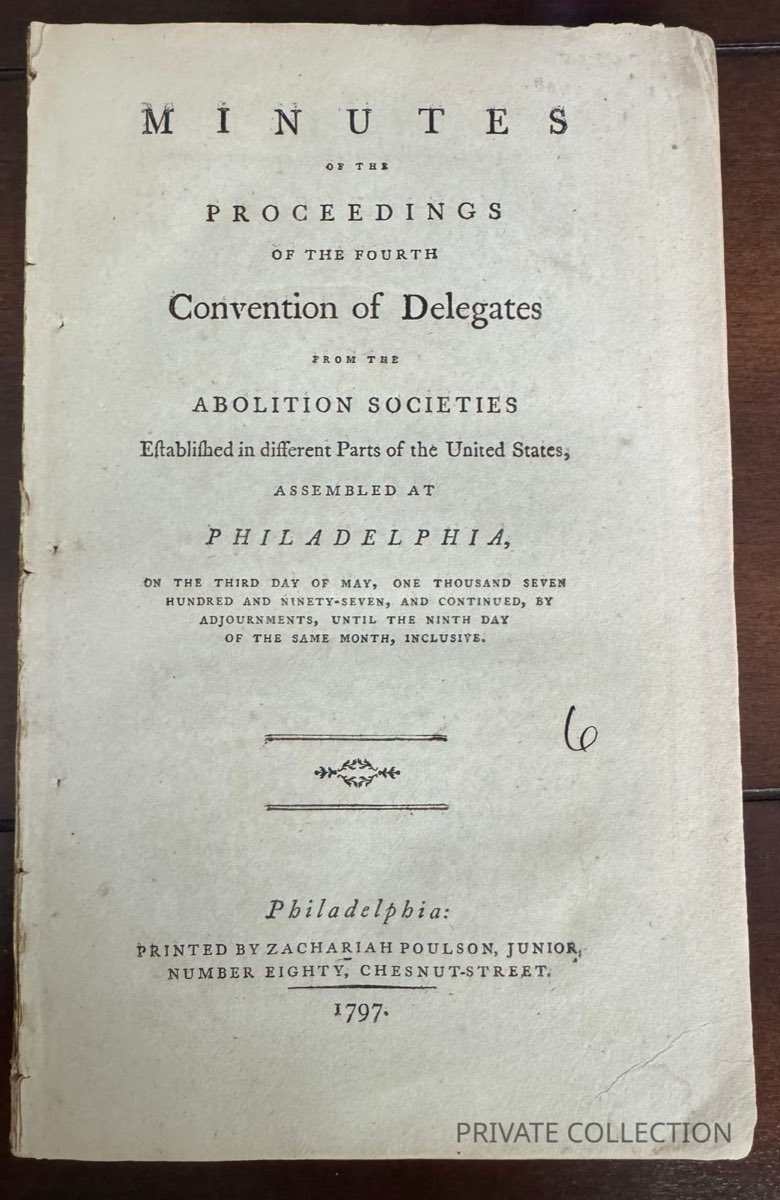
Minutes of the Proceedings of the Fourth Convention of Delegates from the Abolition Societies Established in Different Parts of the United States
The fourth national convention of the abolition societies, seven years after Franklin's death and with Rush now president of the Pennsylvania society he and Franklin had led. It condemned American participation in the foreign slave trade and, in the paternal manner of its age, urged the formerly enslaved to avoid gaming and attend the schools the convention established. Disbound; a very good, clean copy.
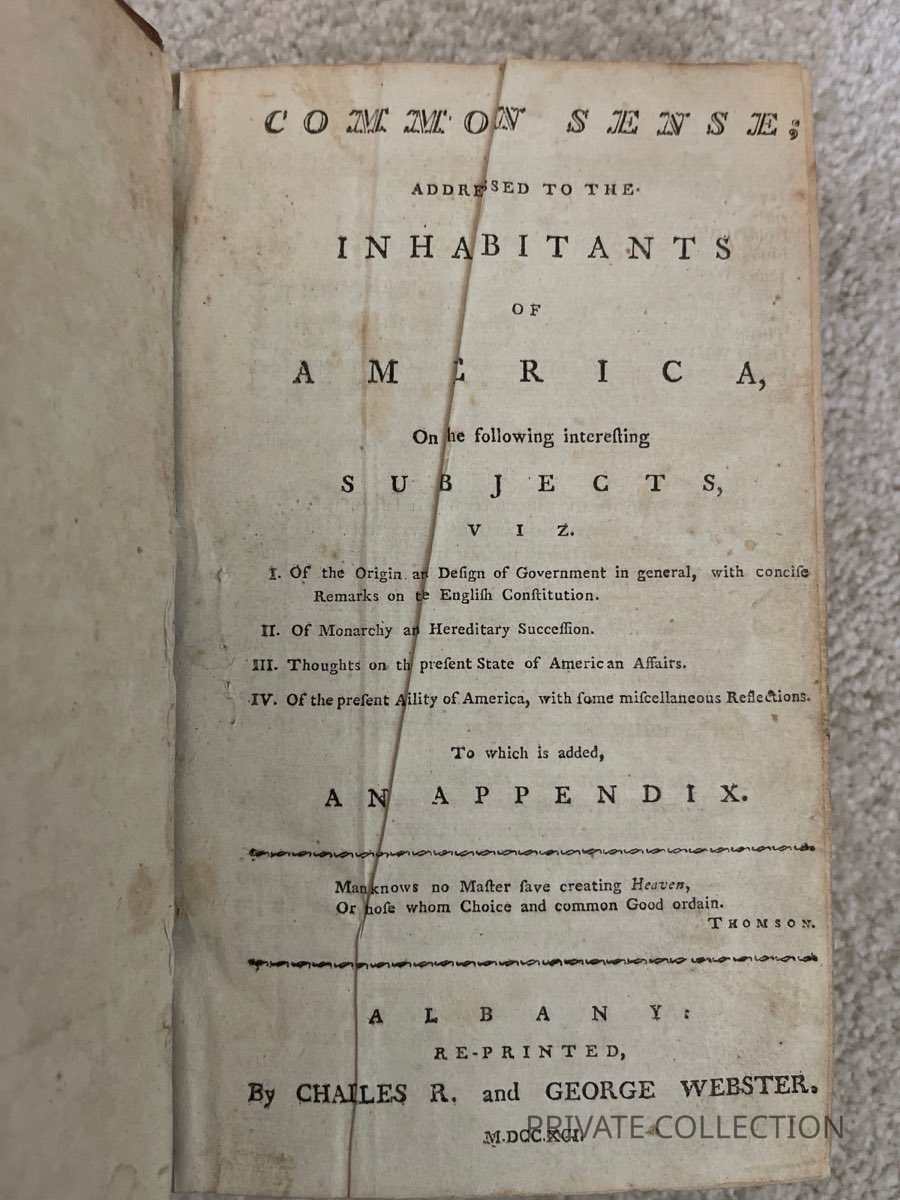
The Writings of Thomas Paine … Including Common Sense, The Crisis, and Rights of Man
Nine of Paine's works bound together in contemporary calf, among them the scarce first collected American Crisis. Paine arrived in Philadelphia in November 1774 carrying Franklin's letter of introduction; fourteen months later, with a title Rush had proposed, he published Common Sense. One book on which the mentor and the physician both left a mark.
Franklin died in April 1790. Rush wrote the Philosophical Society's memorial and, in the years that followed, put Franklin's name into nearly everything he published — the lectures, the essays, the memoir — as the man who had 'first pointed out to me the path of usefulness.' The institutions outlived them both; most are still standing. These objects are what the two men left in them.
The institutions outlived them both. Most are still standing.
- Title page of Rush, An Enquiry into the Effects of Public Punishments upon Criminals, and upon Society (Philadelphia: Joseph James, 1787); reprinted London: C. Dilly, 1787 (Catalog I, Cat. VIII.1). ↩
- Rush, Autobiography, ed. Corner, in which Rush records that he 'suggested to him' the title. See also Hawke, Revolutionary Gadfly. ↩
The Institutions
Wolf, Edwin, 2nd. 'At the Instance of Benjamin Franklin': A Brief History of the Library Company of Philadelphia. Philadelphia: Library Company, 1976.
Hindle, Brooke. The Pursuit of Science in Revolutionary America, 1735–1789. Chapel Hill: University of North Carolina Press, 1956.
The Two Men
Lemay, J. A. Leo. The Life of Benjamin Franklin. 3 vols. Philadelphia: University of Pennsylvania Press, 2006–2009.
Butterfield, L. H., ed. Letters of Benjamin Rush. 2 vols. Princeton: Princeton University Press, 1951.
Corner, George W., ed. The Autobiography of Benjamin Rush. Princeton: Princeton University Press, 1948.