
The College and the Stove
The Academy, the Medical School, and the Science of the City, 1749–1810
FRANKLIN founded things and left. The Academy of 1749 that became the College of 1755, the medical school of 1765, the Hospital of the previous chapter: each was his in conception and someone else's in operation, and the someone else, from 1769 onward, was very often Rush. The same was true of the science. Franklin printed the herbal; Bartram annotated it; Rush taught from the materia medica it described. Franklin invented the stove; a generation later it was being improved, in Philadelphia and in London, for the warming of the hospitals Rush attended.
The Hospital was Franklin's before it was Rush's. Franklin raised the money in 1751, printed the notes, and wrote the Some Account of 1754 (Chapter II); Rush joined its staff in 1783 and served until his death. The College of Philadelphia was Franklin's Academy of 1749 before it was the College of 1755, and the medical school John Morgan proposed at its commencement in 1765 — the founding document is in Catalog I, Chapter II — was the one that made Rush its professor of chemistry in 1769. The diploma of 1808 (Catalog I, Chapter II), signed by Rush, is the institution Franklin chartered conferring the degree Rush taught for. And the science the two men shared was Philadelphia's own: John Bartram, Franklin's friend and fellow founder of the Philosophical Society, annotated the herbal Franklin printed in 1751; his son William's Travels of 1791 was the botanical classic of Rush's generation; and Franklin's stove, the most practical of his inventions, was still being improved for the heating of hospitals when Rush was an old man.
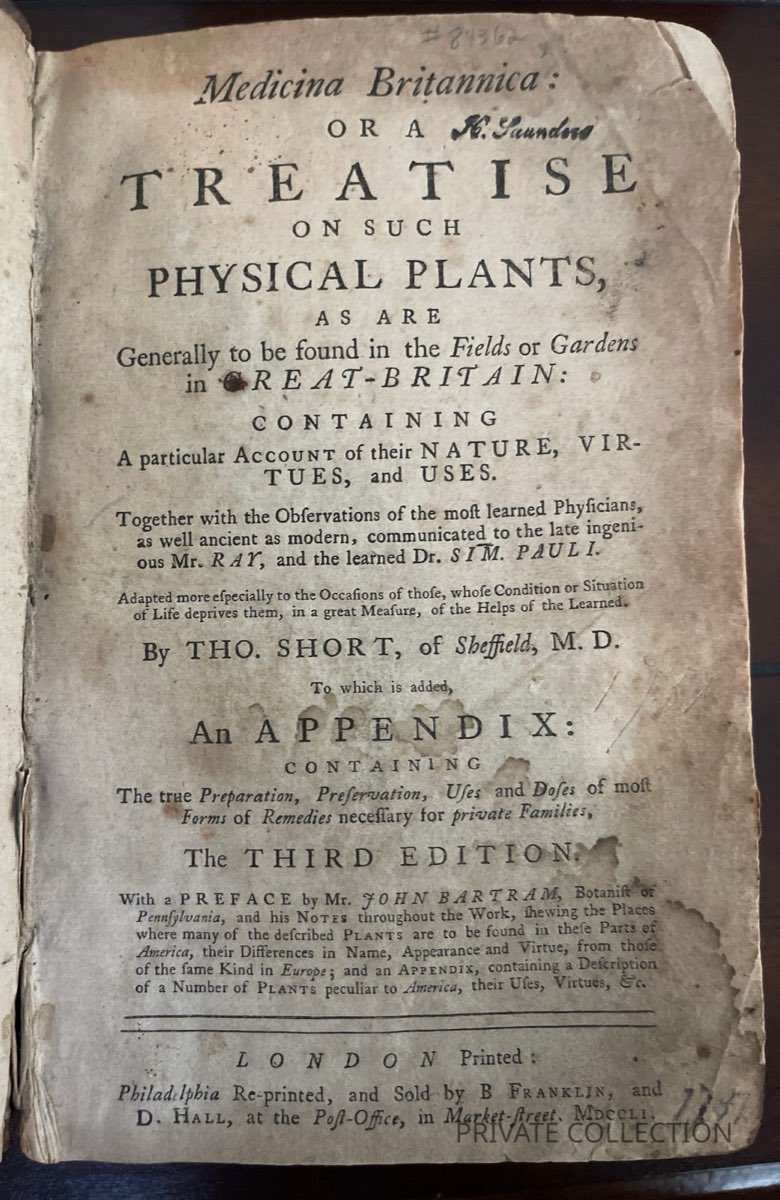
Medicina Britannica: A Treatise on Such Physical Plants as Are Generally to Be Found in the Fields or Gardens
Short's herbal in the American edition that matters: Franklin had Bartram, the greatest botanist in the colonies and a founding member of the Philosophical Society, add notes on which of the English plants grew in Pennsylvania and which American plants could replace them. The materia medica Rush would learn from Cullen, given a Philadelphia annotation by Franklin's press twenty years before Rush went to Edinburgh.
Travels through North and South Carolina, Georgia, East and West Florida
The rare first edition of the classic of southern natural history, by the son of Franklin's friend John Bartram — 'for the period, unrivalled.' Rush was Bartram's contemporary and fellow member of the Philosophical Society; the book belongs to the Philadelphia science both men practised. Contemporary calf, in a clamshell box.
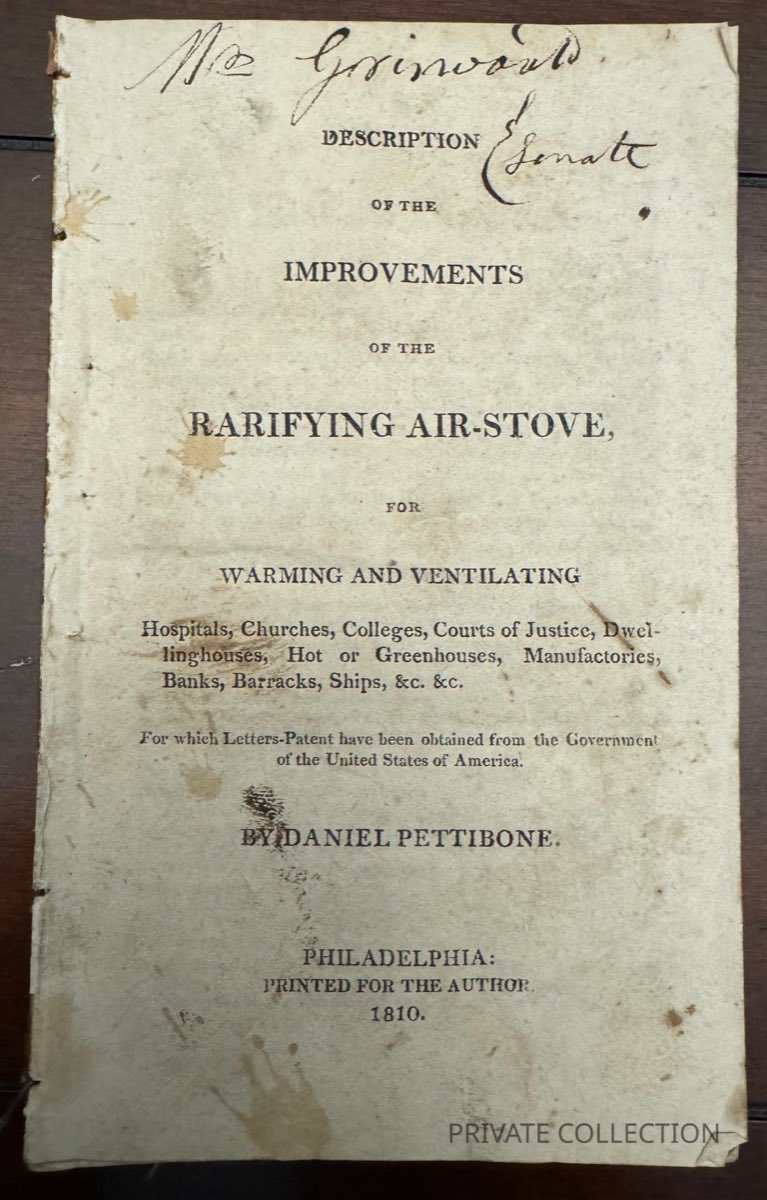
Description of the Improvements of the Rarifying Air-Stove, for Warming and Ventilating Hospitals, Churches, Colleges, Dwelling-houses, Hot or Greenhouses
The Pennsylvania fireplace of 1744, Franklin's most practical invention, carried into the next century as a ventilated heating system for the very institutions — hospitals and colleges — that Franklin had founded and Rush served. Rush, who thought bad air the cause of most fevers, had every reason to read it.
The stove travelled. Franklin had described the Pennsylvania fireplace in 1744 and given the design away; forty years later a London ironmonger, James Sharp, was manufacturing 'Pensilvanian' grates and advertising them in French and English to the Continent, with Franklin's name on the sheet as the authority. The Philadelphia improvement of 1810 and the London prospectus of 1785 are the same invention at either end of the Atlantic: the founder's idea, made useful by other hands.
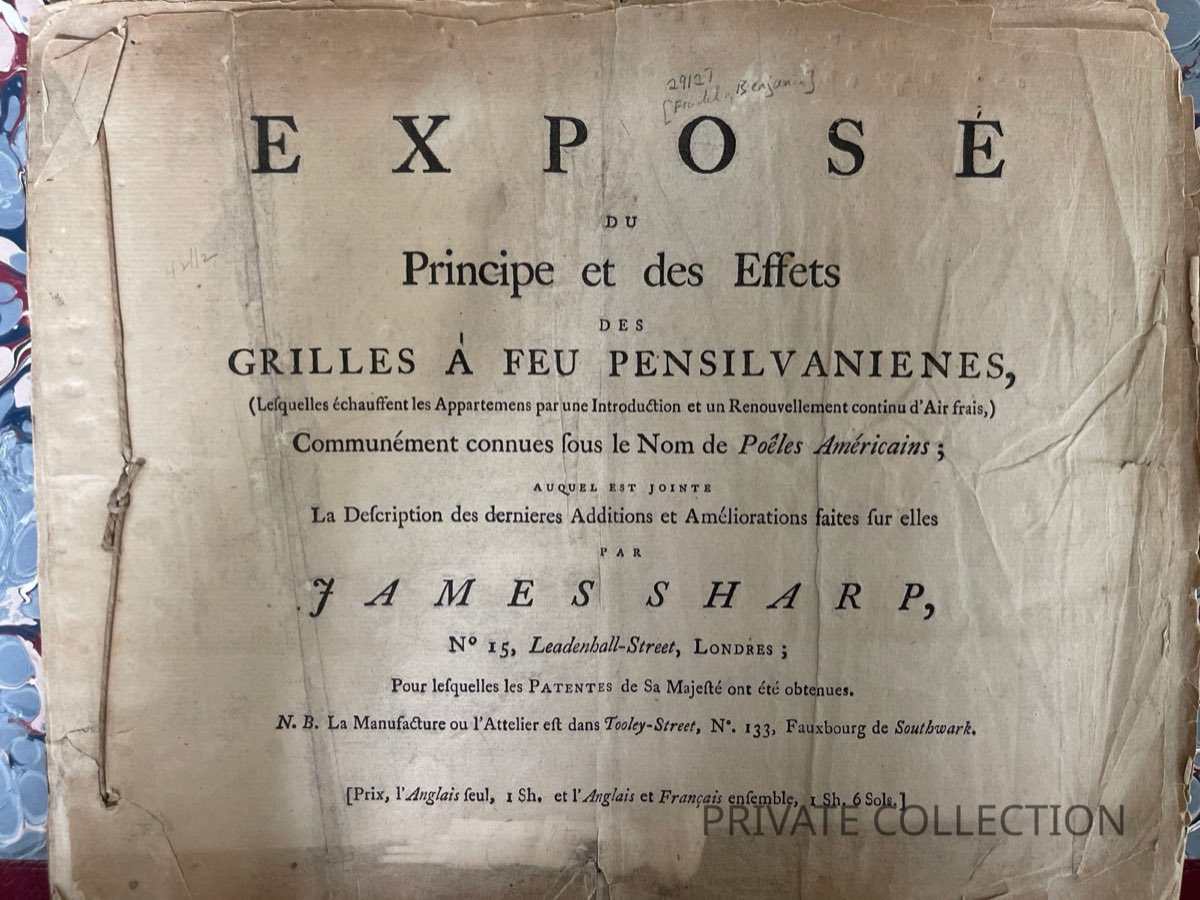
Exposé du Principe et des Effets des Grilles à Feu Pensilvaniennes, Communément sous le Nom de Poêles Américains — with James Sharp's Improvements
The Pennsylvania fireplace explained to the French, with the improvements of the London ironmonger James Sharp who manufactured it — Franklin's stove of 1744 as a European product forty years on, in a rare bilingual trade publication. WorldCat locates six copies. With Pettibone's American improvements, the stove's whole career.