
The Pamphlet War
1794–1797: Physicians at War in Print
THE epidemic ended in November 1793. The controversy was just beginning. Within months, the major physicians on both sides had gone to press, and the pamphlet war that followed would last nearly a decade, producing more medical literature on a single American epidemic than had ever been generated before. The collection holds the complete record of both sides.
Rush published first and most comprehensively. His Account of the Bilious Remitting Yellow Fever, published in early 1794 as the third volume of his Medical Inquiries, was the definitive statement of the localist, non-contagionist, depletion position: yellow fever arose from domestic miasmatic conditions (specifically the rotting coffee on Ball's Wharf); it was not contagious person-to-person; it required aggressive depletion to treat. Rush laid out the argument with the systematic confidence of a man who had treated hundreds of cases from inside the epidemic and emerged, if barely, convinced that his method had been vindicated.
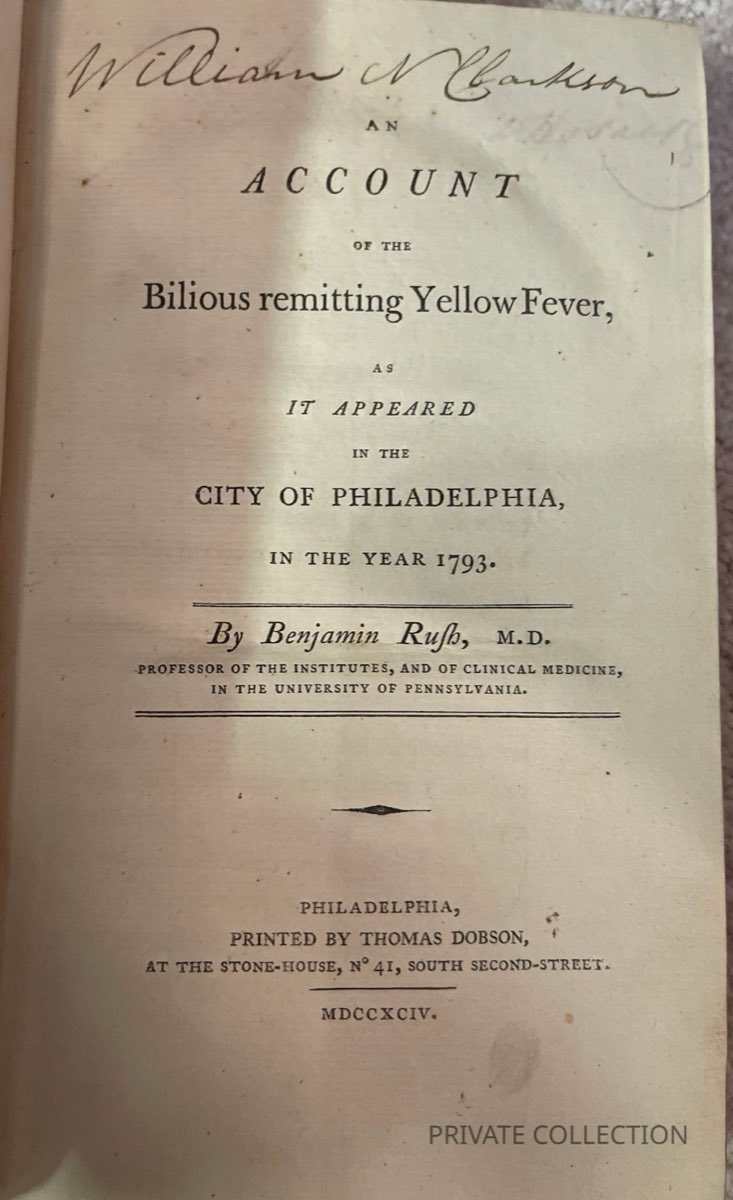
An Account of the Bilious Remitting Yellow Fever, as it Appeared in the City of Philadelphia, in the Year 1793
Rush at his most systematic and most embattled: the document on which his entire yellow fever reputation rests. Published while the controversy was still raw and the opposition already in print against him, the Account traces the epidemic from its miasmatic origin through its clinical progression to his "double-barreled" treatment. Rush had contracted the disease himself while writing it. He had lost two assistants and his sister. He was absolutely certain he was right.
William Currie published against Rush almost simultaneously. Where Rush was systematic, Currie was combative: the Synochus Icteroides treatise names Rush's methods directly, proposes bark and wine as the superior treatment, and argues that the epidemic was imported and contagious — three positions, each the opposite of Rush's. Currie was one of the founders of the College of Physicians and among the most technically accomplished physicians in Philadelphia. He has received almost no biographical attention in subsequent scholarship, a lacuna that reflects how completely Rush's narrative of the epidemic has dominated the historical memory of 1793.
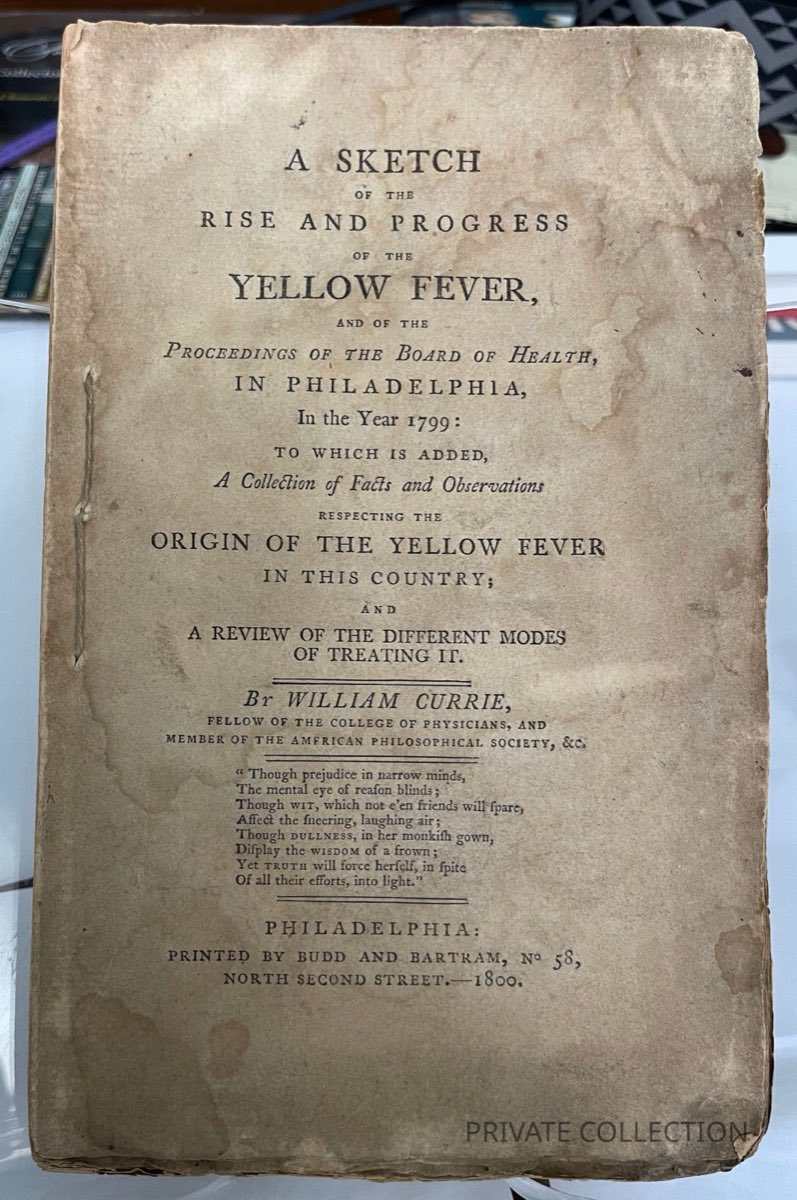
A Treatise on the Synochus Icteroides, or Yellow Fever as it Lately Appeared in Philadelphia
The essential opposition document, and Rush's most formidable single antagonist in print. On origin: imported, not domestic. On transmission: contagious, not miasmatic. On treatment: bark and wine, not bleeding and calomel. Three positions, each the direct inverse of Rush's. Both men trained in Edinburgh. Both clinically meticulous. Same epidemic, opposite conclusions. The collection holds two copies of this first edition.
A Treatise on the Synochus Icteroides — Second Copy
The collection holds two copies of the primary Currie treatise for the same reason it holds two copies of the rarest Rush yellow fever title: the debate between these two physicians is the central intellectual event this collection documents, and it is represented here with equal depth on both sides.
Isaac Cathrall — a Philadelphia physician who conducted experiments that should have convinced him yellow fever was not contagious, then concluded it was — represents the most poignant dead end in the collection. He injected himself with black vomit from yellow fever victims. He rubbed it into incisions in his own skin. He survived, concluding correctly that the specific matter was "an inert secretion" with no morbific power. Then he maintained that yellow fever was contagious through contact. Both conclusions — right and wrong — came from the same experiments, because the right question (how, exactly, does this disease move between people?) had not yet been formulated. The answer was mosquitoes, a fact that would not be established until 1900.
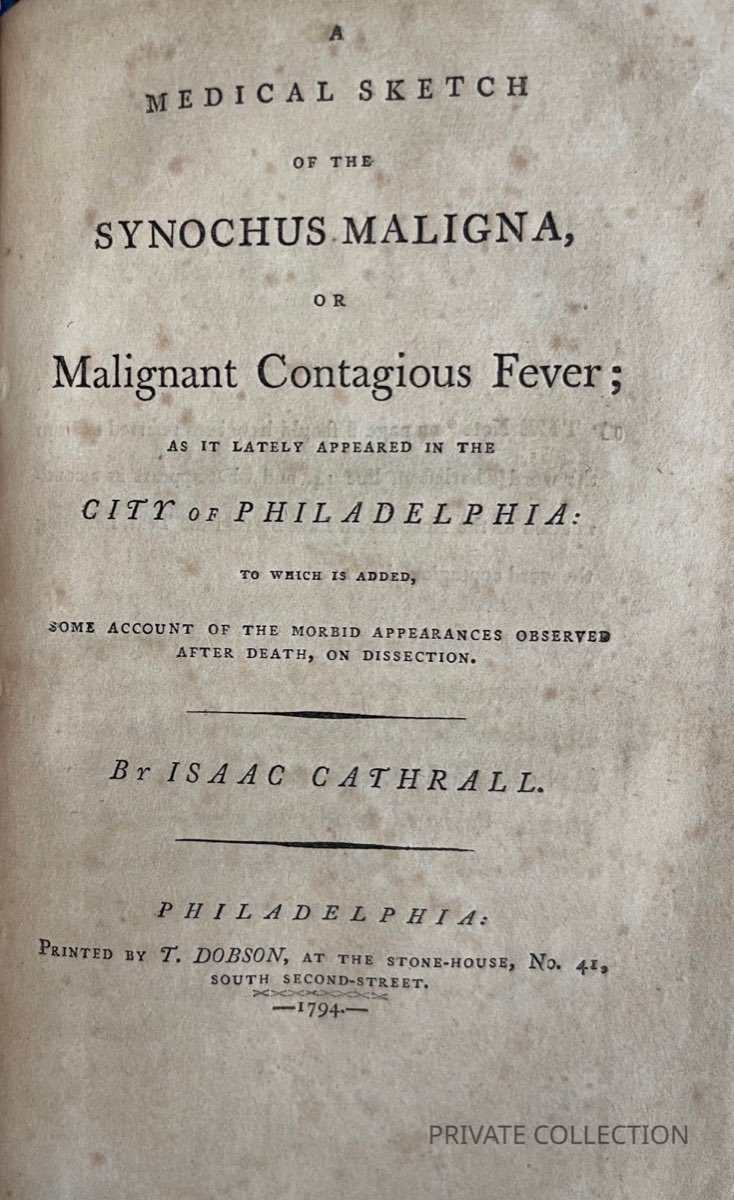
A Medical Sketch of the Synchonus Maligna, or Malignant Contagious Fever as it Lately Appeared in Philadelphia
The clearest case in the collection of a physician reasoning correctly from evidence and reaching the wrong conclusion. Cathrall disproved person-to-person transmission through bodily fluid contact — which was correct. He concluded the disease must spread through some other mechanism of contact — also correct. He could not identify what that mechanism was. The mechanism was mosquito bite, entirely outside his experimental framework.
Rush's most radical act during the pamphlet war was not a pamphlet at all. It was an almanac entry. In 1795, he published his treatment directions for yellow fever — the specific instructions for bleeding and purging — in Poulson's Town and Country Almanac, read by farmers and tradespeople across the mid-Atlantic region. Laypeople could now bleed their neighbors according to Rush's directions, without medical supervision. His opponents found this appalling. Rush found it democratic.
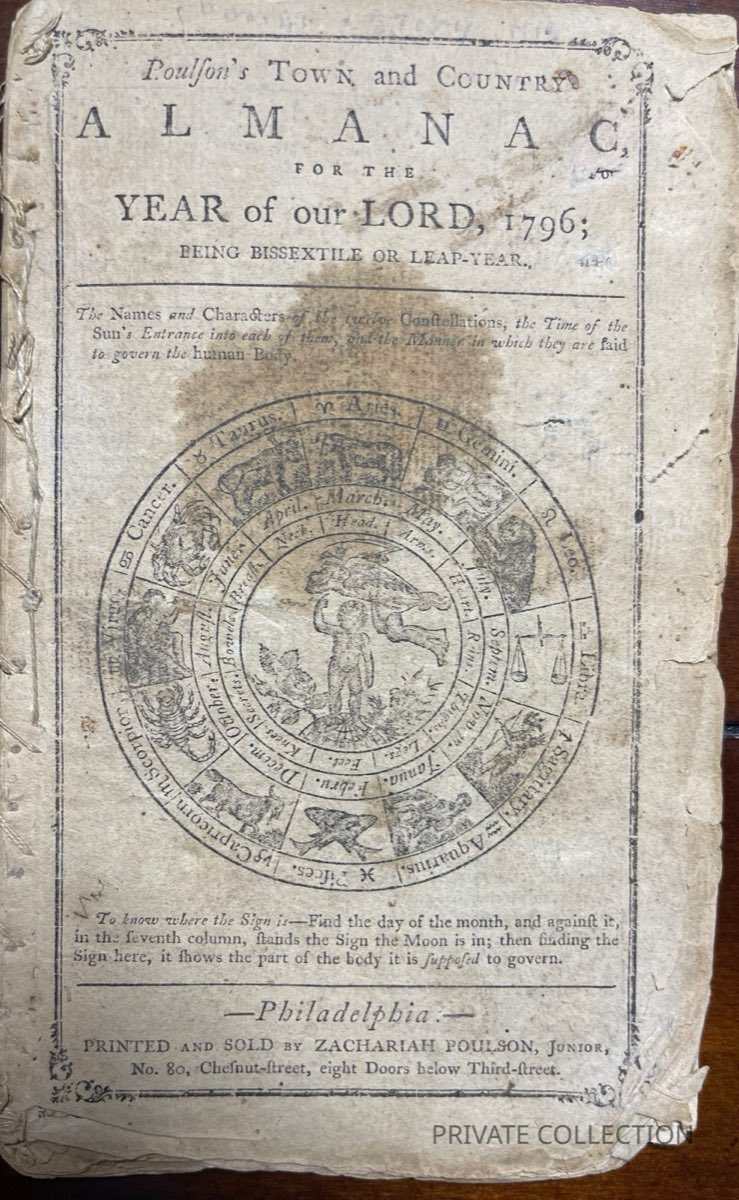
Poulson's Town and Country Almanac for the Year 1796 (Including Rush's Directions for Treatment)
Pages [17-18] contain "Dr. Rush's Directions for the Treatment of the bilious, inflammatory, remitting and intermitting Yellow Fever" — the most powerful physician in America speaking directly to the farmer reading by firelight, bypassing the College of Physicians and the whole apparatus of organized medicine. The almanac also includes a list of births and deaths in Philadelphia's religious societies from August 1794 to August 1795, the demographic record of the city returning to normal mortality.
An English clothier named Henry Wansey arrived in America in 1794, the year after the epidemic, and found a city still processing its catastrophe. His observations — drawn from conversations with Philadelphians still raw from the loss — give us something the physicians' pamphlets cannot: how ordinary people talked about the epidemic to a curious foreigner, and what they remembered about it a year later.
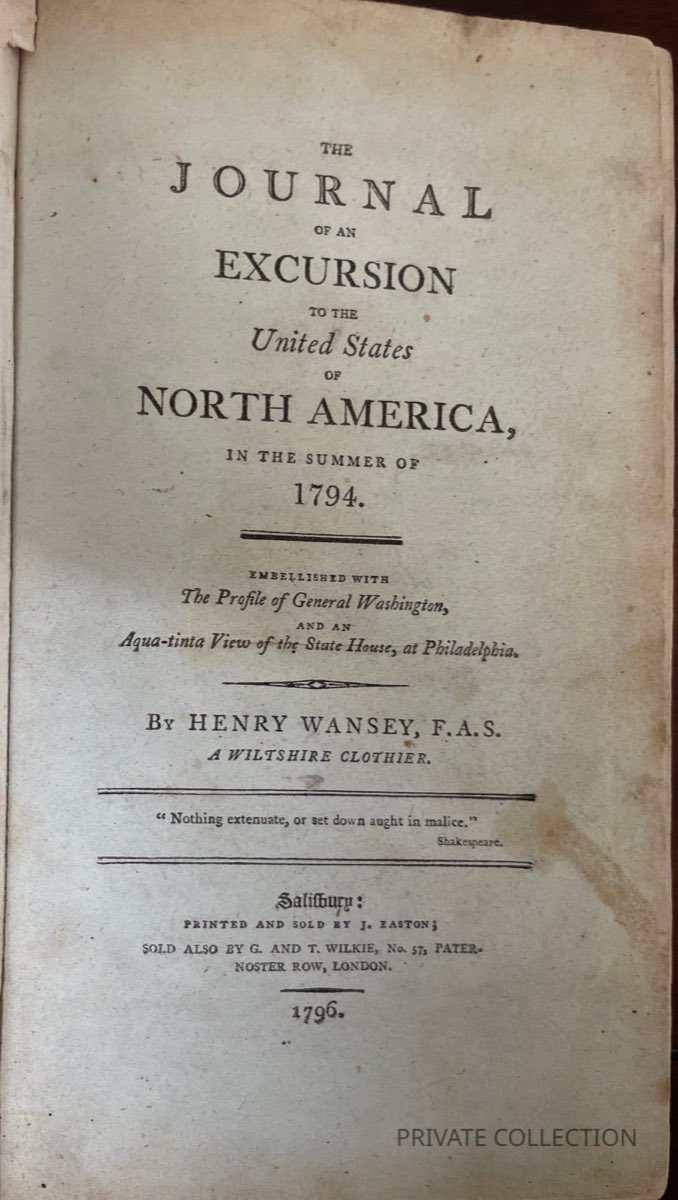
The Journal of an Excursion to the United States of North America, in the Summer of 1794
Pages 138-153 give Wansey's account of the previous summer's epidemic, drawn from his Philadelphia conversations and supplemented by material from Poulson's Almanac. This is the epidemic as social memory: how Philadelphians narrated it to an outsider in 1794, what they chose to emphasize, what they were still trying to understand. The second issue is distinguished by the plate of Washington with eyelash, per Howes.
Jackson's Treatise on the Fevers of Jamaica arrived in its first American edition in 1795, published precisely because Philadelphia physicians needed Caribbean precedent for the therapeutic debate. Jackson had been treating tropical fever in Jamaica since the 1770s. His general preference for depletion in tropical fever contexts supported Rush's approach and was cited by Rush's supporters as independent corroboration — evidence from a military physician with decades of Caribbean experience that aggressive treatment was correct for diseases of this kind.
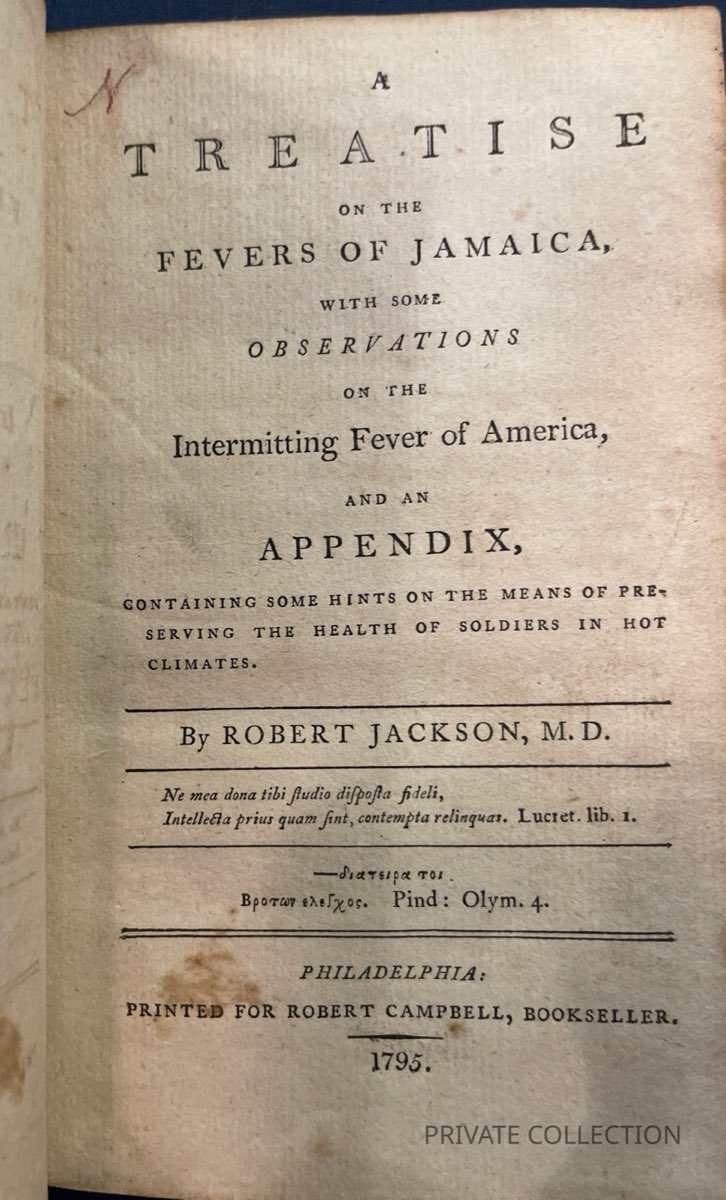
A Treatise on the Fevers of Jamaica, with Some Observations on the Intermitting Fever of America
First published in London in 1791, republished in Philadelphia in 1795 because the demand created by the epidemic made tropical medicine expertise valuable to American readers. Jackson's clinical reasoning is more careful than Rush's about when and how much to bleed — his Caribbean experience had given him a more nuanced view of the disease's variable presentations — but his general therapeutic framework supported Rush's approach and was deployed accordingly.