
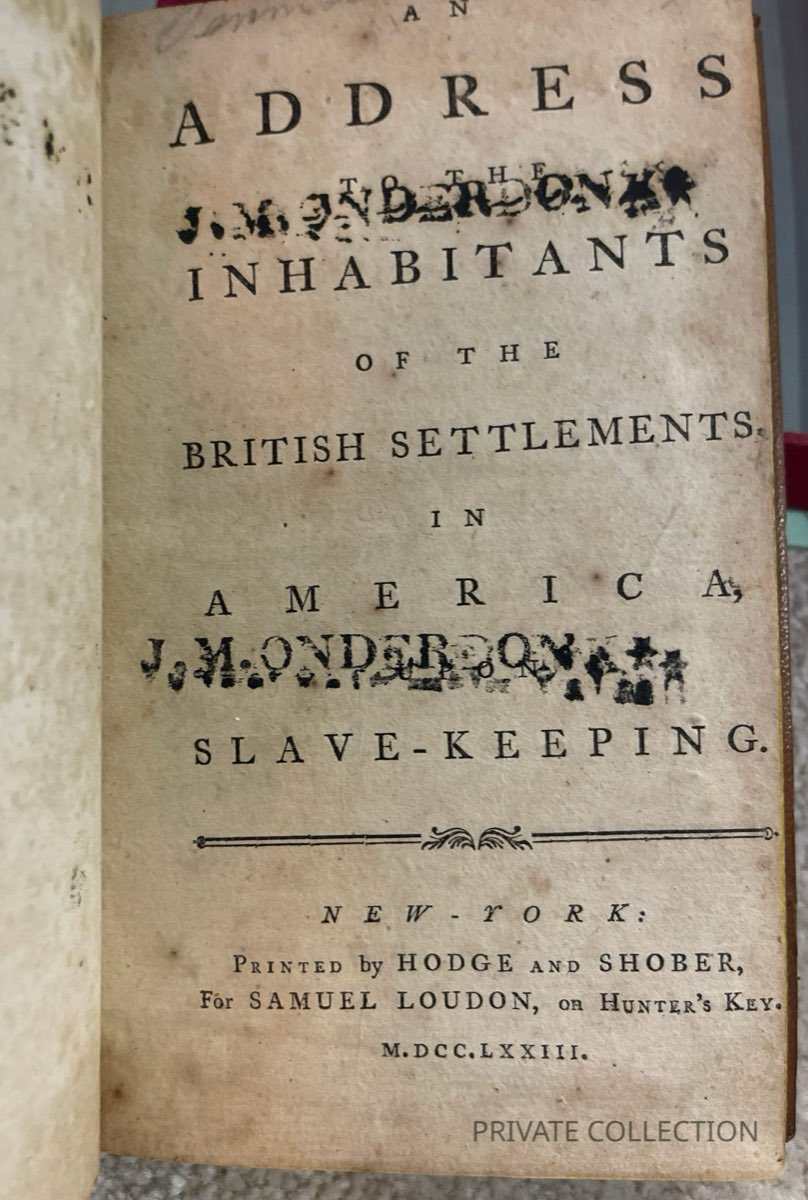
The Address upon Slave-Keeping
Rush wrote it anonymously in 1773 at the urging of Anthony Benezet, and identified himself as the author in a letter to Barbeu-Dubourg that April. Butterfield calls it the first of Rush's 'controversial tracts, and his first effort in behalf of the Negroes … one of his most forceful productions,' and it remains one of the most readable. It made Rush, at twenty-seven, an abolitionist for life: a founder of the Pennsylvania Abolition Society, its secretary under Franklin's presidency, and later its president.
Rare — only nine copies at auction in the last 125 years, the latest in 2004. This is the New York printing of the same year, by Hodge and Shober for Samuel Loudon.
An Address to the Inhabitants of the British Settlements in America upon Slave Keeping
Rush was twenty-eight years old when he published this pamphlet — already Benjamin Franklin's student in the broadest sense, following the older man's example of using the press as an instrument of civic improvement. The argument is both moral and medical: slavery is incompatible with natural rights principles; the experience of enslavement produces precisely the moral and physical degradation that slave-holders use to justify the institution. Publication in 1773 — two years before the Revolution and two years before the founding of the Pennsylvania Abolition Society — marks Rush as one of the earliest antislavery voices in America. Franklin read it with approval.