
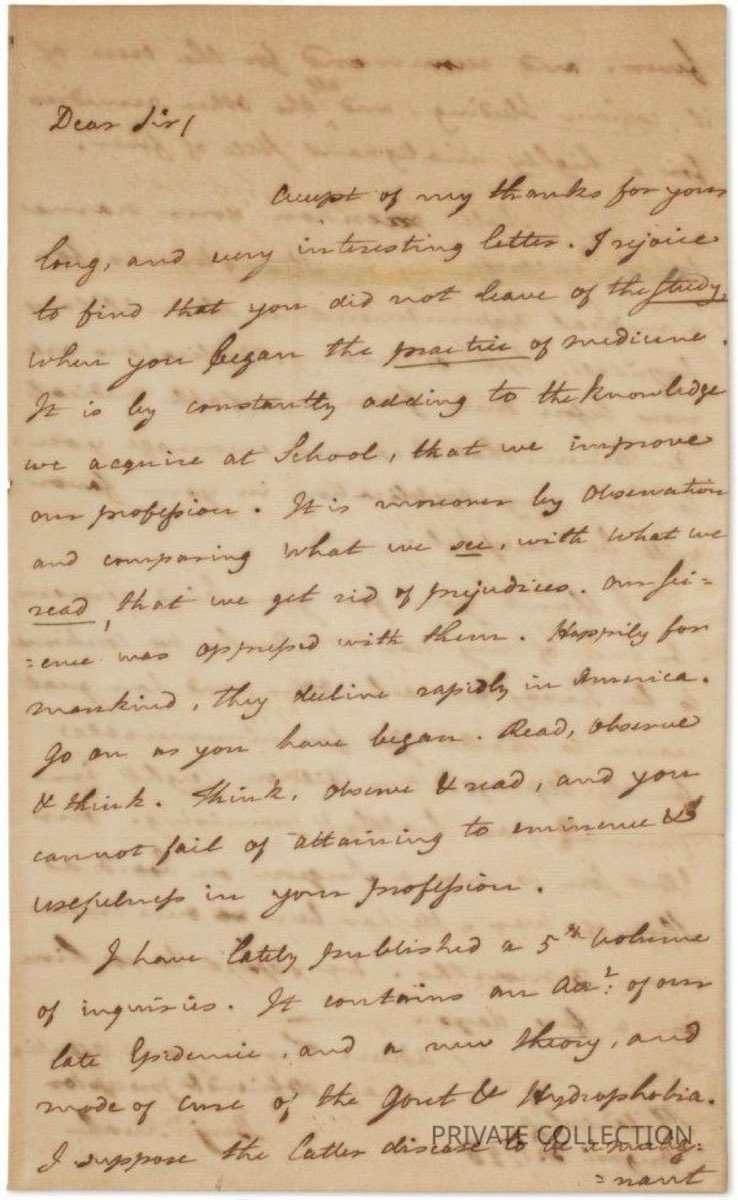
'Read, observe and think'
'Go on as you have begun,' Rush writes to a former student who has stayed in practice where he began. 'Read, observe & think. Think, observe & read, and you cannot fail of attaining to eminence & usefulness in your profession.' It is by 'constantly adding to the knowledge we acquire at school' that a physician improves, and 'by observation, and comparing what we see with what we read, that we get rid of prejudices.'
Rush repeated the three words for the rest of his life and put them into the autobiography he wrote for his children. The letter also mentions the fifth volume of his Inquiries, just published, with its account of the late epidemic and a new theory of gout and hydrophobia — and, in passing, his eldest son, who would live out his life in the psychiatric ward of the Pennsylvania Hospital. The teacher, the physician, and the father in one page.
Benjamin Rush ALS August 2, 1798
Rush writes to Dr. John McClelland during the 1798 epidemic: advising continued study, announcing his forthcoming fifth volume, reporting his efforts to secure McClelland a military appointment. He mentions his eldest son serving as a ship's surgeon — the son who would later spend years in the Pennsylvania Hospital psychiatric ward, one of the most painful ironies in the life of the physician who wrote America's first treatise on mental illness.