
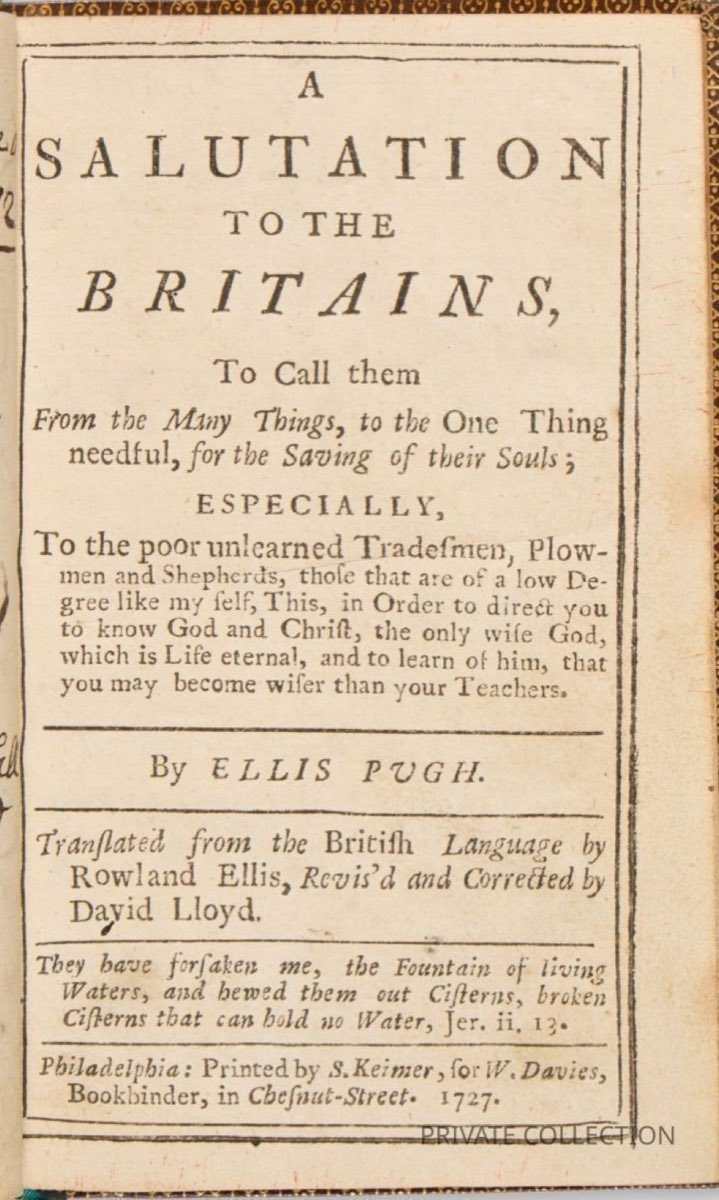
The Press before It Was Franklin's
In the spring of 1727 Franklin went back to work for Samuel Keimer, the printer he despised, on the promise that he could run the printing-house himself. He composed, he worked the press, he trained Keimer's five hands, and he cast new type to replace a worn-out font. On October 2 the two men quarreled and Franklin walked out; within the year he had a press of his own. Keimer's imprints from those months are, in every sense but the name on the title page, the first productions of Franklin's press.
Ellis Pugh's Salutation to the Britains is one of them: a Welsh Quaker's testimony, translated for the Philadelphia meeting, printed for the bookbinder William Davies in Chestnut Street. Keimer's imprints are rare in any state; this copy has Quaker ownership from the year it was printed, and came to the collection from the Jay T. Snyder sale at Sotheby's in June 2026. Catalog II begins with the press as an institution. This is what the institution looked like the year before it existed.
[KEIMER/FRANKLIN IMPRINT] Ellis Pugh: A Salutation to the Britains
A rare Keimer imprint from the year Franklin rejoined the shop. Pugh's exhortation, translated from the Welsh for the Meeting, is the small steady work that kept a Philadelphia press alive between commissions — and the kind of work Franklin would soon take from Keimer for good.