EIS LIBRIS
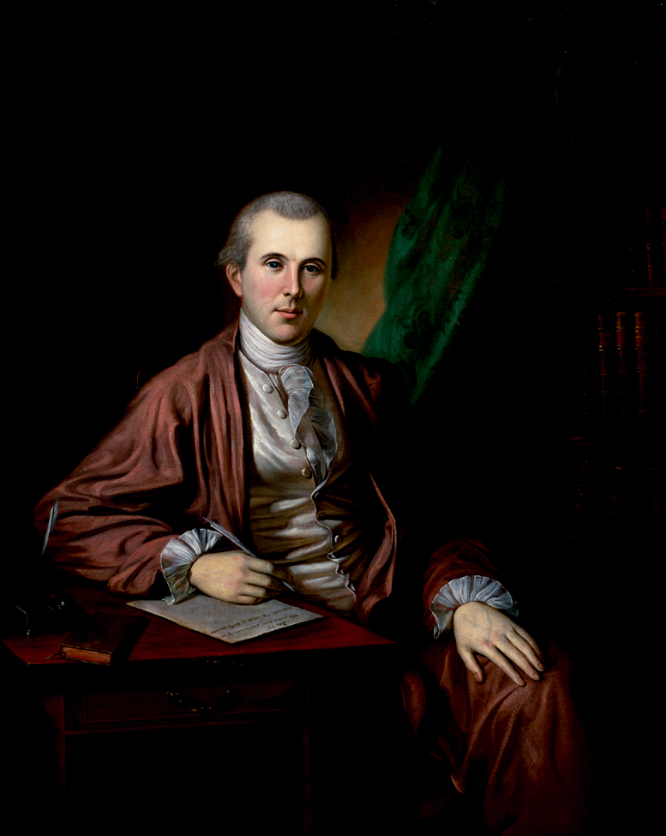
Benjamin Rush, by Charles Willson Peale, 1783. Winterthur Museum.

Room 8 of 10

Rush

Physician, teacher, reformer, and the trial that followed, 1745 to 1813

Benjamin Rush, by Charles Willson Peale, 1783. Winterthur Museum.

Benjamin Rush was a physician first and a reformer by the same impulse. He believed that disease had one underlying cause and that society had a few, and he went after both with the same confidence. In the space of forty years he founded the first free dispensary in America to treat the poor, campaigned against slavery and against capital punishment and against all public punishment, argued that women should be educated, attacked tobacco and strong drink, and insisted that madness was a disease of the body to be treated rather than a visitation to be endured.

His reforming life began in a building Franklin had paid for. Rush joined the staff of the Pennsylvania Hospital in 1769, the year he came home from Edinburgh, and served it without a fee for the rest of his life. The free dispensary, the arguments about punishment and slavery and drink, and the treatment of the insane in the Hospital's cells all grew out of that appointment. The room before this one is where the Hospital was built.

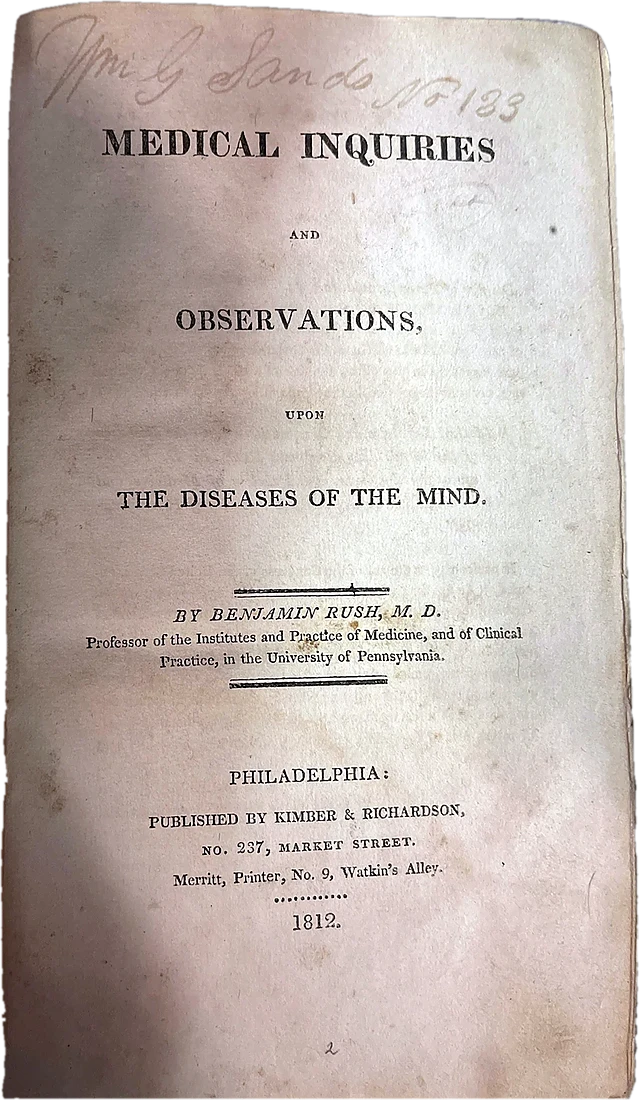
He was also a signer of the Declaration of Independence, Surgeon General of the middle department of the Continental Army, a founder of Dickinson College, and the man who in 1812 patched up the long quarrel between John Adams and Thomas Jefferson by writing to each of them until they wrote to each other. His Medical Inquiries and Observations upon the Diseases of the Mind, published in 1812, was the first American textbook of psychiatry and stood alone for seventy years.

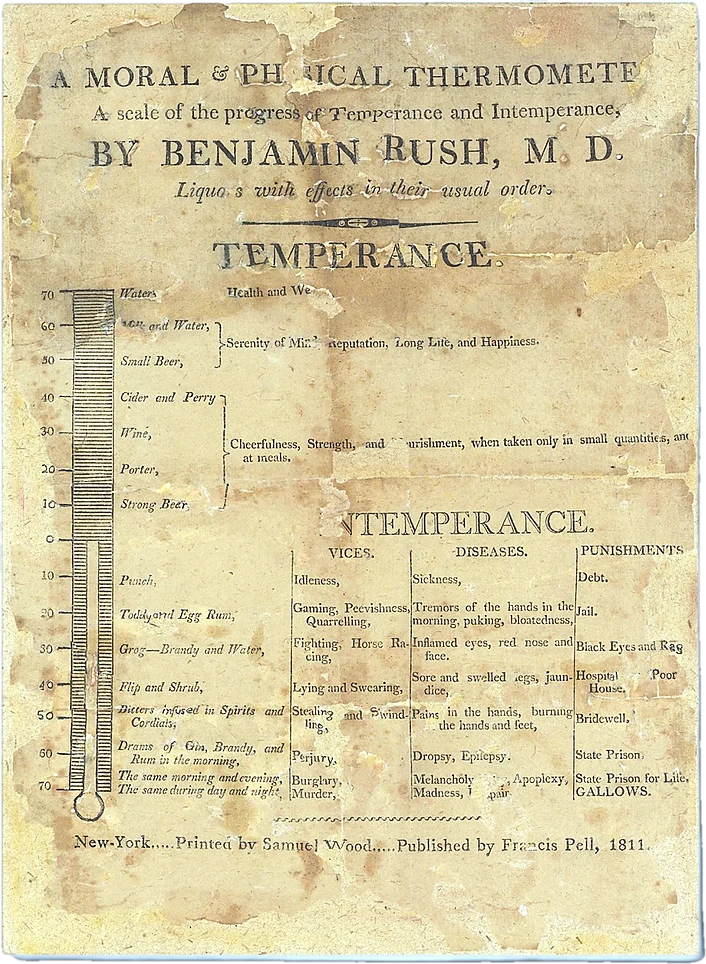
He was wrong about a great deal, and heroically so. He bled his patients past the point his colleagues could stomach and defended the practice to the end of his life. But the Moral and Physical Thermometer in this room, a printed scale running from water and milk at the top, through beer and wine and punch and grog, down to delirium, the poorhouse and the gallows, is recognisably the ancestor of every public health campaign since.

The certainty that carried him also brought him to court. William Cobbett, an English pamphleteer writing in Philadelphia as Peter Porcupine, spent the autumn of 1797 telling the city that Rush was killing his patients, and Rush, who had answered his critics in print for twenty years, decided this time to answer in court instead. That quarrel has a section of its own at the end of this room, with both sides of it and two newspapers that followed the case from Connecticut.

Rush died in April 1813, twenty-three years after Franklin. He had outlived his mentor by almost exactly the span he had known him. He had been right about some things: that yellow fever was not contagious, that drunkenness was a disease, that criminals could be reformed. He had been wrong about others: the bleeding, and the taxonomy of madness. He had been certain about all of them.

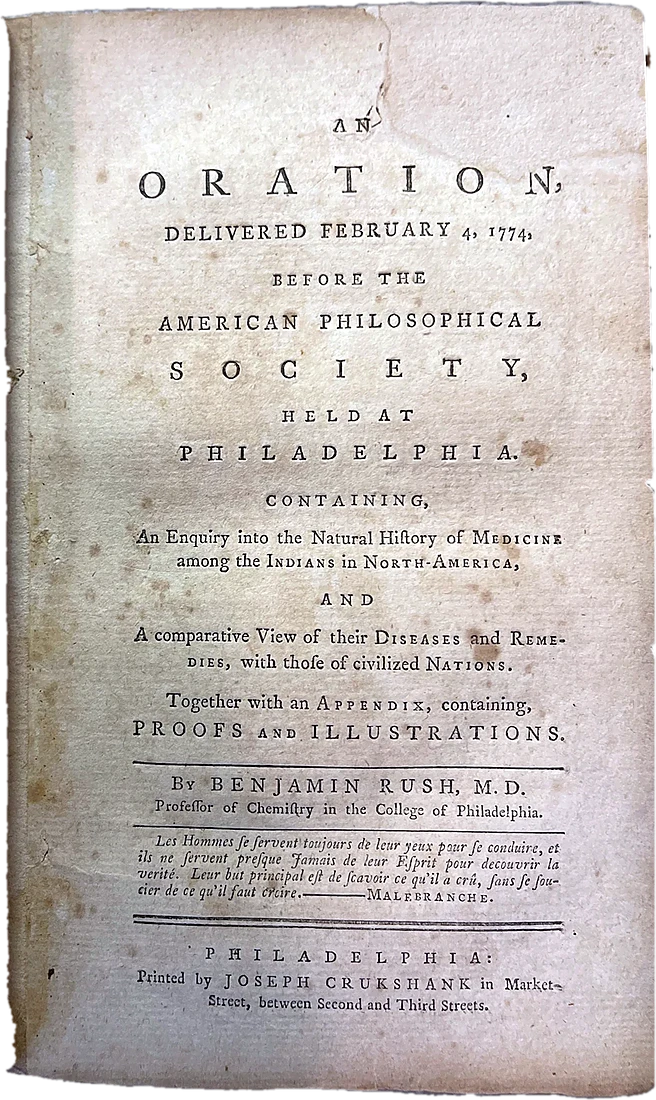
Oration Delivered February 4, 1774, before the American Philosophical Society, Held at Philadelphia. Containing, An Enquiry into the Natural History of Medicine among the Indians in North-America, and A Comparative View of Their Diseases and Remedies, with those of Civilized Nations.

Oration Delivered February 4, 1774, before the American Philosophical Society, Held at Philadelphia. Containing, An Enquiry into the Natural History of Medicine among the Indians in North-America, and A Comparative View of Their Diseases and Remedies, with those of Civilized Nations.
BR-2023.031

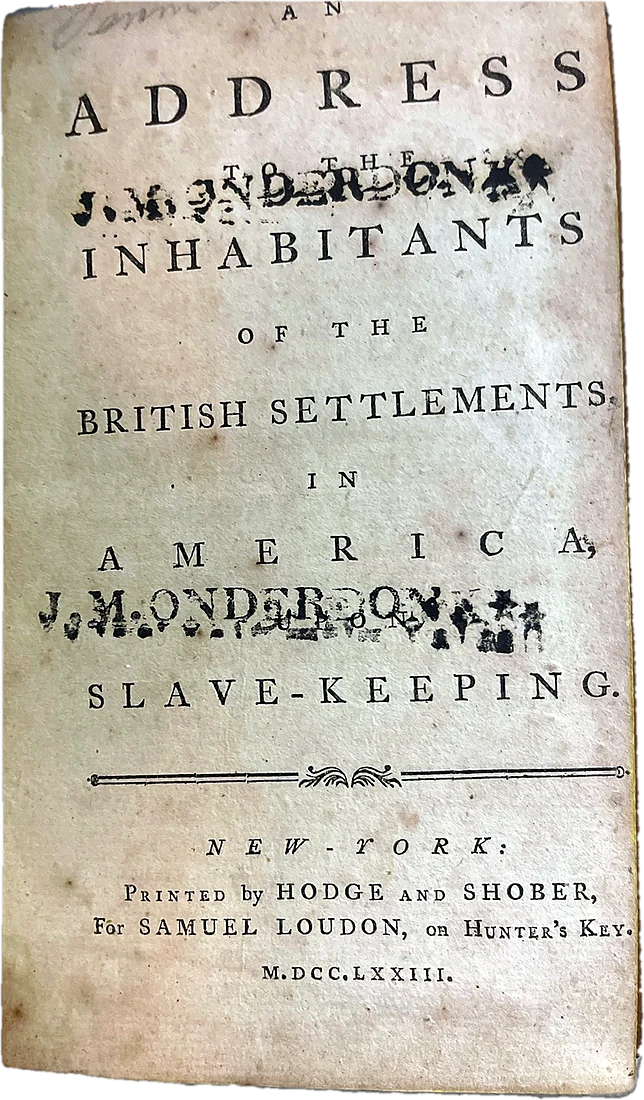
An Address to the Inhabitants of the British Settlements in America upon Slave Keeping

An Address to the Inhabitants of the British Settlements in America upon Slave Keeping

1773
BR-2023.017

An Address to the Inhabitants of the British Settlements in America upon Slave-Keeping, 1773. Rush's first antislavery pamphlet, written at twenty-seven at the urging of Anthony Benezet.

Read the full entry · 5 photographs

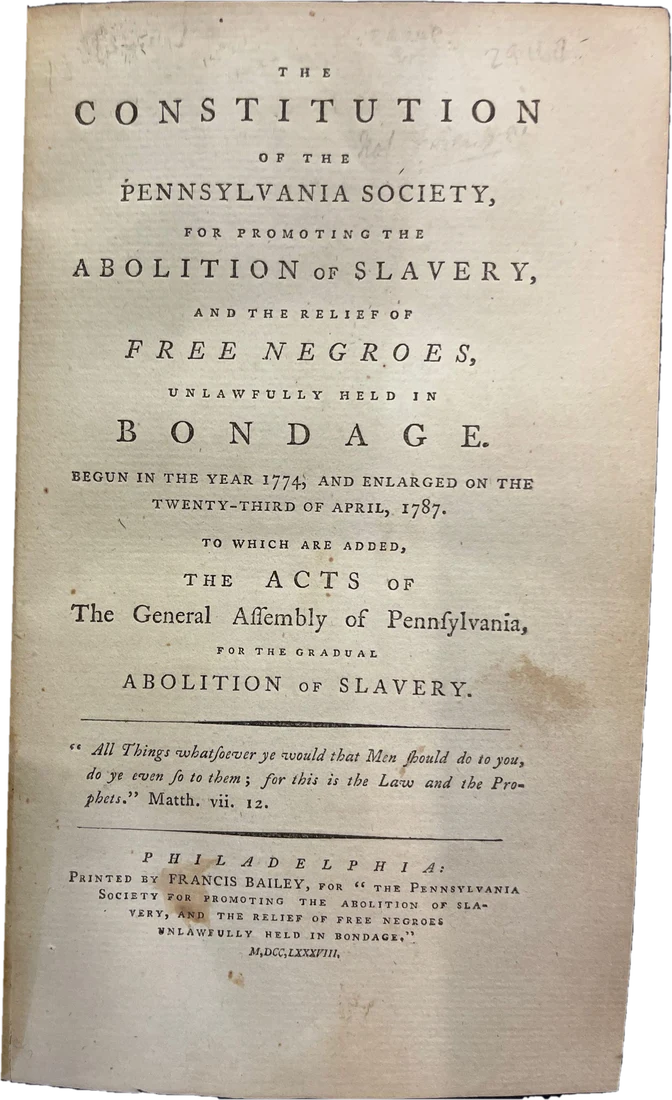
Constitution of the Pennsylvania Society for Promoting the Abolition of Slavery

Constitution of the Pennsylvania Society for Promoting the Abolition of Slavery

Philadelphia: Francis Bailey, 1788
BR-2022.015

The Society was begun in 1774 on the initiative of Anthony Benezet and enlarged on 23 April 1787, the constitution printed here. The officers listed on page 7 are Benjamin Franklin as president, with Benjamin Rush and Tench Coxe as secretaries, and Franklin and Rush are credited with helping to write the constitution. Most of the members were Quakers.

The pamphlet follows the constitution and the list of officers with the Pennsylvania acts on slavery, among them the act of 1780 for gradual abolition and the amending act of March 1788, which the Society had petitioned for.

Read the full entry · 2 photographs

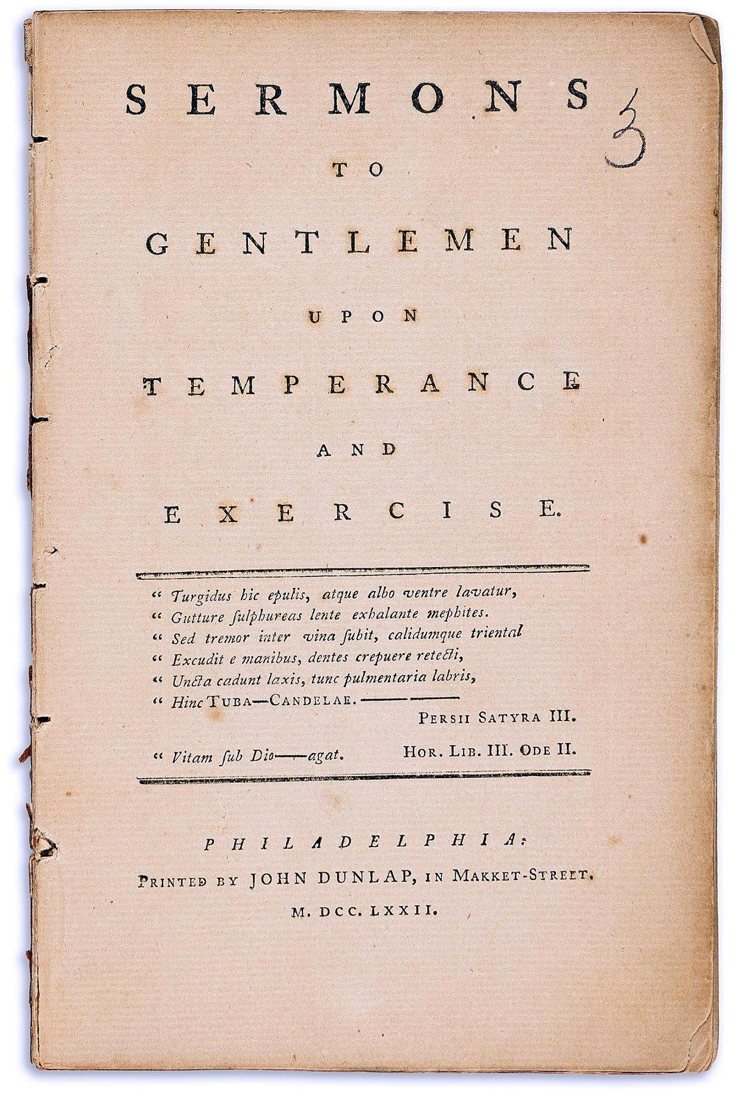
Sermons to Gentlemen upon Temperance and Exercise

Sermons to Gentlemen upon Temperance and Exercise

Philadelphia, 1772
BR-2026.007

Rush published these three sermons anonymously at twenty-six, three years home from Edinburgh. They are his first word on the subject he never left: that health is kept by temperance in eating and drinking, and by exercise.

A footnote on page 33 makes this pamphlet the first American book to mention golf, which Rush had watched in Scotland. “It is played with little leather balls stuffed with feathers,” he explains, and “he who puts a ball into a given number of holes, with the fewest strokes, gets the game.” A man would live ten years longer, he had been told, for playing once or twice a week.

Read the full entry

Medical Inquiries and Observations upon Diseases of the Mind

Medical Inquiries and Observations upon Diseases of the Mind

1812
BR-2023.049

Medical Inquiries and Observations upon the Diseases of the Mind, 1812. The first American work on psychiatry, written out of thirty years on the wards of the Pennsylvania Hospital.

Read the full entry · 4 photographs

A Moral & Physical Thermometer.

A Moral & Physical Thermometer

Broadside, New York, 1811. Unrecorded
BR-2023.005

Temperance as a scale. Water stands at the top, at seventy degrees of health, wealth and happiness. Rum, taken morning and night, stands at the bottom, among murder, madness, despair and the gallows. Rush first printed his thermometer in 1789, and it was copied in newspapers, magazines and almanacs on both sides of the Atlantic.

This illustrated broadside, printed in New York in 1811, is unrecorded and unpublished. No other copy is known. The collection also holds the first American printing of 1789.

Read the full entry

An Oration. Delivered before the American Philosophical Society,

An Enquiry into the Influence of Physical Causes upon the Moral Faculty

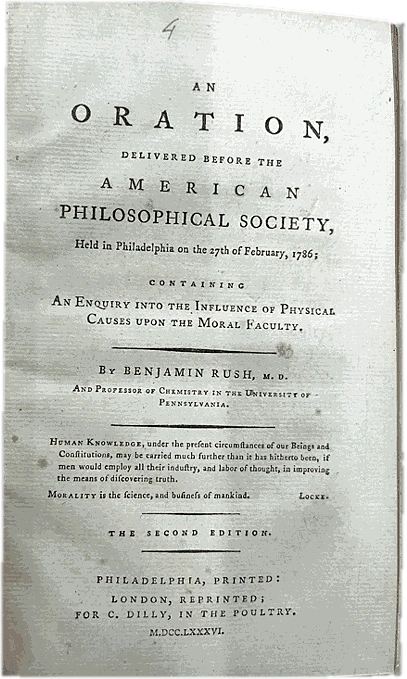
Delivered before the American Philosophical Society, 27 February 1786. Philadelphia, printed; London, reprinted for C. Dilly, 1786
BR-2022.009

Rush's argument that conscience is seated in the body, and that climate, diet, drink, hunger, pain, idleness, cleanliness and solitude all act upon it. If the moral faculty can be disordered by physical causes, he reasoned, then it can be treated, and the physician has business with the drunkard, the criminal and the madman. Everything else he did in public follows from this paper.

He read it to the society Franklin had founded, in the year Franklin came home from France to preside over it, and he dedicated the printed text to him. Twenty years earlier Franklin had given a young man with no connections a letter to Cullen at Edinburgh. This is what the young man made of it, offered back in print to the man who wrote the letter.

Read the full entry · 8 photographs

An oration, delivered before the American Philosophical Society, 27 February 1786

An oration, delivered before the American Philosophical Society, 27 February 1786

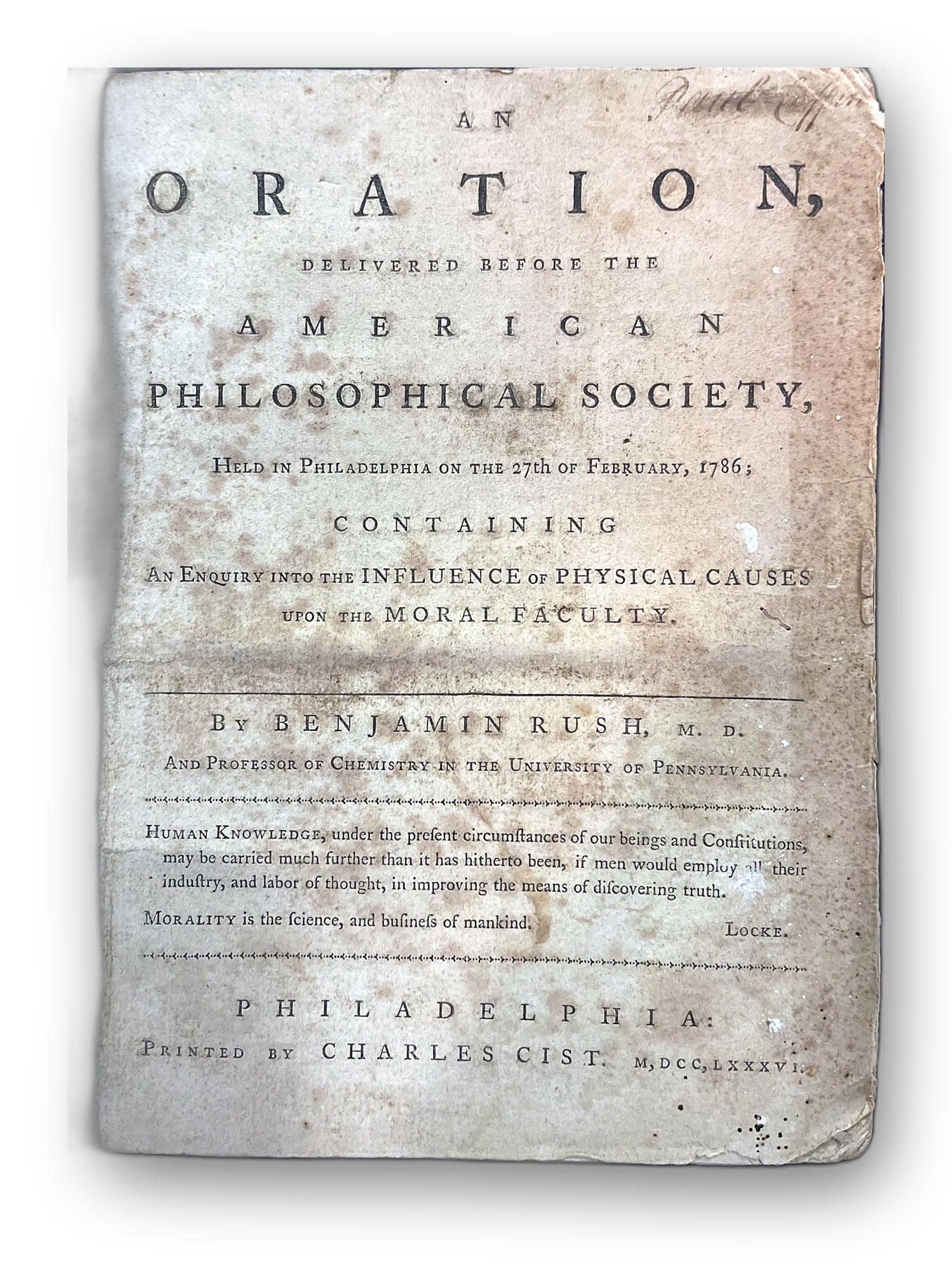
Philadelphia: Charles Cist, 1786. The first printing
BR-2022.008

The first printing of Rush's oration on the influence of physical causes upon the moral faculty, among the most important addresses he ever gave. The London reprint is the entry above. Rush argued that immoral conduct has physical causes, that drunkenness, crime and madness are disorders of the body and not only of the soul, and that they can be treated. It reads, in places, like an anticipation of what is now called functional medicine, and it is where his work on mental illness and his work on crime and punishment begin.

This copy carries early signatures, presumably of Paul Coffin (1738 to 1821), the Congregationalist minister at Buxton, Maine.

Read the full entry · 2 photographs

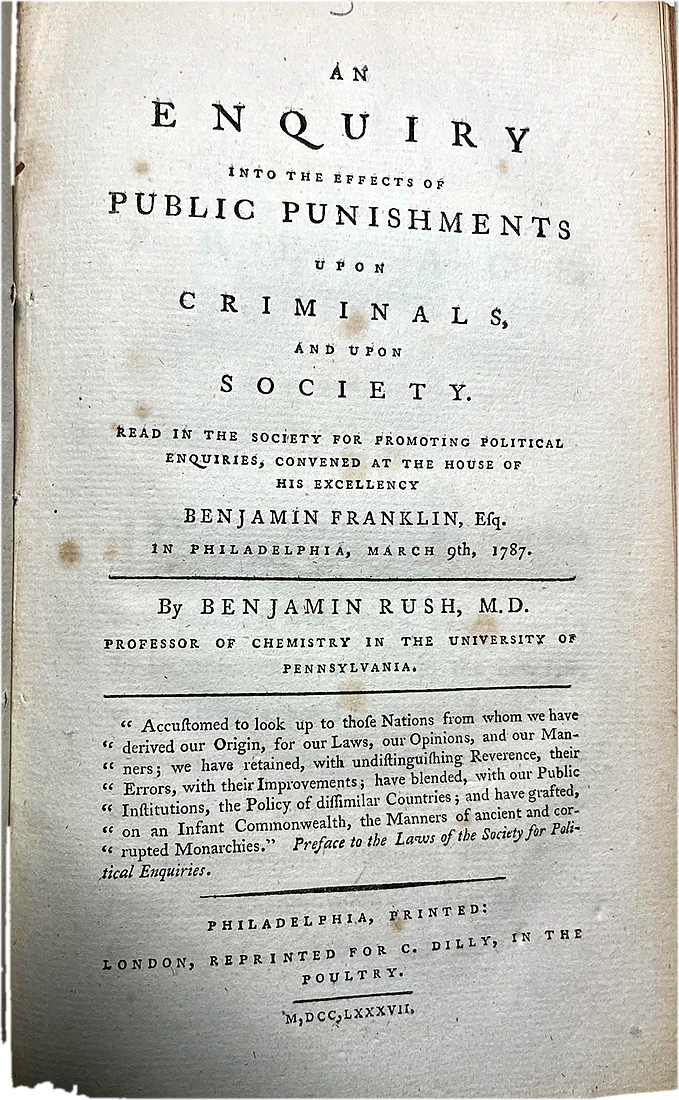
An Enquiry Into the Effects of Public Punishments upon Criminals

An Enquiry Into the Effects of Public Punishments upon Criminals

Read 9 March 1787. Philadelphia, printed; London, reprinted for C. Dilly, 1787
BR-2024.024

On the evening of 9 March 1787 the Society for Promoting Political Enquiries met, as it always did, at the house of its president, Benjamin Franklin, on Market Street. Rush read this paper to the company. He argued that public punishment, the whipping post, the pillory, and the chained wheelbarrow men sweeping the streets of Philadelphia, hardens the criminal, degrades the spectator and makes reform impossible, and that punishment belongs out of sight, in private, with labour and instruction in place of shame.

It was printed anonymously, and some readers took it for Franklin's own. Two months later the Convention sat a few streets away. The title page of this copy still records where it was read, which is as close as the collection comes to putting the two men in one room on one evening: Franklin at eighty-one in his own chair, and the pupil he had sent to Edinburgh twenty years earlier, reading aloud.

Read the full entry · 4 photographs

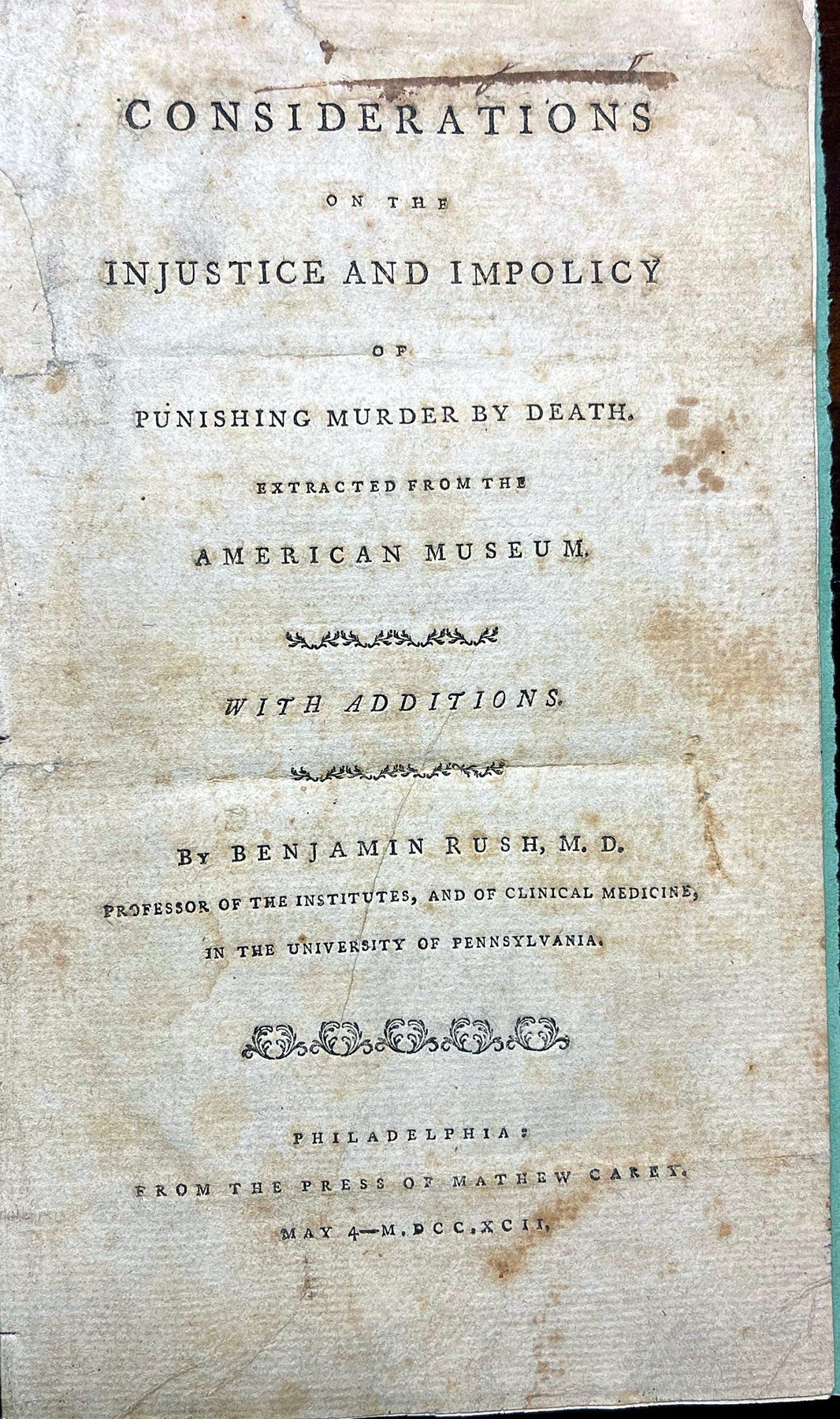
Consideration on the Injustice and Impolicy of Punishing Murder by Death

Consideration on the Injustice and Impolicy of Punishing Murder by Death

Philadelphia, 1792
BR-2022.014

Rush challenged the belief that the death penalty deters. He thought it increased crime, thought public punishments of every kind did harm, and proposed private confinement with labour, solitude and religious instruction. Franklin and the Attorney General of Pennsylvania, William Bradford, supported him. Pennsylvania became the first state to divide murder into degrees of guilt, and in 1794 it abolished the death penalty for every offence except first-degree murder.

This is among the rarest of Rush's publications, and the last auction record found is the Pennypacker sale of 1909.

Rush answered his critics in a printed Rejoinder, shown with it. Accused of rejecting the law of Moses, he replied that Christians should beware how far they condemn the popular virtue of humanity because deists recommend it, and he cited Voltaire and Beccaria. The editor of his letters calls it one of his most effective statements of his humanitarian principles.

Read the full entry · 4 photographs  ·  The Rejoinder · 3 photographs

Diseases of Minorca

Diseases of Minorca

1809
BR-2023.022

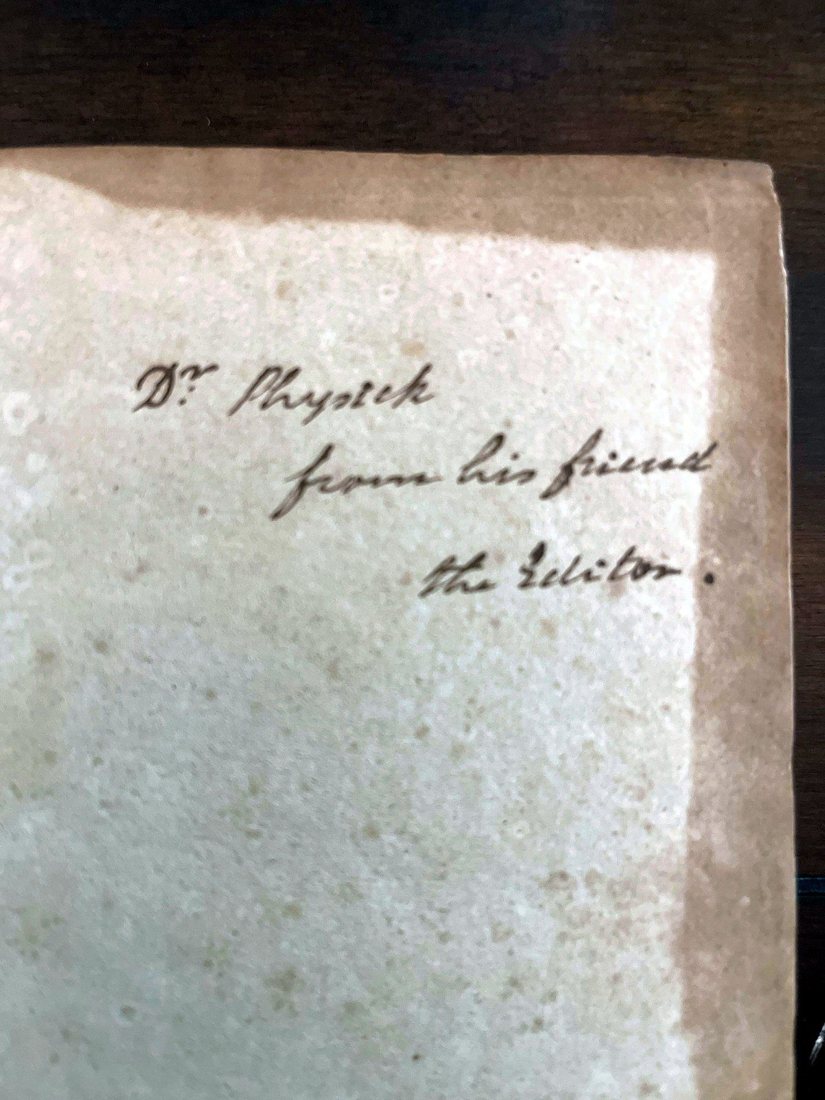
Cleghorn's Diseases of Minorca, edited by Rush and inscribed by him to Philip Syng Physick, "from his friend the Editor." Franklin had inscribed a book to Rush in 1788 in almost the same words. The phrase passing down a generation is the collection's argument in one line.

Read the full entry · 6 photographs

Benjamin Rush, An Account of a Negro Physician

Benjamin Rush, An Account of a Negro Physician


BR-2023.053

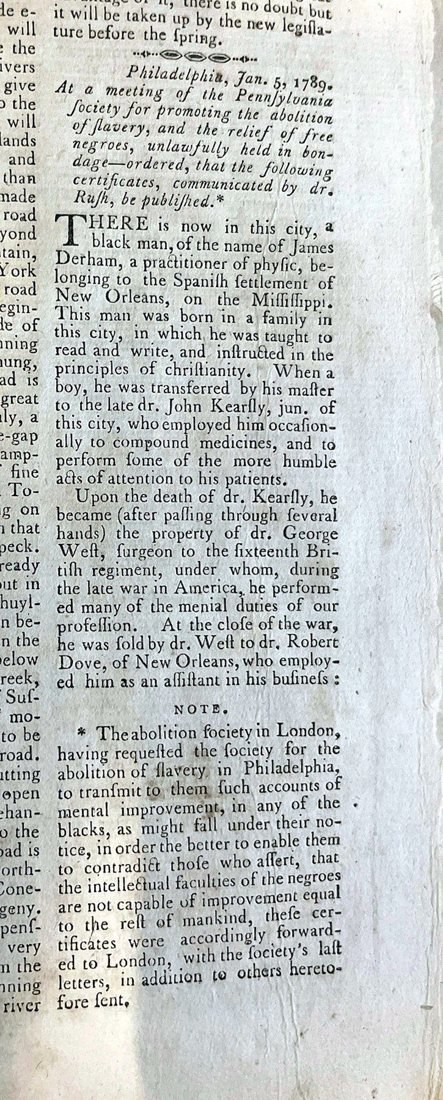
An Account of a Negro Physician: Rush on James Derham of New Orleans, whom he called the ablest practitioner he had met on the subject of fevers.

Read the full entry · 2 photographs

The Philadelphia Medical Museum, volumes one to five and the new series

The Philadelphia Medical Museum, volumes one to five and the new series


BR-2026.005

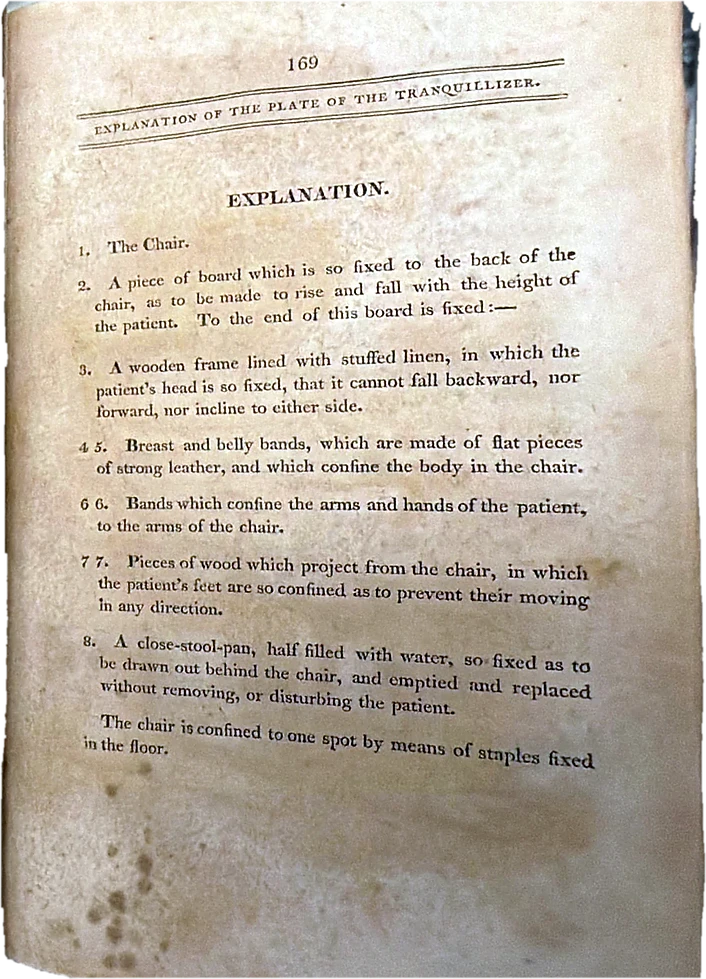
The Philadelphia Medical Museum, 1805 to 1811, volumes one to five and the new series, edited by John Redman Coxe with Rush among its contributors. In its pages the tranquilizing chair was published to the profession. Rush the physician and mentor in the journal of his own city.

Read the full entry · 7 photographs

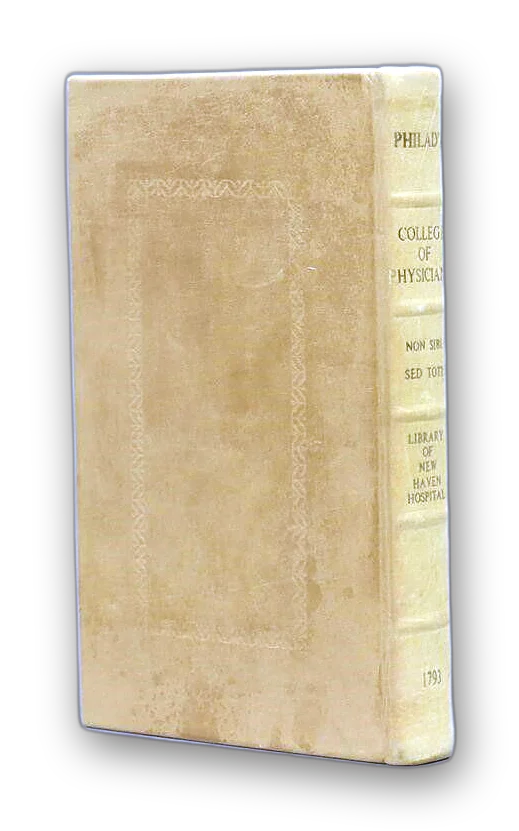
Transactions of the College of Physicians of Philadelphia

Transactions of the College of Physicians of Philadelphia

Philadelphia: Thomas Dobson, 1793. Volume 1, part 1
BR-2023.046

The College of Physicians was founded in 1787, and Rush was among the founders. This is the first volume of its Transactions, printed by Dobson in 1793, the year of the fever. Though the title page calls it the first part of the first volume, no further part appeared until 1841.

The fever turned the College against Rush. His bleeding and purging, and his insistence that the disease was homegrown and not imported, set him against the Fellows, and he eventually resigned from the body he had helped to found.

Read the full entry · 6 photographs

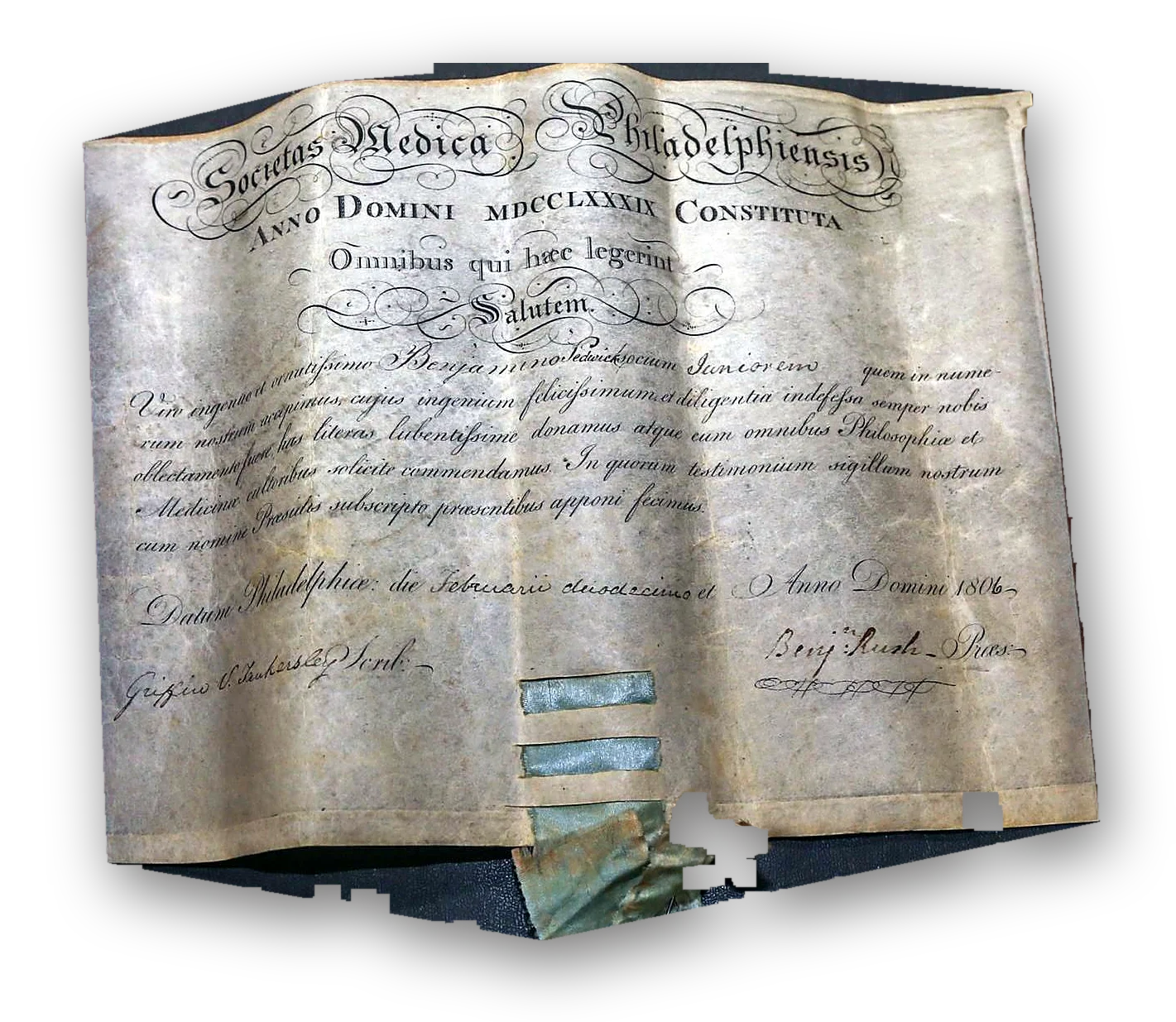
Philadelphia Medical Society, certificate of junior fellowship

Philadelphia Medical Society, certificate of junior fellowship

Certificate, 12 February 1806, signed by Rush as President
BR-2023.051

The Philadelphia Medical Society was founded in 1789, with Rush as its first president, and incorporated in 1792. This is a certificate of junior fellowship dated 12 February 1806, made out to Benjamin Sedwick, signed by Rush as President and by Griffin V. Tankersley as scribe, with its red wax seal and ribbon. A contemporary manuscript translation into English accompanies it.

The Society was Rush's own institution. It was a body of students, graduates and honorary members, and in 1806 he was still presiding over it, whatever had become of his place in the College of Physicians.

Read the full entry · 7 photographs

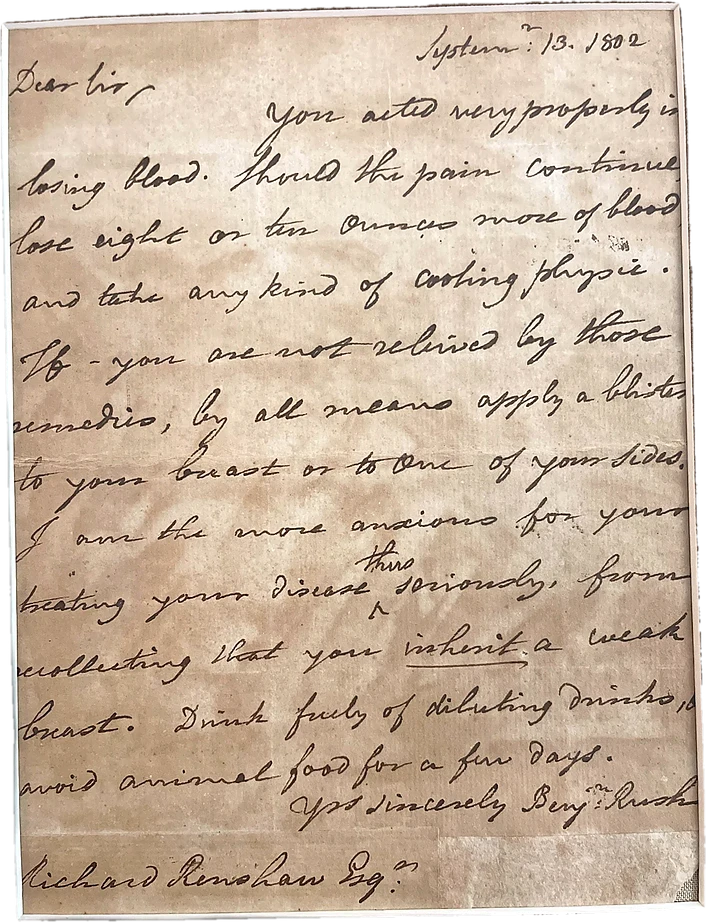
Benjamin Rush, autograph letter signed

Benjamin Rush, autograph letter signed


BR-2024.021

An autograph letter signed by Benjamin Rush. His correspondence over forty years fills two volumes in Butterfield's edition; this is one leaf of it, in the hand that wrote to Adams and Jefferson until they wrote to each other.

Read the full entry

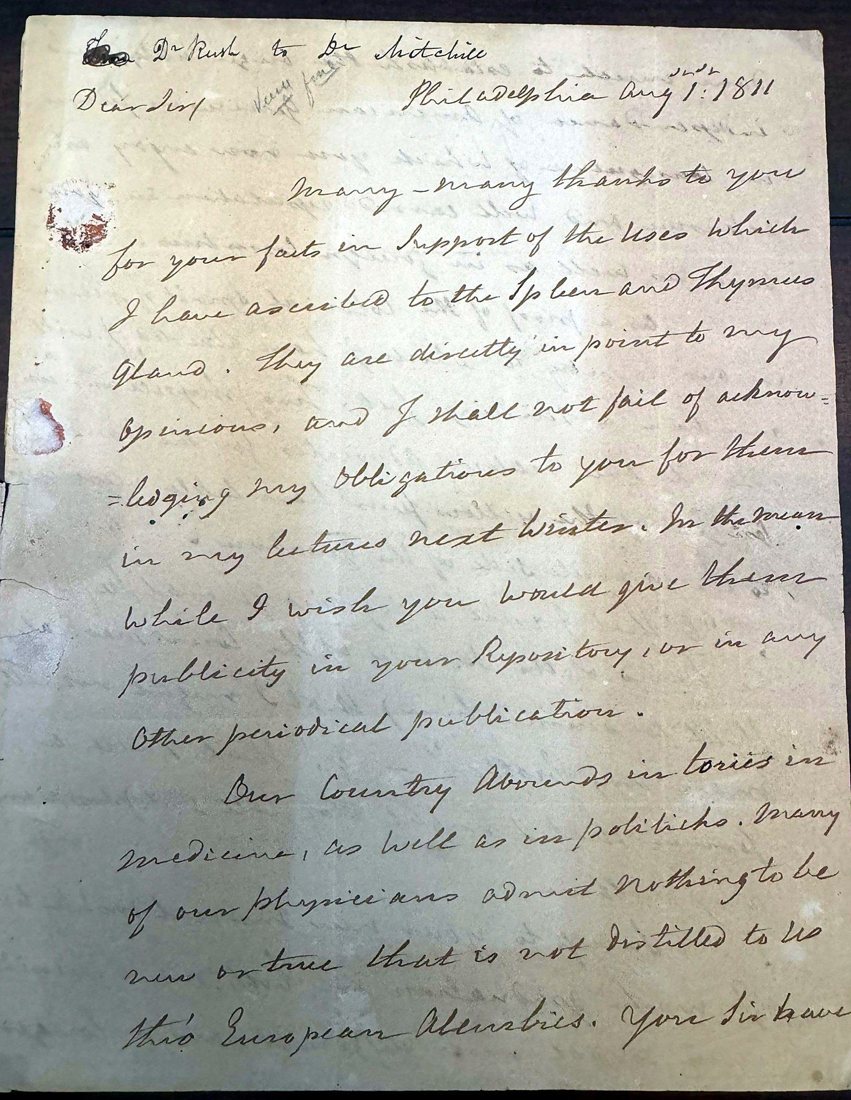
Benjamin Rush, autograph letter signed, to Samuel Latham Mitchell

Rush to Samuel Latham Mitchill, 1 August 1811


BR-2024.030

Rush kept up a correspondence with the leading physicians of his day. Here he writes to Samuel Latham Mitchill of New York, founder of the Medical Repository, the first medical journal in the United States. He thanks Mitchill for facts that support his views on the spleen and the thymus gland, and then turns on his colleagues. “Our country abounds in tories in medicine, as well as in politics,” he writes. Too many physicians “admit nothing to be new or true that is not distilled to us thro’ European Alembics.” The letter also takes up the yellow fever, and the long quarrel over whether it was imported or domestic, contagious or not.

Read the full entry · 4 photographs

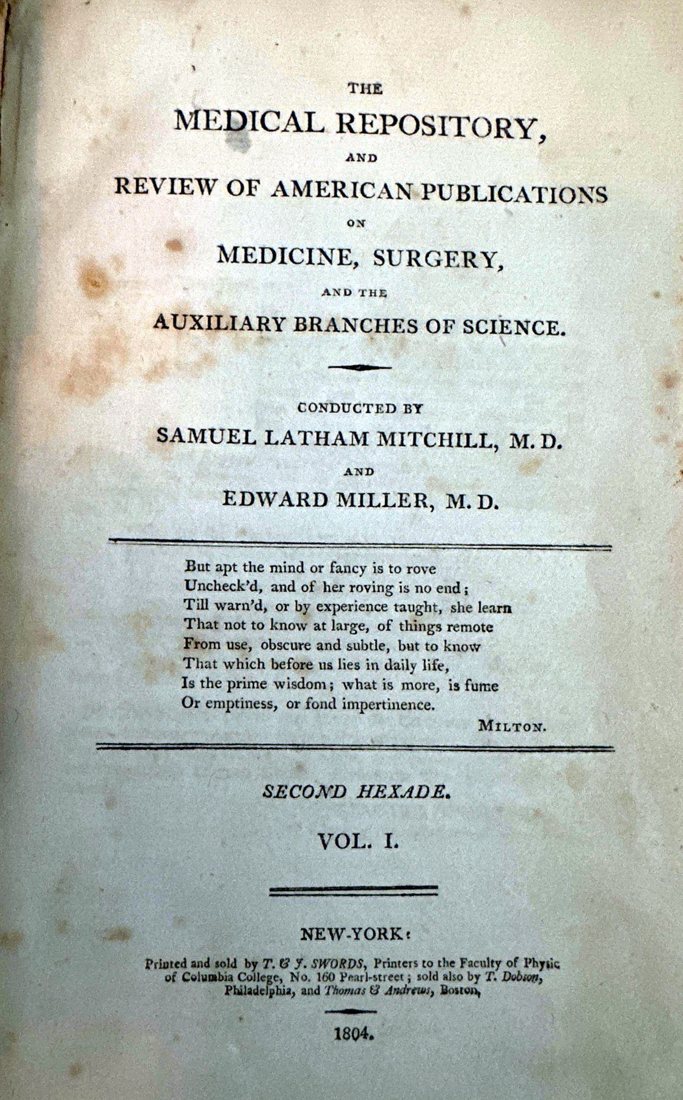
The Medical Repository

The Medical Repository, 1804

New York, 1804
BR-2025.107

This is the journal Rush names in his letter. Samuel Latham Mitchill and his colleagues founded it in New York in 1797, and it was the first medical journal in the United States. The volume here opens its second series, with contributions from Rush, Philip Syng Physick, John Redman Coxe, David Ramsay and William Bartram, and a eulogy of Joseph Priestley. It was sold in Philadelphia by Thomas Dobson, who published so much of what Rush wrote.

Read the full entry · 6 photographs

Rush vs. Cobbett: The Trial for Libel

Through the autumn of 1797 Porcupine's Gazette called Rush a remorseless bleeder whose method had contributed to the depopulation of the earth. Rush sued. The case came to trial before Chief Justice Shippen in December 1799, and the verdict was the largest libel award the country had seen. Both sides of the quarrel are here, and two Connecticut newspapers that followed it from three hundred miles away.

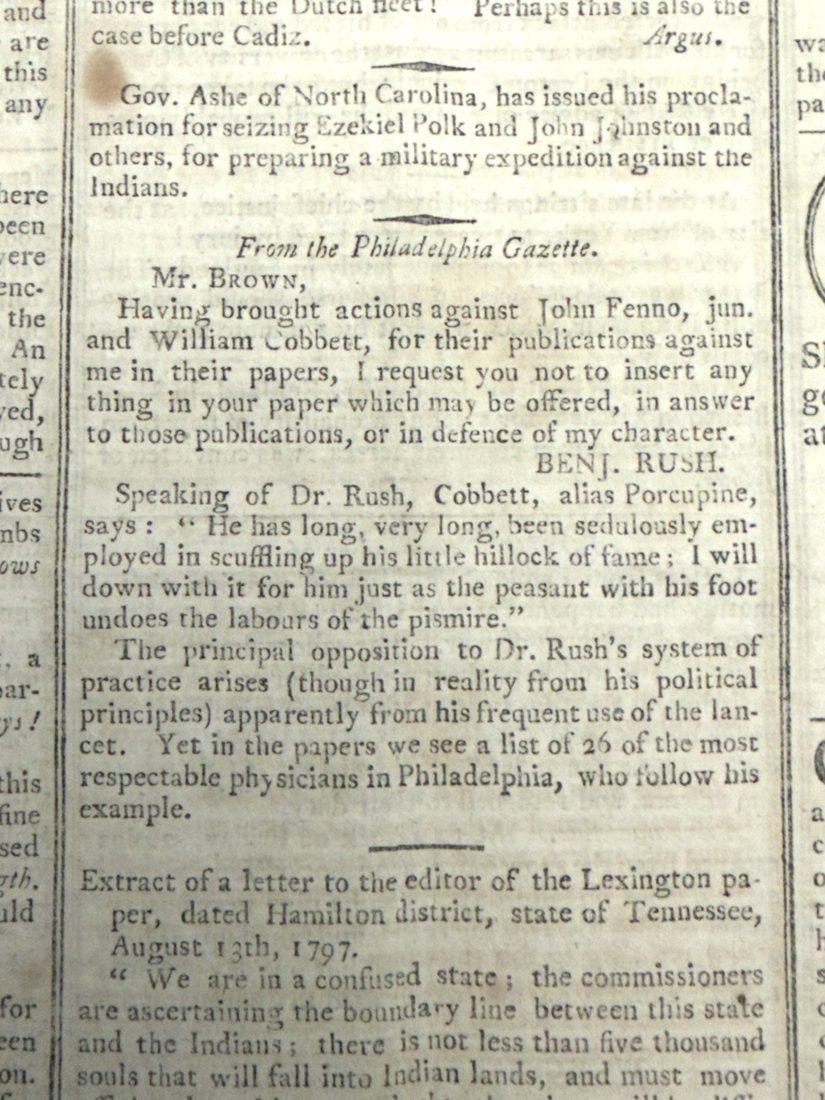
The Bee, 11 October 1797: Rush announces his suits

The Bee announces the suits

New London, Connecticut, 11 October 1797
BEE-1797

Rush's own notice, reprinted from the Philadelphia Gazette: having brought actions against John Fenno the younger and William Cobbett for their publications against him, he asks the newspapers to print nothing further on either side, "in answer to those publications, or in defence of my character."

Below it, the paper prints what Cobbett had written: that Rush had long been "sedulously employed in scuffling up his little hillock of fame; I will down with it for him just as the peasant with his foot undoes the labours of the pismire." And it makes the point the case would turn on, that the attack on Rush's practice came in reality from his politics, while twenty-six of the most respectable physicians in Philadelphia followed his method.

Read the full entry · 2 photographs

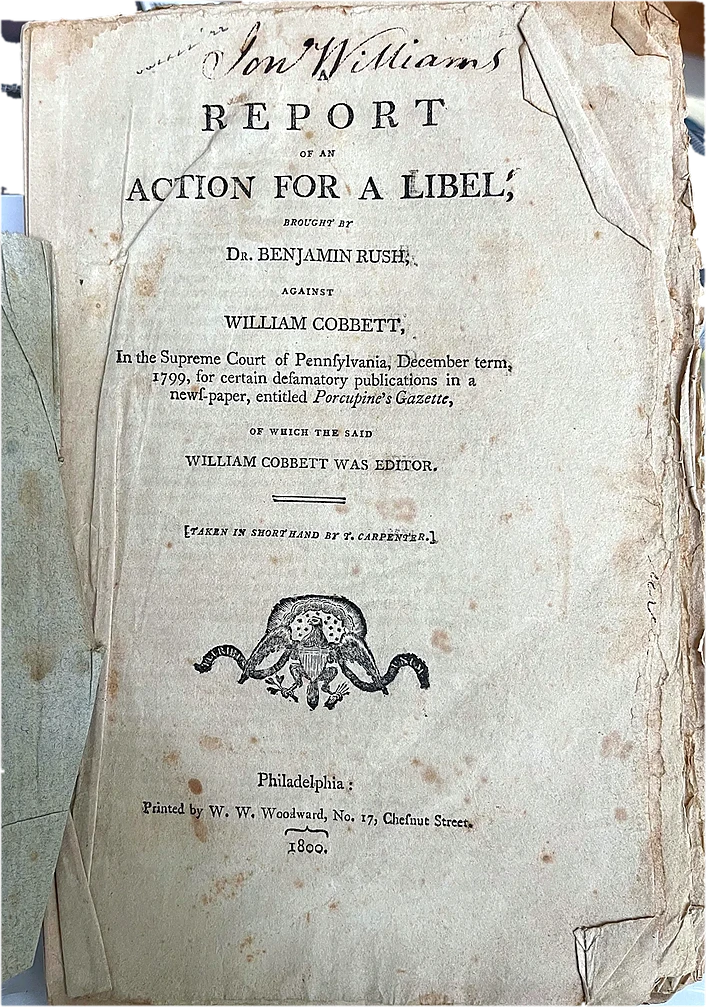
Report of an Action For A Libel

Report of an Action For A Libel

1800
BR-2022.029

Report of an Action for a Libel, brought by Dr. Benjamin Rush against William Cobbett, 1800. Cobbett, writing as Peter Porcupine from a bookshop in Second Street, had called Rush's bleeding a method of depopulating the earth. Rush sued in 1797. In December 1799, while the jury was out, George Washington died at Mount Vernon after being bled of perhaps five pints in twelve hours on the same principles. The jury awarded Rush five thousand dollars, the largest libel verdict in America to that date.

Read the full entry · 4 photographs

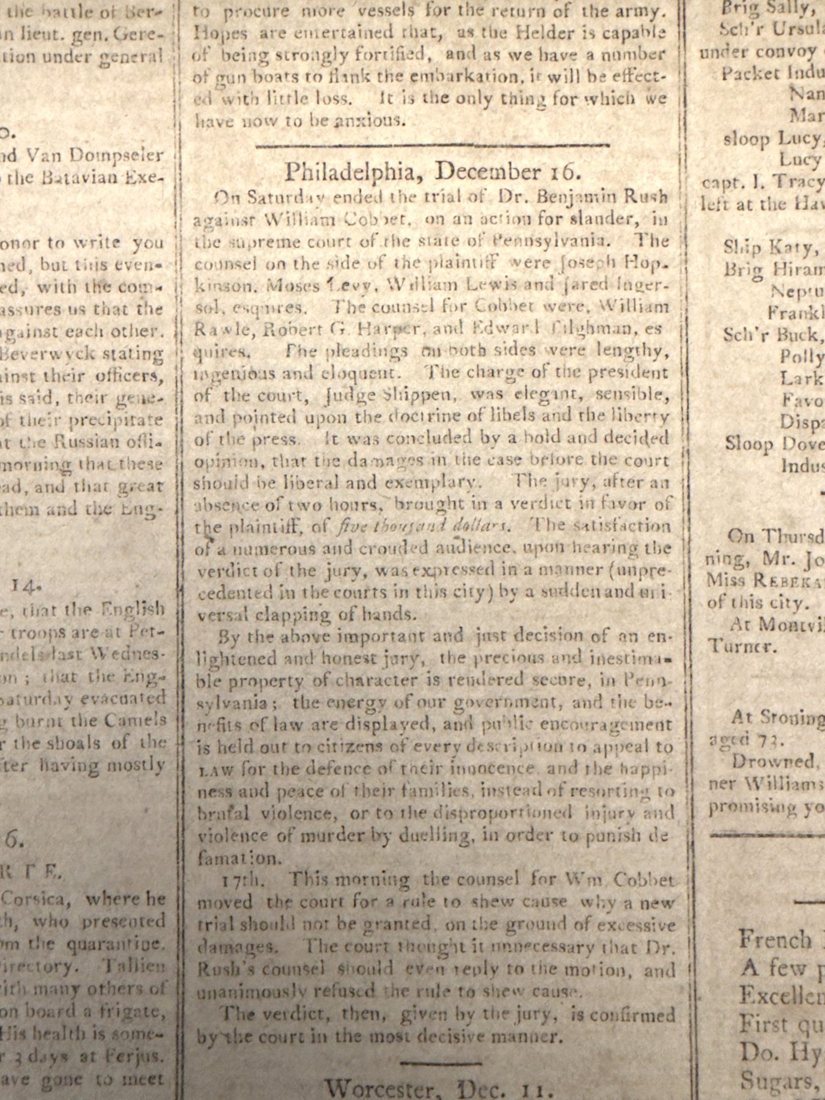
The Bee, 25 December 1799: the verdict

The Bee reports the verdict

New London, Connecticut, 25 December 1799
BEE-1799

"On Saturday ended the trial of Dr. Benjamin Rush against William Cobbett." Shippen's charge was pointed upon the doctrine of libels and the liberty of the press, and ended in a decided opinion that the damages should be liberal and exemplary. The jury was out two hours and returned five thousand dollars, and the courtroom broke into applause in a manner unprecedented in the city.

The next day Cobbett's counsel moved for a new trial on the ground of excessive damages. The court refused the rule. Washington had died at Mount Vernon on the Saturday the jury sat, bled of some five pints by physicians reasoning much as Rush did.

Read the full entry · 2 photographs

The Rush-Light

The Rush-Light

1800
BR-2023.044

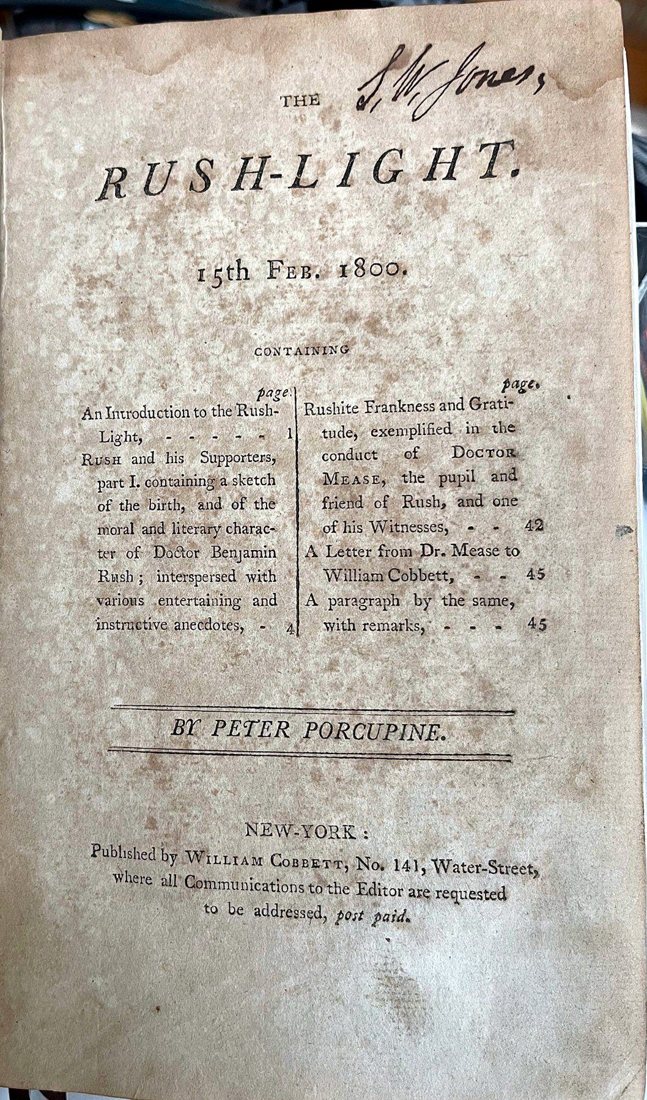
The Rush-Light, 1800. Cobbett's answer, written in New York while packing for England: five numbers devoted entirely to the verdict, the trial, and the character of Benjamin Rush. One of the most sustained pieces of invective in American printing.

Read the full entry · 12 photographs

Porcupine's Works, in twelve volumes

Porcupine's Works, in twelve volumes


BR-2026.004

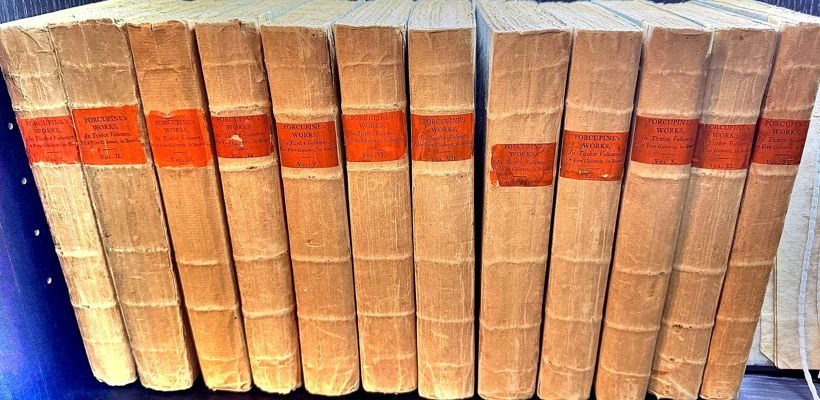
Porcupine's Works, twelve volumes, London 1801, in the original drab boards with the orange paper labels still reading “Price Five Guineas, in Boards.” The collected invective, published after the retreat from Philadelphia.

Read the full entry · 4 photographs

Further Reading

Where the story of this room is told at length.

The Cast of This Room

The people whose names are on the objects in this room. Each opens a short life in the Dramatis Personae, with the institutions that person belonged to and every other object in the collection that carries the name.

Benjamin FranklinBenjamin RushThomas DobsonJohn MorganJohn Coakley LettsomPhilip Syng PhysickBenjamin Smith BartonWilliam BartramJohn AdamsWilliam Cobbett