
Rush the Physician and Mentor
Theory, Therapy, the Tranquilizing Chair, and the Students Who Dedicated Their Work to Him, 1774–1812
RUSH was a theorist before he was anything else, and he never apologized for it. He had learned from Cullen that medicine without a system was mere empiricism, and he spent forty years building one: that there was in the end only one fever, that its proximate cause was a convulsive excitement of the blood vessels, and that the physician's task was to reduce that excitement by whatever means came to hand — the lancet first, then calomel and jalap, then the regimen. The system was wrong in most of its particulars and enormously productive in its consequences. It gave Rush a reason to observe everything, to write everything down, and to argue with everyone.
His first public performance as a medical thinker was an oration before the American Philosophical Society in February 1774, on the medicine of the American Indians. It is the first treatise on the subject published in North America, and it is characteristic: Rush approved of Indian practices that resembled his own — bleeding, sweating, purging — and dismissed the rest. But the questions he asked were the right ones. What did a people without physicians do about disease? What did their health say about the diseases of civilization? Rush would return to that second question for the rest of his life.
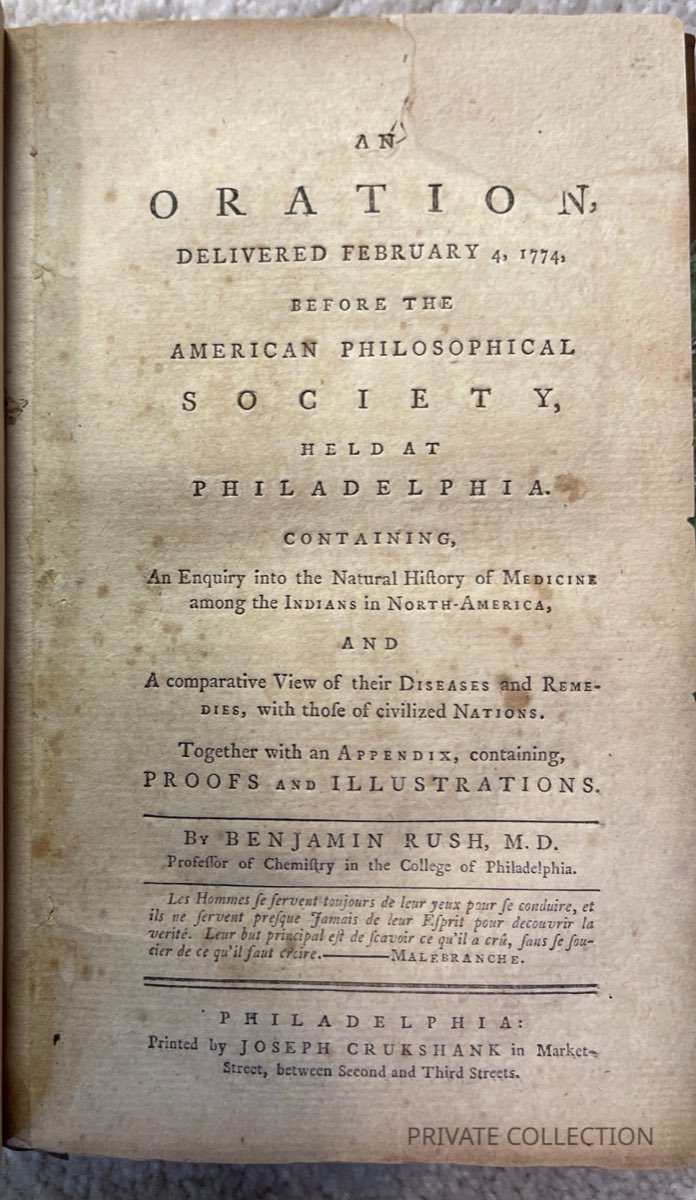
An Enquiry into the Natural History of Medicine among the Indians in North-America, and a Comparative View of Their Diseases and Remedies with Those of Civilized Nations
Rush's oration before the American Philosophical Society, February 4, 1774: the first treatise on North American Indian medicine published in North America. Rush learned what he knew from travelers and from the occasional Native visitors to Philadelphia, and judged their practices by whether they matched his own. Rare — one copy at auction in forty years, eight in the auction record altogether.
The teaching came next, and the teaching produced paper. The syllabus Rush printed for his students in 1798 is in Chapter III; here the collection sets the textbooks Rush taught from, annotated in his own editions — Sydenham with Rush's notes, Pringle on the diseases of armies with Rush's notes.
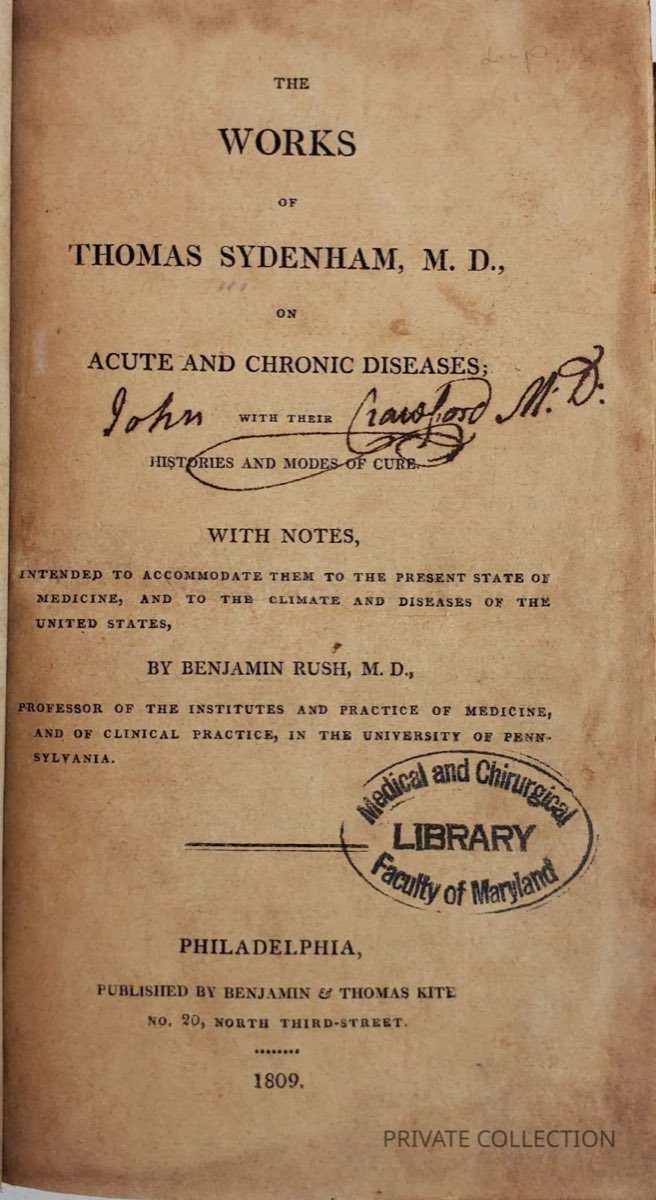
The Works of Thomas Sydenham, M.D., on Acute and Chronic Diseases, with Notes … by Benjamin Rush
The 'English Hippocrates' accommodated to the climate and diseases of the United States by the American who thought himself Sydenham's heir. Rush's notes are a running argument with the text — where Sydenham trusted nature, Rush trusted the lancet. This copy belonged to Dr. John Crawford, whose ownership signature is on the title.
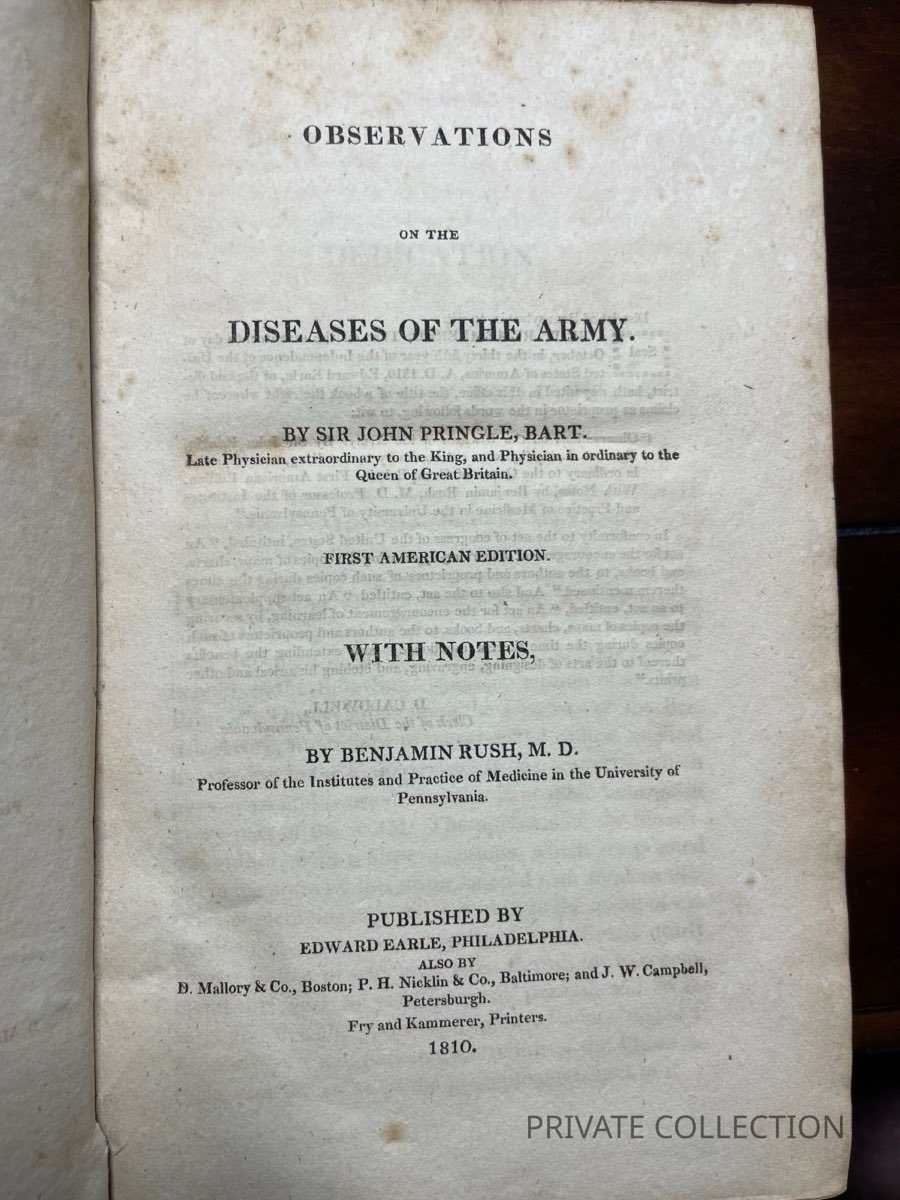
Observations on the Diseases of the Army, with Notes by Benjamin Rush
Pringle, physician-general to the British army in the 1740s, laid down the principles of military sanitation; his book put blankets on foot soldiers. Rush, who had been Surgeon General of the Continental Army's Middle Department and had written his own Directions for Preserving the Health of Soldiers in 1777, edited the first American edition. The collection holds three copies.
The system was wrong in most of its particulars and enormously productive in its consequences.
Rush's students dedicated their dissertations to him, and argued with him, which is the best evidence that he taught them well. The inaugural essays of the Pennsylvania graduating classes carry his name on their dedication leaves year after year; the collection holds the class of 1806 bound as its members kept it, and adds to it the dissertations dedicated to Rush as they come to hand. Rush's students argued back, which is the best evidence that he taught them well. James Mease took his degree in 1792 with a dissertation on hydrophobia, and nine years later published a pamphlet against his old professor's theory that rabies was an inflammatory disease to be treated by bleeding. The collection holds both, bound together, with James Thacher's later survey of the whole controversy — three works that show a Philadelphia medical argument being conducted in print, in public, with the professor on one side and his pupil on the other.
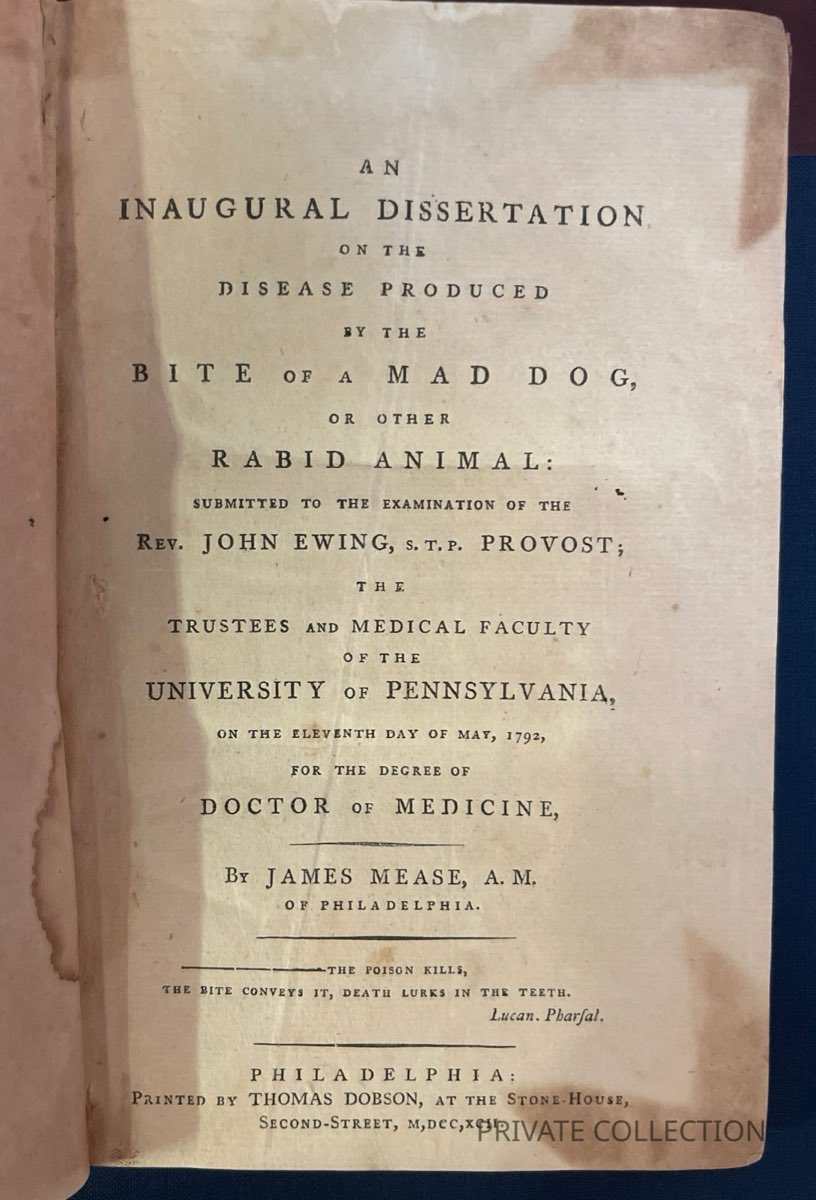
An Inaugural Dissertation on the Disease Produced by the Bite of a Mad Dog — with — Observations on the Arguments of Professor Rush
Mease's University of Pennsylvania dissertation of 1792 and his 1801 answer to Rush's argument that hydrophobia was inflammatory in nature. The dissertation has been offered at auction four times since 1975; the Observations once in fifty years. Mease was a polymath — physician, scientist, author, and, as it happens, the man credited with making ketchup an American condiment.
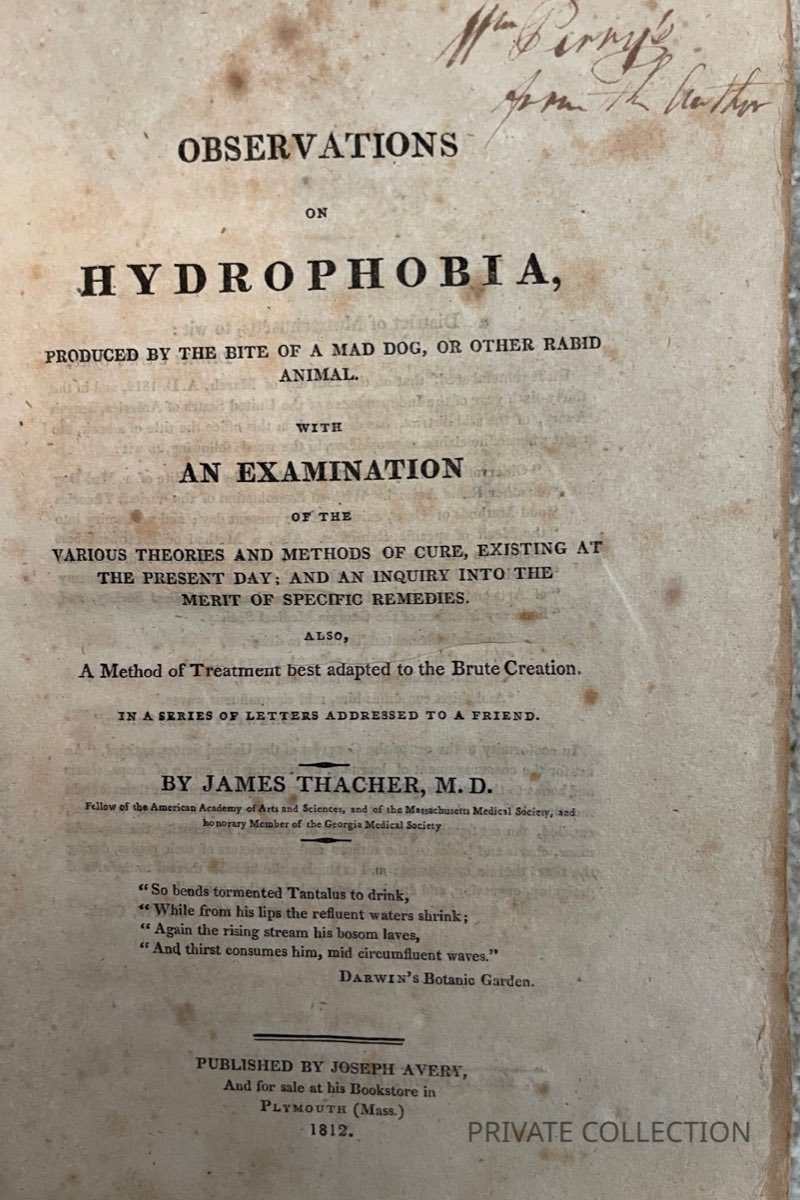
Observations on Hydrophobia, Produced by the Bite of a Mad Dog, or Other Rabid Animal
Thacher's survey of every theory and method of cure then current, including Rush's, and a method of treatment adapted to animals. Thacher had served as a surgeon through the Revolution and kept the best diary of the war; here he referees the argument between Rush and Mease from a distance.
The institutions Rush built were medical before they were anything else. He was a founder of the College of Physicians in 1787 — the eulogy on Cullen he delivered before it in 1790 is the hinge of the previous chapter. He was president of the Philadelphia Medical Society, whose fellowship certificates carry his signature. And he wrote for and published in the journals that made Philadelphia the medical capital of the republic — the Medical Repository in New York, Barton's Philadelphia Medical and Physical Journal, and the Philadelphia Medical Museum, in whose pages appeared the only printed description and picture of his most notorious invention.
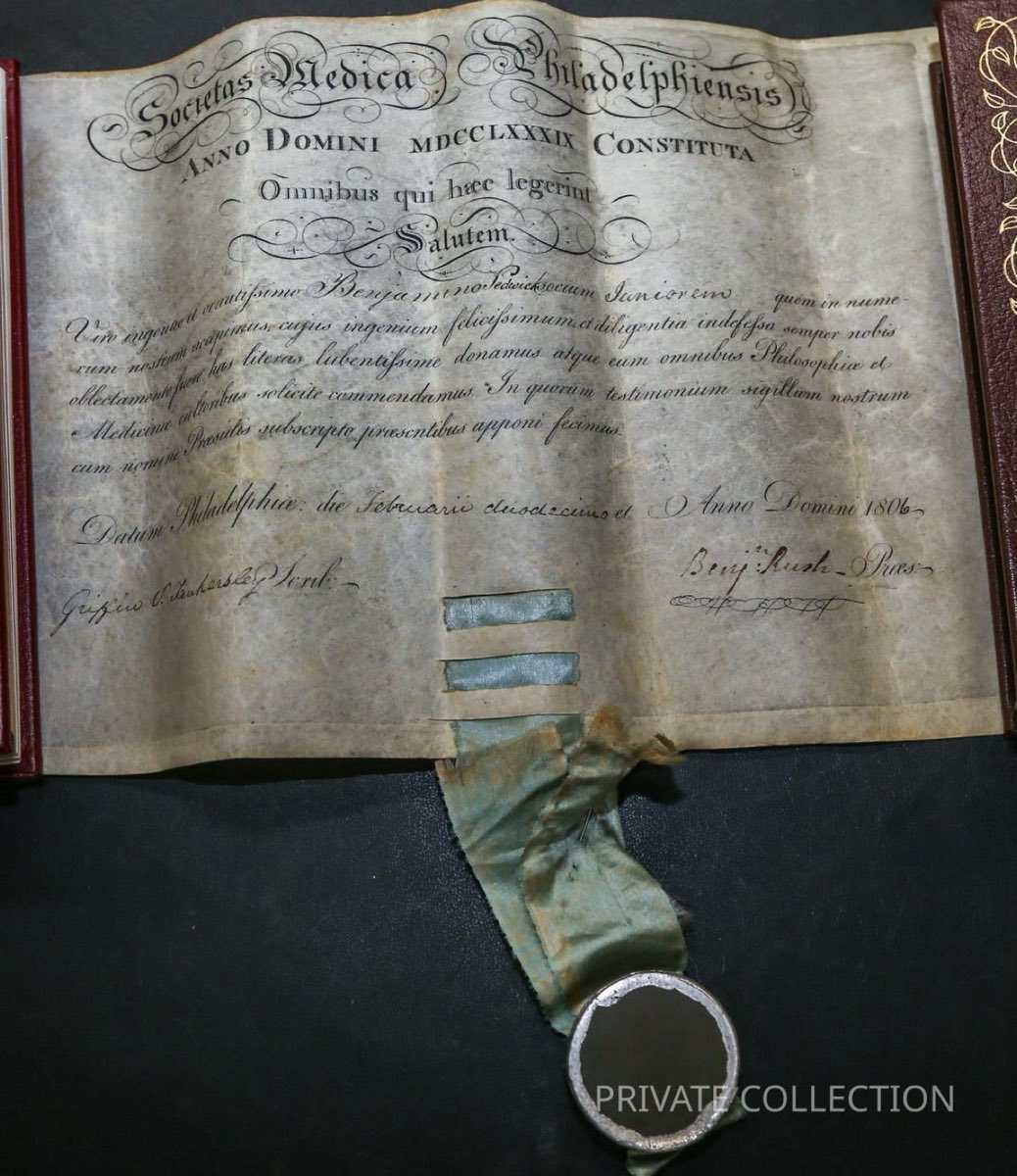
Certificate of Junior Fellowship in the Philadelphia Medical Society, signed by Rush as President
A Latin certificate of fellowship for Benjamin Sedwick, signed by Rush as President and by Griffin V. Tankersley as scribe, the red wax seal intact and the ribbon fragile. With it, a contemporary manuscript translation into English in an unknown hand — the document and its crib, as the new fellow would have kept them.
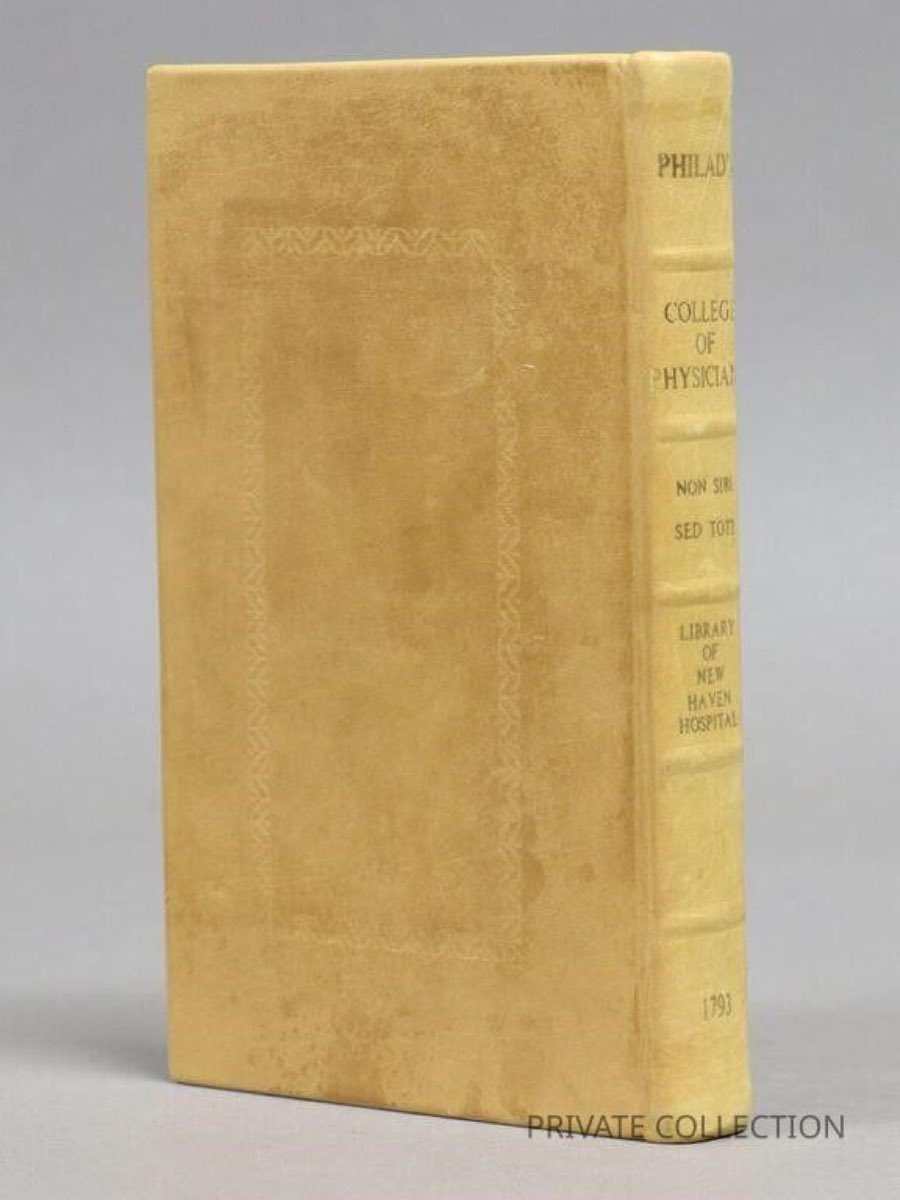
Transactions of the College of Physicians of Philadelphia, Volume I, Part I
The only volume the College published in the eighteenth century: 'Volume I, Part I' on the title, and nothing more until the Summary of the Transactions began in 1841. It appeared in 1793, the year the College's own physicians split over the fever, and it carries the institution's founding papers and first proceedings — the professional body Rush helped found in 1787 and would quarrel with for the rest of his life. From the library of the New Haven Hospital, the gift of Dr. E. H. Bishop.
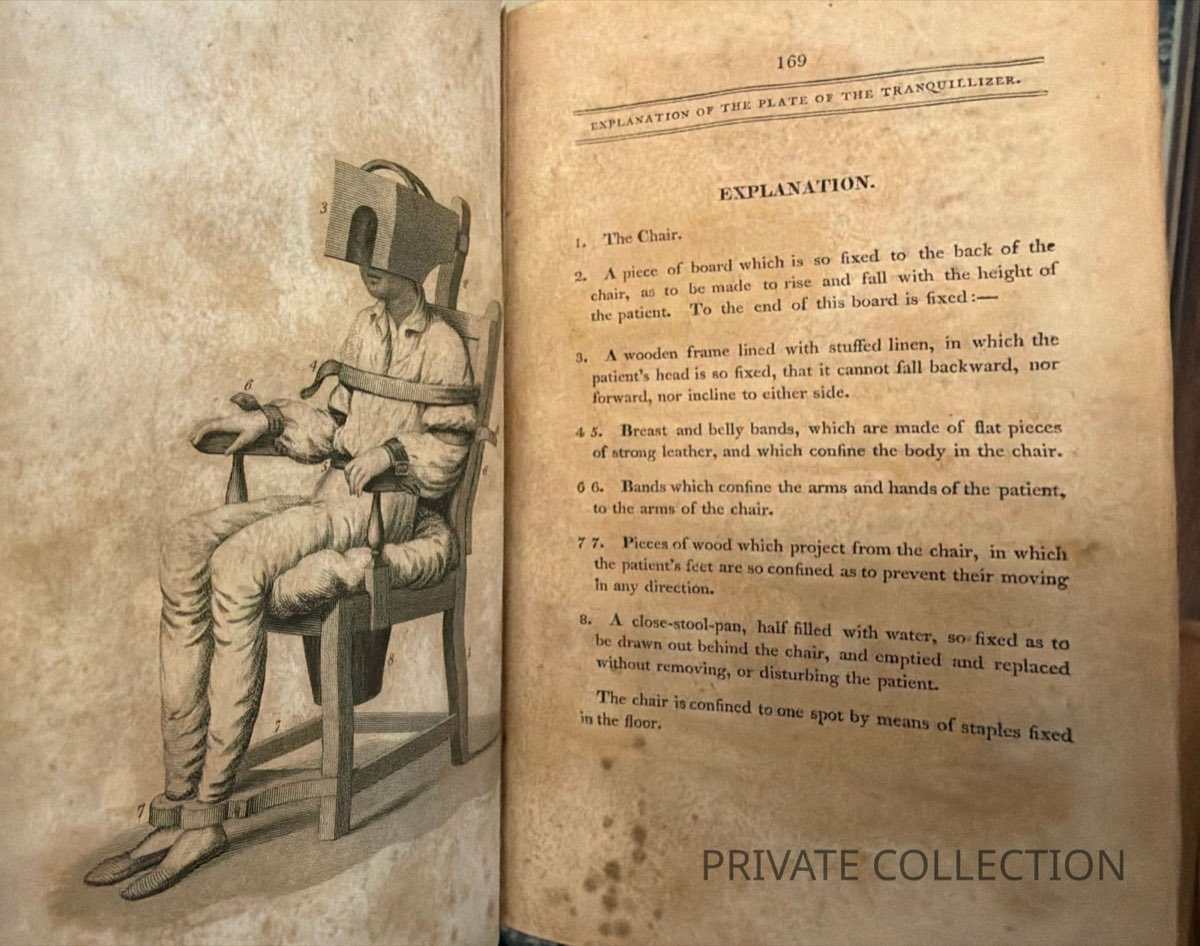
The Philadelphia Medical Museum, Volumes I–V and New Series Volume I
A run of Coxe's journal containing many of Rush's contributions, among them the first and only printed description and image of his tranquilizing chair: the restraint chair with its box for the head and its bucket beneath the seat, designed to still the maniac's circulation by immobilizing him. It is the most infamous object in the history of American psychiatry and, in Rush's mind, an act of mercy — an alternative to the strait-waistcoat and the chain. This is where it was published.
The most infamous object in American psychiatry was, in Rush's mind, an act of mercy.
The chair belongs with the book that is Rush's lasting monument. Medical Inquiries and Observations upon the Diseases of the Mind, published in 1812, a year before his death, was the first American treatise on psychiatry and remained the standard one for decades. Its premise — that the mind and body 'are moved by the same causes and subject to the same laws' — is the same premise that produced the chair, the bleeding, and the moral thermometer, and it is the reason the historians who have judged Rush most harshly for his therapeutics have also called him the father of American psychiatry. Both judgments are correct. The collection holds the book in Chapter III, with the lectures; it holds here the physicians who came after him.
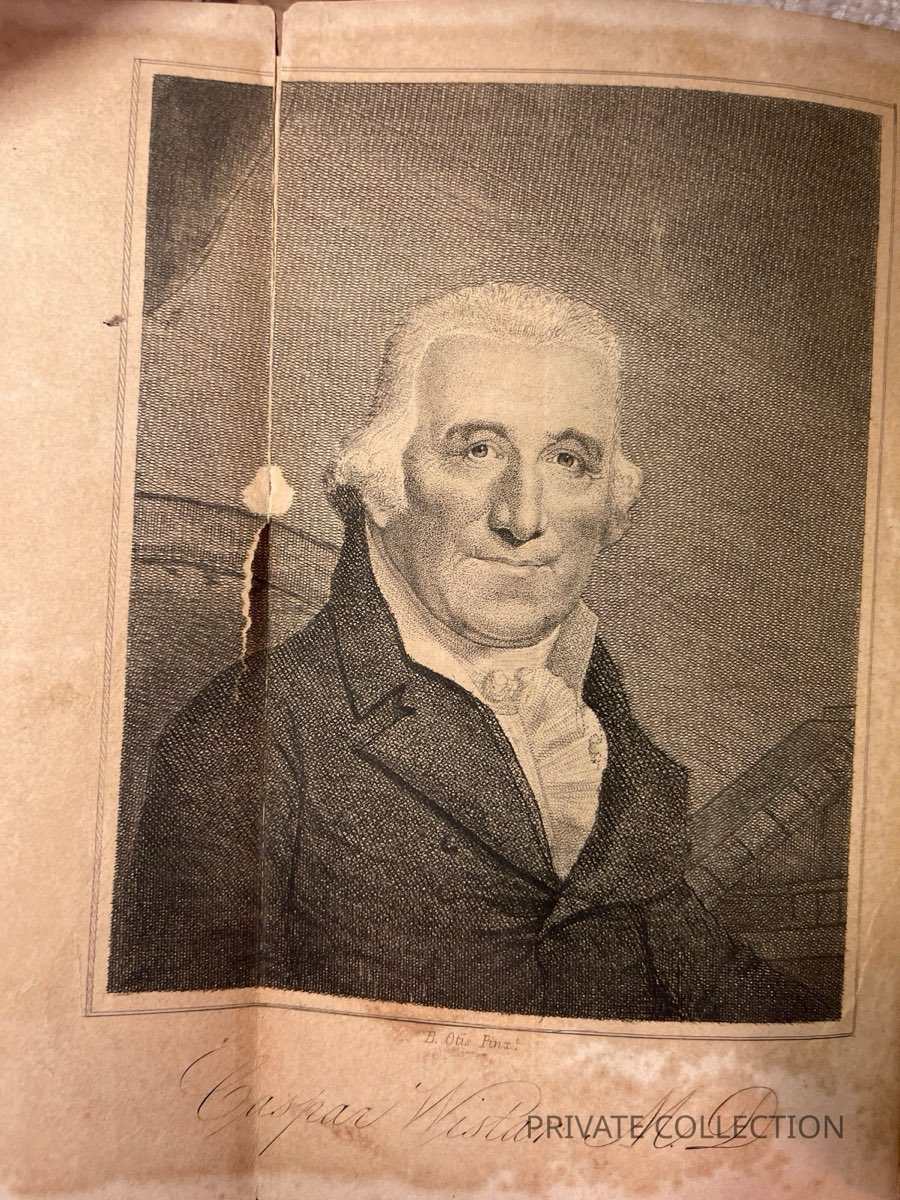
Sammelband of Three Eulogies: Wistar on Shippen (1809); Tilghman and Caldwell on Wistar (1818)
Three eulogies bound together, from the Wistar family's own library: Caspar Wistar on William Shippen before the College of Physicians in 1809, and, nine years later, Chief Justice Tilghman and Charles Caldwell on Wistar himself, who had succeeded Rush's generation at the University and the Philosophical Society. Housed in a custom clamshell box. The Philadelphia medical establishment burying its founders, one by one.
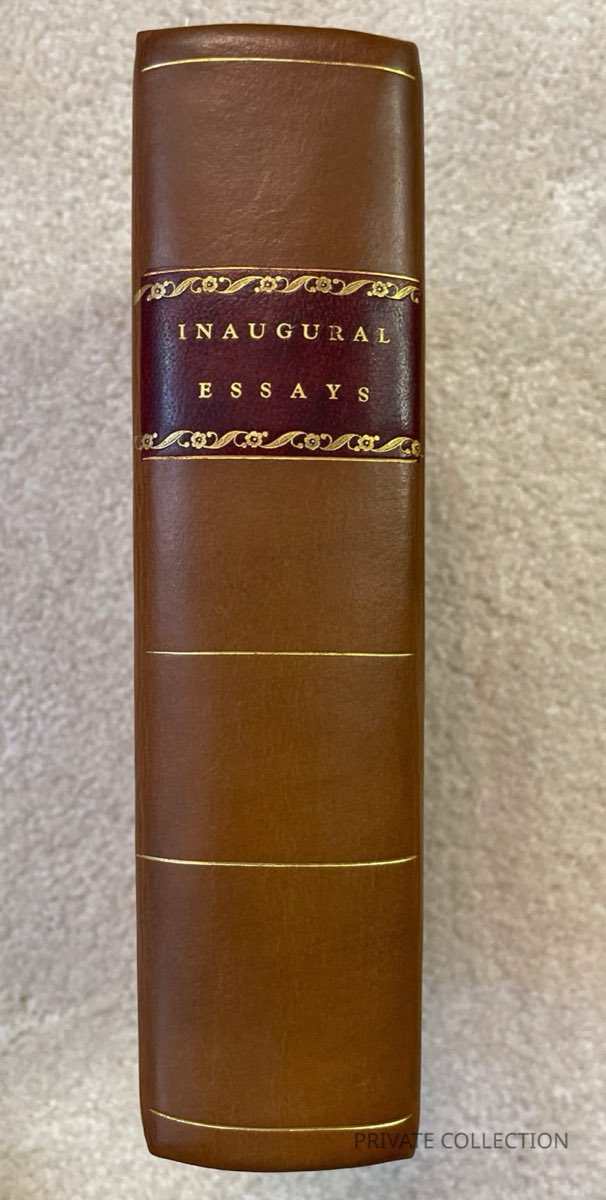
Inaugural Essays: Sammelband of Dissertations for the Degree of Doctor of Medicine, University of Pennsylvania, 1806
The printed dissertations of a single graduating class, bound together as the students' own record of themselves. Every man in this volume sat through Rush's lectures; several defended his doctrines in these pages. The Edinburgh sammelbands in Chapter I show where the custom came from; this is the custom transplanted.
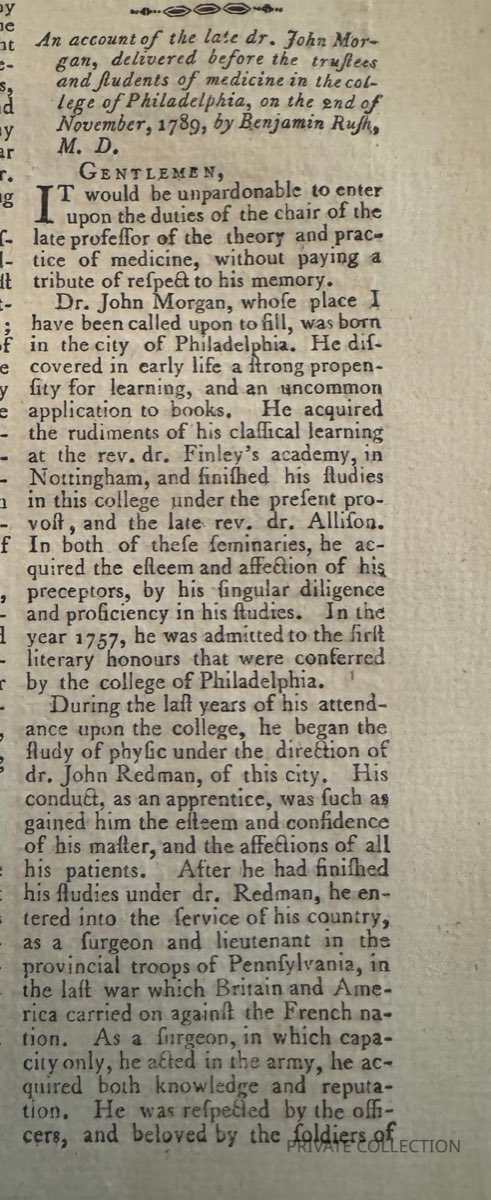
An Account of the Late Dr. Morgan, delivered before the Trustees and Students of Medicine in the College of Philadelphia
Rush's memorial of John Morgan, the founder of the medical school in 1765 and Rush's colleague and rival, delivered in November 1789 and printed here among other articles. Morgan had died poor and embittered after his dismissal as Director-General of the Continental Army's hospitals; Rush, who had helped bring him down, spoke over him with the generosity of a survivor.